
 1 week ago
6
1 week ago
6 
One could argue that Gregory Maguire’s novel, Wicked, and its Broadway adaptation are entirely different stories. Alongside the stage musical’s revision of key character personalities, relationships, and even fates, it also softens the novel’s highly adult themes for a more diverse audience. But what binds the two together is an understanding that Wicked is more than a prequel to The Wizard of Oz—it’s an allegory for fascism and its irreversible cruelty. While the first Jon M. Chu stage-to-screen adaptation, Wicked, seemed aligned with this perspective, the much-anticipated second installment, Wicked: For Good, seems to have lost the plot.
Though Chu couldn’t have known that his adaptation would coincide with a second Trump presidency, the timing of Wicked: For Good and the media coverage it has garnered is highly culturally significant, given the United States’ own worrying rise of authoritarianism. Especially in our own era, the changes made by this film are not frivolous—they are dangerously out of touch and speak to a growing habit of downplaying the stickiness of fascism’s harm. The Broadway musical is certainly a more hopeful story than Maguire’s original novel, but its ending is still somber, as Elphaba fails to rescue the Animals and flees Oz, likely never to return. Changing Wicked’s ending to an unfettered triumph of overthrowing a dictatorial regime, Wicked: For Good occupies a problematic cultural perspective, one that blissfully forgets fascism’s lingering pain and permanent damage.
As others have pointed out, Wicked and the extensive literary history of Oz itself have long been considered political. L. Frank Baum’s 1900 novel The Wonderful Wizard of Oz has been suspected of being a commentary on the McKinley administration. And Maguire’s 1995, decidedly adult novel Wicked is undeniably political, with visible threads throughout of propaganda, anti-intellectualism, systemic oppression, and even state-sanctioned murder gesturing towards fascism in general, and specifically, the crimes of Nazi Germany. And at its debut in 2003, the Wicked musical cemented its own continuation of such political commentary, especially in relation to the George W. Bush presidency.
So when Chu’s Wicked premiered last year, we had no reason to doubt that this political narrative would remain, if not strengthen. Indeed, in comparison to the musical, part one of Chu’s adaptation saw a marked increase in the narrative time for the talking Animals—the population targeted and oppressed by the Wizard—no doubt due to the affordances of CGI in comparison to the limited abilities of stage productions. The film maintains the Broadway musical’s inclusion of the Cowardly Lion, the flying monkeys, and Dr. Dillamond, the Shiz University goat professor whose violent removal from his classroom as a result of anti-Animal legislation radicalizes Elphaba, who, in the film, keeps the professor’s glasses, broken during his arrest. In addition to these mainstay characters, the film adds Dulcibear, a talking bear who serves as Elphaba and her sister Nessa’s childhood nanny, alongside many other new Animal faces to strengthen their place in the narrative, and, in turn, their political significance to the overarching story.
When Chu’s Wicked premiered last year, we had no reason to doubt that this political narrative would remain, if not strengthen.
It isn’t difficult to read the novel or see the stage musical or film adaptations of Wicked without taking notice of Maguire’s intended allegory for Nazi Germany. The oppression and silencing of the Animals, including Dr. Dillamond, reflects the oppression and genocide of Jewish people and other “undesirables” during the Holocaust, including the ousting of Jewish professors and “politically unreliable” people from German universities and state positions with the Law for the Restoration of the Professional Civil Service. More recently, though, Dr. Dillamond’s removal compares with the removal of a Texas A&M University professor for teaching about gender identity, as well as the University of Oklahoma’s suspension and eventual firing of a graduate teaching assistant for failing a student’s paper on gender identity that cited the Bible and referred to trans people as “demonic.”
Compounding this, the second installment of Chu’s adaptation opens to a starkly different scene than audiences experienced in the first film, released in 2024. Wicked began with the Broadway musical’s well-known number “No One Mourns the Wicked,” but Chu’s Wicked: For Good opens with a scene unfamiliar to fans of the stage musical—the exacerbated state of the oppression of Oz’s Animals, set into motion during the events of the first film. In our return to the theater and Oz, audiences witness the continued construction of the yellow brick road, being built by the forced labor of Animals. We watch as an overseer whips two chained bison to keep them moving, snapping at them not to speak, as the Animals groan in pain, struggling to keep up.
It seemed, then, that Wicked: For Good was intent on creating a more visceral representation of oppression, including Wicked’s inevitable bad ending for the Animals that Elphaba tries to liberate. Yet shortly after the hard-hitting opening, this vision begins to falter. Elphaba encounters a group of Animals, including Dulcibear, hurriedly escaping through a tunnel dug into the yellow brick road and willingly venturing into the “Place Beyond Oz,” understood as a wasteland, to escape persecution.
As Dillamond’s removal from his position reflects contemporary attacks on American educators, the flight of the Animals evokes the real-world increase in “self-deportations” after the Trump administration’s threat to undocumented immigrants to “leave now” or be removed by force. Especially with the increase in ICE raids, it’s an option that was once unthinkable for those building lives in the United States, but one that many are now considering to avoid being taken from court houses, sidewalks, and schools, being held in detention centers, and being separated from their families.
When Elphaba finds the Animals escaping through the tunnel, she implores them to stay. Here, with the addition of the original song “No Place Like Home,” Wicked: For Good veers into confusing, even, dare I say, corny, territory.
In the song, Elphaba insists that “Oz is more than just a place / It’s a promise, an idea,” espousing a view similar to the “American Dream,” and, as others have noted, a liberal nationalistic perspective that prioritizes an “idea” over an actual place where the Animals are currently unable to live safely. Elphaba continues to sing, “When you feel you can’t fight anymore / just tell yourself there’s no place like home,” and “When you want to leave / discouraged and resigned / that’s what they want you to do / But think of how you will grieve / for all you leave behind / Oz belongs to you, too.”
On one hand, “No Place Like Home” can be accepted as a cheeky callback to Dorothy’s famous line in The Wizard of Oz and a musical addition to the film meant to galvanize the fleeing Animals into fighting back for their freedom. On the other hand, though it’s possible to see the sentiment behind the lyrics, “No Place Like Home” ultimately comes across as trite, even tone-deaf, given the high stakes that the Animals face. The insistence that the Animals shouldn’t be forced from their homes is a correct one, but the lyrics betray Elphaba’s idealism and feel patronizing.
Elphaba doesn’t offer supplies, routes to safehouses, or support of any kind. Rather, she asks the Animals to stay in an unsafe land with no other avenues or options for protection or shelter. While Elphaba has her magic, her undiscovered hideaway, and her mode of quick transportation when she’s in danger thanks to her broomstick, the Animals have none of this, on top of being quite easy to spot. Without real substance or promise, her words ring hollow.
Though I cringed at the lyricism of “No Place Like Home,” I was initially willing to write it off as a musical misstep, especially given the film’s apt attention to the many tools employed by authoritarian and fascist governments. Specifically, I was taken by the film’s focus on how easily orders fly off of desks and into enforceable law. Signs declaring “NO ANIMALS” go up around Oz, and travel bans are enforced for both Animals and Munchkins on the whim of Elphaba’s sister, Nessa, now mayor of Munchkinland.
Further into the film, like the stage musical, Elphaba eventually finds Dr. Dillamond again, kept in a cage and having lost the ability to speak. But unlike the stage musical, Elphaba finds far more Animals caged alongside Dillamond, driving home how widespread and systematic their disappearances have become. The Wizard, trying to win back Elphaba’s favor, tells her, “Some animals just can’t be trusted.” However, Chu’s film refuses to let us linger in this horror, undercutting the seriousness of Elphaba’s discovery by playing what comes next for comic relief.
By the end of the chaos, Morrible is launched, face-first, into the towering wedding cake, landing on the ground with a satisfying thwomp.
In her anger, Elphaba’s magic releases the Animals from their cages as she tells the Wizard: “Run.” The Animals give chase, barging through the doors and stampeding through the wedding of Glinda and Fiyero. Guests scream, scramble for cover in their over-the-top wedding guest attire and hairstyles, which adds to the absurdity. Madame Morrible, screaming, “This is the work of the Wicked Witch,” is drowned out by the noise caused by the Animals. By the end of the chaos, Morrible is launched, face-first, into the towering wedding cake, landing on the ground with a satisfying thwomp.
The Animal imprisonment quickly unravels from dark horror to a victory, and a funny one. It revises itself in real time into something lighthearted and whimsical, a distraction from the horrors of Oz’s fascist regime. The stage musical, while fun and colorful, is still meant to make audiences think hard about the pain they are witnessing. In this sense, the played-for-laughs fun of this scene arguably becomes reflective of the bubbly, fun nature of the massive marketing campaign and franchising of the Wicked films, which has developed into a narrative all its own.
Courtesy of 400+ brand partnerships, Wicked’s colorful, glittering aesthetic has been inescapable for over a year. The film’s marketing strategy and brand deals, suspected to have cost as much as the first film, have produced everything from nail polish, limited edition eye shadow pallettes, and Barbie dolls to Dawn dish spray, cereal, and even mac and cheese cups. Admittedly, I was not strong enough to resist the siren call of a Glinda-pink collapsible Swiffer sweeper, telling myself it was a practical purchase as I loaded it into my Amazon cart.
That isn’t to say this vibrant and Glinda-fied merchandising doesn’t have a connection to the story itself. Wicked has canonically had its fair share of whimsy, from elaborate set design to quirky language. But its ending has always maintained a somber tone. In the stage musical and Maguire’s novel, though the future for Animal liberation remains possible, Elphaba herself fails in her quest, and those she sought to save continue to be scapegoated by the Wizard’s administration, have their rights stripped, are silenced through cages, and even murdered. It’s a grim finality, but one that maintains a foothold in the reality of systematic oppression.
Yet Wicked: For Good takes a decidedly different approach. After Elphaba and Glinda have their emotional goodbye in “For Good,” Glinda returns to the Emerald City, demands that the Wizard remove himself from Oz via the hot air balloon he arrived in, and imprisons Madam Morrible in one of the cages she had built for Animals. The ending, like the original stage musical, returns us to the beginning with “No One Mourns the Wicked.” However, in this version, Glinda pauses the reprise, telling the crowd, “I have something more to say.”
Glinda motions for the Animals to emerge from the crowd of Ozians, gently imploring, “Come out. Wherever you are, come out.” Her prodding is akin to that of an adult encouraging children to return from a game of hide and seek, not to return from being hunted down. And given that we have, until this point, understood the Animals to have mostly been imprisoned or having fled from Oz entirely, it’s surprising to see them suddenly in the middle of the crowd, smiling up at Glinda.
Glinda continues her speech, clarifying, “I don’t see any enemies here. We’ve been through a frightening time. And there will be other times and other things that frighten us. But if you’ll let me, I’d like to try to help, to change things. I’d like to try to be… Glinda the Good.” The scene shifts quickly, showing Animals regaining their place in society, being greeted by the suddenly de-prejudiced Ozians. A wand wave, and years of persecution and fear evaporate.
The Animals who fled during “No Place Like Home” emerge again from the tunnel, Dulcibear smiling in relief. And then the kicker: the camera lands squarely on Dr. Dillamond, back in his classroom, glasses fixed, ready to teach again. His fate is magically reversed from his murder in the novel and his permanent silencing and transformation into a “real animal” in the stage musical. Instead, he resumes his career, presumably alongside the very colleagues and students who did nothing to intervene as he was dragged from his classroom.
You can’t uncast a spell. You can’t undo what has already been done.
Many have noted their immense relief that Dillamond survives, and a part of me has to agree with them. The character has always been a fan favorite, and Peter Dinklage’s talent only adds to his charm. But I also couldn’t help but feel uneasy at this change—it feels too clean, and far too simple.
The primary rule of magic that Elphaba and others in Wicked consistently repeat is that you can’t uncast a spell. You can’t undo what has already been done. In many ways, this idea points to the irreversibility of harm inflicted by fascist regimes and their implementation of systematic violence. This major change to Wicked’s ending, which sees smiling Animals with speech restored and once again accepted without question by previously prejudiced, and even violent, Ozians, is not just improbable but may even be dangerous messaging, especially given the growing levels of suspicion, propaganda, state and interpersonal violence, and heightened oppression of marginalized groups in the United States.
Jon M. Chu’s Wicked Understands Politics Are Personal
In the film adaptation of the musical, Elphaba and Glinda’s friendship is at the center of the film’s politics
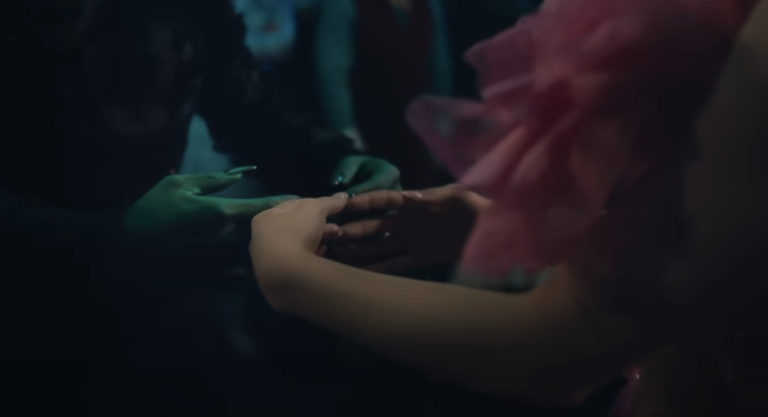
While injury is easily and hurriedly inflicted by powerful state entities, as we have been witnessing over the last year in particular, disentangling ourselves from that harm has been proven to be much, much more difficult. Wicked and Wicked: For Good both have a concrete understanding of how fascism operates, the delight it takes in violence, the tools it employs, and how it takes hold in the first place. What this film has trouble grappling with is how fascism is broken apart and what happens in the aftermath. Wicked: For Good’s finale shift is not merely an insistence on a happy ending for audience satisfaction. Rather, this small but significant change undercuts the real work that must be done to recover from fascist ideology. That recovery requires hope, certainly, but it must be a hope willing to hurt as it clambers after something better. It must be a hope that refuses to forget.
Building a future in the wake of fascism is never simple. It isn’t a heel click or a wand wave away. It’s a hard reckoning. It’s the beginning of a long climb. And it’s in our best interest not to pretend otherwise.
The post You Can’t Uncast a Spell appeared first on Electric Literature.



 Bengali (Bangladesh) ·
  English (United States) ·