
 1 month ago
62
1 month ago
62 
Vi Khi Nào and Lily Hoàng’s collaborative text Timber & Lụa is a trilingual collection of ten short stories, each presented in Vietnamese, English, and a sui generis hybrid of the two, Vietlish. The book is structured to make its multilingualism legible and accessible: English is presented on the verso side, Vietnamese on the recto, while Vietlish sections are paired with an index of translated terms facing each page of narrative. The book’s glossary functions not unlike the Folger editions’ expansions of Shakespeare’s anachronistic language, providing guidance without foreclosing an experimental playfulness. Readers are free to move between versions—or remain with just one—and much pleasure of the text can be found in noticing which phrases are retained and which are transformed in the Vietlish.
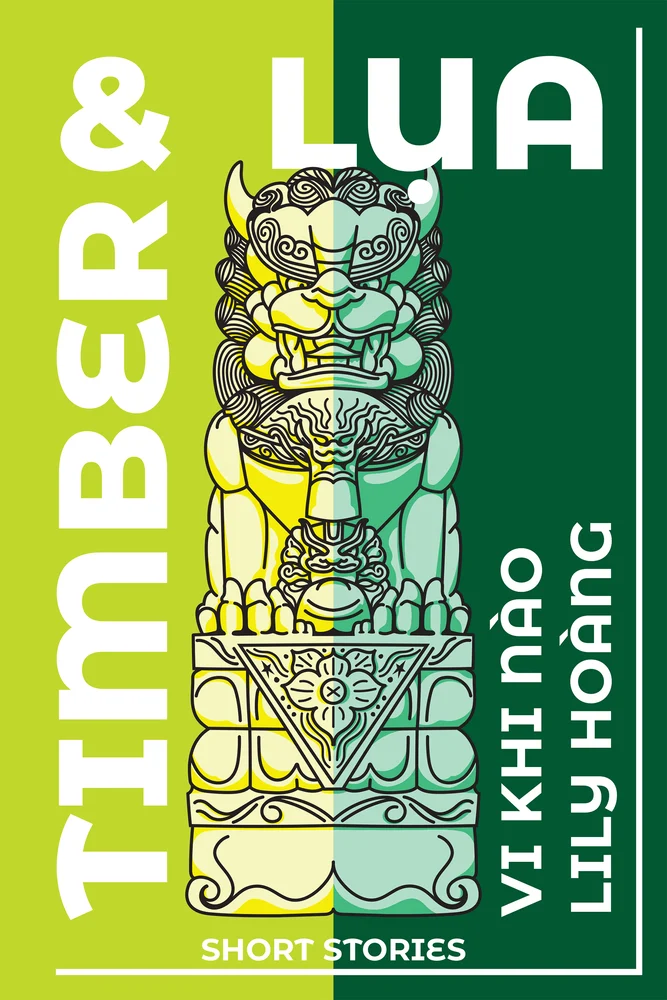
With Nào and Hoàng’s signature styles of experimentation blending together, the resulting text is a cross narrative exploration of linguistic points that extract worlds populated by squids who are stars, Judith Butler-quoting sex robots, esophagus-swimming minnows, and lachyrimal episodes between cross-species lovers that threaten to last for millions of years. Interwoven in these plot points, which contort linearity until it’s an unrecognizable secret, is a surreal world not wholly unlike material reality: These characters still need to eat, make love, give birth, even as they morph into posthuman entities that defy easy taxonomy. These plot points invigorate the imagination as they shift quickly from one episode to the next. One moment we’re glimpsing an argument between lovers, and the next our narrator is contemplating the implications of growing a banana penis in her womb.
Timber & Lụa is a bridge between languages that generously holds the reader even as it destabilizes concrete presuppositions of separate cultures, which mirrors the ways in which the authors’ distinctive voices coalesce into a winking singularity of narrative finesse and postmodern exploration. The resulting text expands the boundaries of what is possible both narratively and linguistically. This collection elevates translation from a this-or-that dichotomy into a space of an intermingling, cross-pollinating and continent-traversing ellipse (or ellipses . . . ) that evokes notes of Samuel Beckett’s self-translation and a rich tradition of Viet texts.
Nào and Hoàng offered some of their time and thoughts on the nature of a collaborative text, obsession, and the complexities of working together in translation.
Rory Strong: Writing is often seen as an individualistic pursuit of the self—the myth of the “solitary genius” is still a dominant (often masculinized) paradigm of the Serious Author. As collaborators, how do you feel your influences blend together to form something that is neither wholly Vi Khi Nào nor Lily Hoàng but a “secret third thing” (as the meme goes) that muddies the mythology of a singular voice and instead opts for the genesis of a narrative that expands possibility via the creation of a third, collaborative voice that contains both fractions of self and a unified whole?
Vi Khi Nào: While I am uncertain if my collaboration with Lily is the “secret third thing” in question, the concept evokes Margery Wolf’s A Thrice Told Tale: Feminism, Postmodernism, and Ethnographic Responsibility. This work employs a similar tripartite structure to ours—hers being fictional, ethnographic, and article-based renderings of a single event from her Taiwanese research—to give birth to a feminist anthropological response to postmodernist critiques. We, however, craft our feminist response by refracting a single story through a triad of linguistic prisms: Vietnamese, English, and Vietlish.
RS: While the postmodern voices in Timber & Lụa differ greatly from each other and from Wolf’s model, we have, as you noted, forged a singular “third thing”—a unique feminist dimension emerged from the fusion of self, language, typography, and a fraction of that coalesced sum became Timber & Lụa.
Lily Hoàng: In my teaching, I actively work against the myth of the suffering genius writer. Last year, I taught a collaboration workshop for the first time, and as my students collaborated on the first day of class, the room erupted with laughter. Afterwards, my students reported that they never knew writing could bring them so much joy. Did they create the highest art? Probably not, but they had fun. Similarly, I have never laughed so much while writing as I did collaborating with Vi. I, too, had not realized that writing could make me feel joy. In particular because Vi and I collaborated in real time, I had the opportunity to watch her brain work in response to mine—and let me tell you: Vi has an incredible brain!
Collaboration forces our writing into unexpected territory. It requires both collaborators to be extremely flexible and lithe. When Vi and I first began collaborating, we worked in English only. Those stories were okay, but something really transcendent occurred when we added Vietnamese into the mix. When we began generating our collaborative stories in Vietlish, a powerful new thing popped into being. It was instantly right, like a big bold epiphany, and it was only possible because we were collaborating. Whereas individually, Vi and I had used Vietnamese words in our writing (and Vi, of course, also translates), I wouldn’t have had the audacity to try to use more than a smattering of Vietnamese words across an entire book. Somehow, together, Vietlish was simply the correct language, and it wouldn’t have been possible for me to even think up, had I been writing on my own.
RS: Were there any unique challenges or unexpected discoveries that emerged in the process of exploring these linguistic traditions?
VKN: Translation is an immensely time-consuming process. Given the experimental nature of both the original text and our approach, there was a point where a single Vietnamese sentence took us an hour to translate. What I truly admired about working with Lily was her commitment to precision, no matter how long it took. Also, the process revealed a deeper layer to her identity beyond that of a writer; beneath her literary composition lies a whole ecosystem of sorrow, heartache, death, and hiếu thảo (filial piety) that informs and underpins her work and her profound love for Vietnamese language and culture.
RS: In Timber & Lụa, the pieces are initially presented with a hybrid of English and Vietnamese sharing the page and a translation guide on the recto side. Later, stories are printed fully in English (verso) and fully in Vietnamese (recto), but I was really struck by the experience of reading the Vietlish pages. What influenced your decision to make this a linguistically hybrid work?
VKN: Prior to adopting the tripartite model, I was finishing writing a Vietlish poetry manuscript titled: Reverse Abyss. This project, which employs mathematical equations and Vietnamese diction to capture the period before my second open-heart surgery, inspired me to suggest to Lily that we organically shift to the tripartite model. A few months ago, while discussing our collaboration, my sister Uyên introduced me to the work of Tree Vo, a queer Vietnamese Instagram influencer and comedian. She is a master of storytelling using the informal genre of “Vietlish.” She’s part of a growing group of creators in this experimental “lexical” space. I find this tongue-and-cheek “genre” to be uniquely accessible, relatable, and emotionally powerful.
Last year, I taught a collaboration workshop and the room erupted with laughter. My students reported that they never knew writing could bring them so much joy.
LH: When Vi and I first started collaborating, we wrote in English only. And it was OK. Whereas Vi had a lot of experience collaborating, I hadn’t. I’d published two books that look like collaborations, but that’s just the surface of things: For Unfinished, I asked fifteen or so writers for stories that they started but couldn’t finish, things in their “Unfinished” files, and I finished the stories for them; and in The Mute Kids, I asked 140+ writers for a sentence or stanza of their work, and I used those words as the basis for a piece of flash. In both these books, I did collaborate with other writers, but ultimately, the end result was something I made. I just used their words as source material. So when I started writing with Vi, my concept of collaborative writing was skewed. I was used to a kind of collaboration that wasn’t actually collaboration, by which I mean, I had a difficult time acclimating to legit collaboration.
A few years later, we tried again. Coming off a Vietnamese lesson (my amazing grad student Gin To was teaching me how to read and write in Viet), I talked to Vi about a few punny words, and we just started generating a story with both languages. And it was magical. It was like something just clicked into place and we found the correct method to collaborate and make art together.
RS: Regarding the nitty-gritty of writing in collaboration, could you share a little bit on what your process was like? For example, would one of you begin with a story idea and then share it with the other, or was it a more granular, sentence-by-sentence collaboration along the lines of perhaps an exquisite corpse-like process? Or something else entirely?
VKN: Our collaboration began with a structured, turn-by-turn approach, where we would alternate sentences—sentence-by-sentence as you say—to build a story. As the projects evolved—particularly our narrative set in the mid-27th century—our process became more fluid and organic, with each of us writing in a more integrated fashion.
We watched each other, constantly, and we wrote one sentence at a time, switching back and forth.
While we met frequently during the Covid-19 pandemic, our sessions have since become less regular due to increasing professional commitments. Our collaboration was nearly over when the true burden of the Vietnamese translation became apparent. The workload felt intensely one-sided. When we first began the project, Lily informed me that she could barely read, write, or speak the language and was only learning it incrementally on Duolingo. In contrast, I have a stronger foundation from voraciously reading Vietnamese literature. To compensate for the imbalance, Lily proposed using reserved funds from her professorship to hire professional translators from the U.S. and Vietnam. This solution, however, introduced new problems, primarily the bureaucratic red tape involved in paying them.
LH: Timber & Lụa was written on Zoom and Google docs. We watched each other, constantly, and we wrote one sentence at a time, switching back and forth. We didn’t start by talking through a story. We just wrote.
RS: Sometimes as a reader, I pick up on what I perceive as the obsessions of the author. This book seems to have obsessions, or at least fascinations, with food, transhuman identities, and relationships (to name a few). Do you feel you each have obsessions as a writer? And if so, how do the obsessions of two artists meet—what do they say to each other?
VKN: My obsession, it seems, is that I produce books too frequently, which is counterproductive and is at odds with a publishing culture that prefers a slower, more measured pace of output. When two artists meet they say: “Chữ tài liền với chữ tai một vần” (Talent and misfortune share the same rhyme).
Vi and I both think in books.
LH: Oh yeah, Vi and I both have our own obsessions as writers, and I think a close reader can catch the difference. In particular, Vi has a very specific diction and I have a very specific syntax. There are words that find themselves in many Vi Khi Nào books, and they exist in this one, too. Similarly, I am obsessed with punctuation, and you can find that in this book, too. Of course, because we both know each other’s particularities, I think there are instances where we will adopt and adapt from each other, and that’s fun to watch and catch!
RS: In the acknowledgments, you thank your “new BFFs,” Google Translate and ChatGPT. The use of AI is contentious in the writing world. Could you speak to your process of incorporating these new technologies in your work?
LH: Vi and I used Google Translate and Chat GPT as the ground floor for our translations. We typed a sentence into each and put them side-by-side, more as a way to conceptualize the grammar of the sentence in Vietnamese, and from there, we wrote our own translation.
I know ChatGPT is contentious, and I’m sure most translators would gasp at our process, but Vietnamese is a complicated language, and only one of us (Vi) has any actual instruction in it. I can say, also, that although we used ChatGPT, by the time we finished translating any single sentence, there was little to no resemblance between what Chat offered and the final translation.
RS: You also mention that some of these pieces were previously published in Denver Quarterly and Puerto del Sol. When you began this project, did you plan on writing a full length collection together?
LH: Vi and I both think in books. Even from the very beginning, we understood that our collaborative efforts would accumulate into a book. There were certainly times along the way that I know I doubted if we could pull it all together as a book, but that is perhaps one of the blessings of writing with another person, especially a person with as much drive, determination, and iron work ethic as Vi Khi Nào.
RS: What would you say to writers who are just setting out or considering working in collaboration?
15 Translated Novels You Should Read This Winter and Spring
The first half of 2026 is introducing literary voices from Iran, Mauritius, Brazil, and elsewhere

LH: For years, Vi and I wrote for at least an hour a day, seven days a week. After a while, we had to make it two hours a day, seven days a week. Before collaborating with Vi, I was a pretty flakey person, but working with Vi, I learned to show up, to not make excuses, and to not be late! Before collaborating with Vi, I only wrote during the summer months, when I was free from the burden of teaching. But writing with Vi meant a whole different style of writing for me, one that was foreign and exciting and quite frankly a little scary. But, in the end, we have this amazing book, and I feel such gratitude for Vi and the art we made together.
The post A Collaborative Story Collection That Spans Three Languages appeared first on Electric Literature.




 Bengali (Bangladesh) ·
  English (United States) ·