

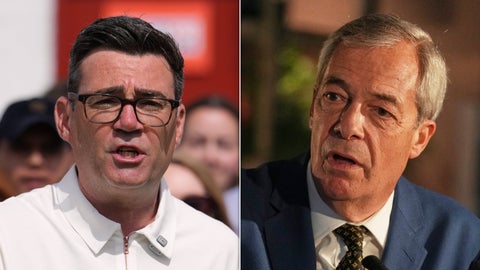
 Andy Burnham speaks as he celebrates his victory in the Makerfield by-election.
In less than a month’s time, Andy Burnham will become prime minister.
One by one, senior figures who have at least considered succeeding Keir Starmer in No.10 have reached the conclusion that resistance is futile, and thrown their support behind the former mayor of Greater Manchester.
Despite his imminent ascension to the highest office in the land, little is known about what he actually intends to do once he walks through that famous black door.
Of course, he had no need to set out his vision for the country when he was simply campaigning to become the MP for Makerfield.
That is why so many Labour MPs had hoped that his policy ideas would be tested in a leadership contest.
However, the absence of a rival candidate able to muster the support of 81 Labour MPs means little is known about what he will do differently from Keir Starmer when he replaces him as PM on July 17.
An ally told HuffPost UK that Burnham’s plans fall into three categories: abiding by Labour’s 2024 manifesto, pursuing the “Manchesterism” philosophy he pursued in his nine years as mayor, and “reacting” to the events of the day.
Burnham will attempt to flesh out his thinking in a major speech in Manchester – where else? – on Monday.
One Labour MP took issue with the choice of venue.
“He needs to speak to the entire country, not just Greater Manchester,” the MP said. “He should have made the speech in a part of the country where Labour is struggling to get a hearing.
“He needs to start speaking to rural communities, to Scotland, to Wales and parts of the country where we are under immense pressure from Reform, the Conservatives, the Lib Dems and the Greens in a way that he didn’t have to do as the mayor,” the MP said.
A source close to Burnham said in the speech, he will say “this is a moment of change” for the UK, and pledge to fix the broken political culture which he believes has led to voters giving up on Westminster.
He will also set out his plans to establish a “No.10 in the north of England” to devolve power away from Westminster, as well as his thinking on welfare reform.
Here, HuffPost UK looks at what Burnham has said on a range of policy areas in the past, and assesses what that tells us about what he will do once he becomes prime minister.
The Economy
In an interview with the New Statesman last year, Burnham said the UK needed to “get beyond this thing of being in hock to the bond markets”, a reference to how the country’s huge debt limited the government’s ability to spend.
That led to speculation that a Burnham government would look to borrow more money to spend on public services.
However, he has since insisted that he will stick to Rachel Reeves’s fiscal rules, which prevent the government from borrowing to pay for day-to-day spending, while also bringing down debt as a proportion of the economy by 2030.
Burnham has said that work is overtaxed while wealth is undertaxed in the UK, leading to speculation that he may increase capital gains tax to bring it into line with income tax.
But he has insisted he would not raise the main rates of income tax, VAT or National Insurance, as Labour pledged in 2024.
Burnham has long suggested council tax and stamp duty should be replaced with a tax on the value of land.
During his by-election campaign, in one of his few policy announcements, he pledged to cut business rates for pubs and music venues by 20%.
Burnham has also insisted he is not squeamish about reducing the welfare bill – although he will be well aware that Starmer’s own attempts to doo so were defeated by a backbench rebellion.
Reversing Privatisation
He famously reversed Margaret Thatcher’s privatisation legacy by bringing Greater Manchester’s buses back under public control, then capping single adult fares at £2.
He said earlier this month that debt-ridden Thames Water should be nationalised.
He has also called for greater public control of utilities like water and energy, although it is unclear whether that would be full nationalisation, and how he would pay for it.
Foreign Policy
Despite having been a frontline politician for 25 years, little is known about Burnham’s approach to foreign policy, which is one of the few areas where Starmer is seen to have done well as PM.
It is thought he will look to spend more time in the UK than his predecessor, who was labelled “Never Here Keir” for his regular trips overseas.
Burnham campaigned for Remain in the 2016 Brexit referendum, and said last year that he hoped to see the UK rejoin the European Union in his lifetime.
However, he has insisted that reversing Brexit would not be a priority for him as prime minister.
Health And Social Care
As a former health secretary in Gordon Brown’s government, Burnham is no stranger to the how the NHS works.
Before the 2010 election, he proposed putting a levy on dead people’s estates to provide billions of pounds for social care.
But the Tories dubbed it a “death tax”, Labour lost the election and subsequent attempts to reform social care have failed.
Devolution
In 2021, Burnham insisted that he would only ever return to Westminster politics “to champion fundamental constitutional reform of England”.
He previously warned Britain would be “left behind” if it continues believing it can “run everything through top-down”.
Given his experience as mayor, he is expected to promote the further devolution of power away from Whitehall to the English regions.
Immigration
Burnham said in the by-election campaign that net migration “needs to fall further”.
He claims to stand by the “broad thrust” of home secretary Shabana Mahmood’s tough reforms, which have helped cut immigration rates.
However, it has been reported that he could look to make it easier for some immigrants to settle in Britain, leading to Reform UK dubbing him “open-borders Andy”.
Constitutional Change
Burnham has previously expressed his support for replacing the existing voting system with proportional representation.
He has also called the House of Lords to be abolished in favour of a “Senate of the Nations and Regions”.
Keiran Pedley, of pollsters Ipsos UK, said Burnham has a lot of work to do to restore the public’s faith in politics, and needs to hit the ground running.
He said: “Assuming Andy Burnham takes office, he will do so at a time of intense public dissatisfaction with how the country is run and a strong lack of faith with the political process itself.
“To avoid the fate of Keir Starmer, whose honeymoon period in office was extremely short lived, he will need to start well and clearly set out how his government represents change and the policies it will pursue to deliver it.
“A Burnham government will also need to be more effective at ‘uniting the left’ against Reform UK. Tactical voting suggests there is a significant anti-Reform voter bloc out there, but the challenge is to pursue an agenda that unites them behind Labour.
“Burnham was able to do this in the Makerfield by-election but whether he can nationally remains to be seen.”
Listen to Commons People, the podcast that makes politics easy. Every week, Kevin Schofield and Kate Nicholson unpack the week’s biggest stories to keep you informed. Join us for straightforward analysis of what’s going on at Westminster.



 Bengali (Bangladesh) ·
  English (United States) ·