
 1 hour ago
5
1 hour ago
5 
TLDR
Gold fell about 1–1.5% on Thursday, trading around $4,441–$4,476 per ounce Conflicting signals from the U.S. and Iran over peace talks are driving market uncertainty Oil is back above $100 a barrel as the Strait of Hormuz stays effectively closed Markets now see almost zero chance of a Fed rate cut in 2024, with a 38% chance of a hike by year-end A stronger U.S. dollar is adding pressure on gold by making it more expensive for foreign buyersGold prices pulled back on Thursday after two days of gains, with traders reacting to mixed messages from Washington and Tehran over whether peace talks are progressing.
Spot gold fell around 1.5% to roughly $4,441 per ounce. U.S. gold futures dropped about 2.5% to $4,457.
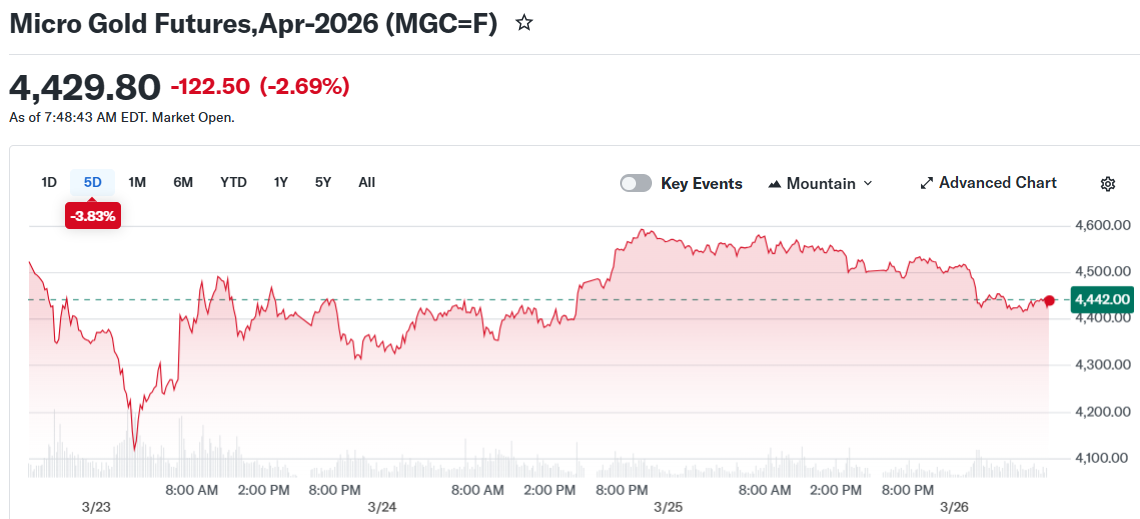 Micro Gold Futures,Apr-2026 (MGC=F)
Gold had climbed back above $4,500 earlier this week after a sharp correction, supported by a weaker dollar and some cautious hope around diplomacy.
President Donald Trump said Iran was desperate for a deal, claiming Tehran had been “obliterated” militarily. He also said Iranian negotiators had been “very different and strange.”
Iran’s foreign minister pushed back, saying his country was reviewing a U.S. proposal but had no intention of holding formal talks to end the conflict.
Analysts say gold is now in a holding pattern. “In the near term, gold is trading inside a defined range,” said Max Baecker, President of American Hartford Gold. “The market needs to clear the mid-$4,500s to shift the tone.”
Kyle Rodda of Capital.com said price movement in the next day or two will be driven purely by headlines. “The really big moves will happen at the start of next week when it becomes clearer whether the U.S. launches a ground invasion in Iran.”
Oil Above $100 as Hormuz Stays Shut
Brent crude climbed back above $100 a barrel on Thursday. The Strait of Hormuz, which handles roughly a fifth of the world’s oil and liquefied natural gas, remains effectively closed since the start of the U.S.-Israeli military campaign against Iran.
Prices had hit around $120 earlier this month before pulling back slightly. They remain well above pre-war levels.
Higher oil pushes up transport and manufacturing costs, which feeds into inflation. That in turn makes central banks less likely to cut interest rates, which is a negative for gold since the metal pays no yield.
Rate Cut Hopes Fade
Before the conflict began, markets were expecting at least two Federal Reserve rate cuts this year. That view has completely reversed.
According to CME Group’s FedWatch tool, there is now almost no chance of a rate cut in 2024. About 38% of traders are pricing in a rate hike by December. Around 93% expect the Fed to hold rates steady at its April meeting.
The U.S. dollar has also strengthened as investors move into safe-haven assets. A stronger dollar makes gold more expensive for buyers outside the U.S., which tends to weigh on demand.
Trump reiterated on Thursday morning that Iran should pursue an agreement with Washington and repeated the claim that Tehran’s military has been destroyed.
The post Why Gold Dropped Today: Iran War, Oil Prices, and Fed Rate Bets Explained appeared first on CoinCentral.




 Bengali (Bangladesh) ·
  English (United States) ·