

Starship may have just made history, but it still has some work to do to get fully up and running.
The megarocket launched on its 15th test flight on Friday (Nov. 13), aiming to pull off a dramatic and unprecedented twofer. SpaceX wanted to bring both Starship elements — its Super Heavy booster and Ship upper stage — back to the launch pad at its Starbase site in Texas to be caught by the tower's "chopstick" arms.
It didn't happen with Super Heavy; the booster diverted to a Gulf of Mexico splashdown on Friday evening after experiencing a low-fuel alarm. But Ship came home successfully, nestling into the tower's arms in a soft and unprecedented embrace on Saturday afternoon (Nov. 14), 22.5 hours after lifting off.
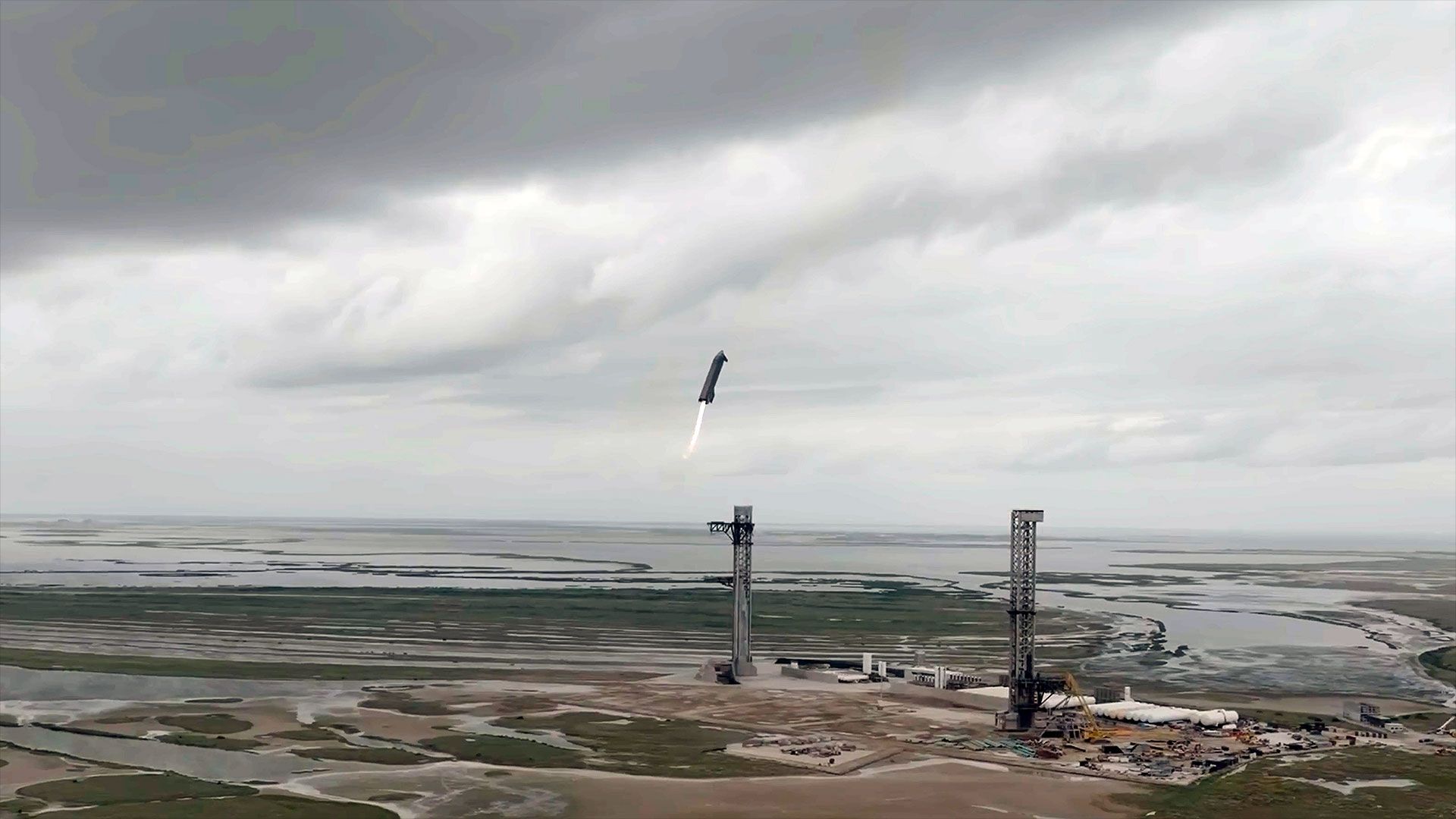
SpaceX has caught Super Heavy on three test flights to date. But it had never caught a Ship before; indeed, it had never even tried before Saturday. It's tougher and riskier to catch Ship; the upper stage flies much higher and faster than Super Heavy, so its return trip is much more more involved.
Saturday was therefore a very big day for the company.
"That was the holy grail of spaceflight, plummeting through fire to be snatched out of the air by steel," SpaceX spokesperson Dan Huot said during the company's landing webcast on Saturday. "We caught a Starship, and now everything changes."
The Flight 15 mission plan gave us a sneak peek at the future: The double catch will be standard on operational Starship missions, as this recovery strategy will enable rapid inspection, refurbishment and reflight of the megarocket, according to SpaceX.
And the company is indeed planning on rapid reflight. Elon Musk has said that SpaceX is targeting 10,000 Starship launches per year by 2030, which works out to more than one liftoff every hour on average.
Why such a mind-boggling cadence? Because SpaceX plans to build megaconstellations far larger than anything circling Earth today. For example, it wants its next-gen Starlink V3 broadband network to consist of 100,000 satellites. And its planned Starmind AI data-center constellation will be 10 times bigger than that, featuring one million spacecraft, if all goes to plan.
For perspective: SpaceX's current-gen Starlink network in low Earth orbit (LEO), by far the largest constellation ever assembled, is about 11,000 strong at the moment.
Rocket recovery is only part of the reuse equation, of course; there's also refurbishment and reflight. And that gets us back to the "work left to do" discussion, for SpaceX has yet to demonstrate rapid reflight with either Super Heavy or Ship.
The company has reflown Super Heavy vehicles on two separate occasions. Booster 14 initially launched on Flight 7 in January 2025, then lifted off again on Flight 9 in May of that year. Booster 15 flew on Flight 8 and Flight 11, which lifted off in March 2025 and October 2025, respectively.
Several months separated each of these Super Heavy reflights. And SpaceX has yet to reuse a Ship, as it had not caught one during a mission until Saturday.
That could change soon: Before Flight 15 lifted off, Musk said that the company wants to reuse both of its Starship stages. That option may still be on the table for Flight 15's Ship.
And we should expect full reuse to be a priority on Starship test flights over the longer haul, with SpaceX working toward shorter and shorter turnaround times — perhaps until an hourly cadence is in sight, if that goal is indeed achievable.
Over the next few years, most Starship launches will likely be devoted to building out the Starlink V3 and Starmind megaconstellations. But the rocket will also carry people to deep space, if all goes to plan, which will require the checking of another set of boxes.
NASA selected Ship to be the first crewed lunar lander for its Artemis program, which aims to establish a base near the lunar south pole by 2032 or so. Current plans call for Ship to land astronauts in that locale for the first time on the Artemis IV mission, which is targeted to fly in 2028.
SpaceX needs to install a crew cabin and life-support system in Ship to make that happen. The company is working on that now and has made considerable progress, according to NASA. Last month, an agency presentation reported that SpaceX is on target to finish building "Cabin 1," a full-scale ground prototype of Ship's crew cabin, by the end of the year.
There's another hurdle to clear, however. On all deep-space missions, Ship will need to fill up its fuel tanks after launch, at a "depot" that SpaceX will set up in Earth orbit. (Launching Ship with full tanks is not an option, as it would be incredibly heavy in that case.)
The depot will be filled by "tanker" variants of Ship. It's unclear how many tanker visits will be required for each Ship deep-space mission; outside experts have floated numbers as high as 22, while Musk has cited six to eight as a probable range.
Whatever the actual number, Ship will need to demonstrate proficiency with off-Earth refueling, something it has yet to do. And there's more to it than just a simple rendezvous: Ship's engines run on liquid oxygen and liquid methane, so the propellants must be kept extremely cold throughout the process.
We're likely to see the first refueling test relatively soon, as time is of the essence for SpaceX. If the company can't get Ship ready for the Artemis IV moon landing in 2028, NASA may go with another private lander — Blue Origin's Blue Moon, which the agency also contracted for Artemis missions.
All of this is to say that, while Flight 15 was a big success for Starship and SpaceX, there's a lot of work left to do — and a lot for space fans to watch for over the coming weeks and months.





 Bengali (Bangladesh) ·
 English (United States) ·