

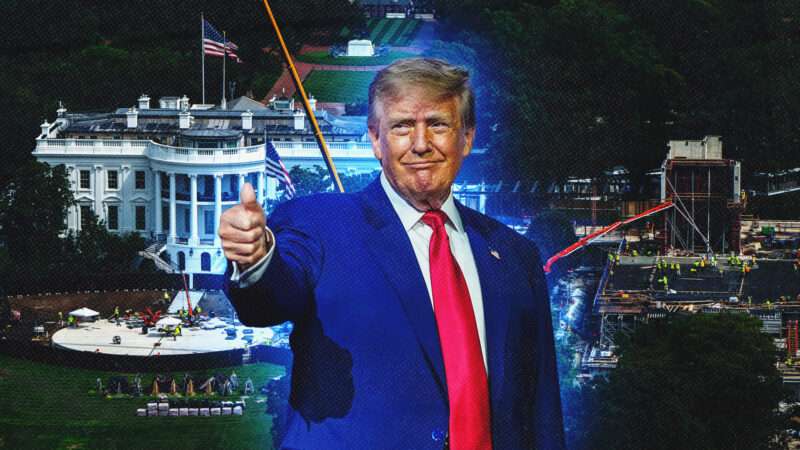
Last year, President Donald Trump bulldozed the East Wing of the White House. In its place, he planned to build a giant formal ballroom that would dwarf the rest of the building.
The project has been the subject of litigation: Federal law says only Congress can approve major structural changes to the White House, while Trump says his preferences take precedent.
It turns out that Trump's attitude extends all the way down to the building codes.
"In the weeks leading up to his resignation last year, the first architect on the White House ballroom clashed with President Donald Trump over design features that the architect believed violated building safety codes," The Washington Post reported this week. "James McCrery II withdrew from the project last October after warning repeatedly that Trump was insisting on a preliminary design that did not provide adequate emergency exit routes or fire-containment measures."
It should perhaps be no surprise that the ballroom had issues. The New York Times reported in March that the proposal had "barely been scrutinized," and there were major design flaws—for example, "its portico is too big, its stairs lead nowhere, its columns will block views from inside the ballroom."
The Post reported last year that Trump and McCrery had butted heads over the project's scope, as the architect cautioned against building an addition so much larger than the primary structure.
New reporting suggests its issues went beyond aesthetics.
"McCrery informed the White House that Trump's ballroom design did not meet fire safety codes, which require the majority of guests to be able to quickly exit through the main entrance during an emergency," per the Post. "The architect also pointed out that alternative emergency exit routes out of the building were insufficient, and that there was little in the design to prevent a kitchen fire from rapidly spreading into the event space on the floor above."
Trump allegedly had a troubling response: "The president countered that no building codes apply to White House construction," the Post continued. He also reportedly stated, "I am the code."
The Supremacy Clause and sovereign immunity doctrine broadly exempt the federal government from adhering to state and local regulations, including zoning laws and building codes. But 40 USC 3312 requires that all construction of or alterations to federal buildings comply with "one of the nationally recognized model building codes."
That's not to suggest these laws are inherently good—byzantine building codes make it more difficult and expensive to build housing and other structures. Members of the Trump administration have rightly criticized these burdensome regulations.
It would be one thing if Trump were making a statement about the downsides of these laws—or if his administration made more than fleeting attempts to address them.
Instead, Trump's interest in the subject seemingly goes no further than how it affects him personally. According to the Post, citing "two people with knowledge of the discussions," Trump asserted that his authority supersedes the law—a recurring theme of the ballroom project.
"Major renovations and construction on the White House are supposed to be handled by the General Services Administration or the National Park Service," the Post notes. "Instead, the work has been routed through the White House Executive Residence, an unusual arrangement that has allowed the president to dictate the terms of the project."
Earlier this year, Judge Richard Leon of the U.S. District Court for the District of Columbia issued an injunction halting construction, which the U.S. Court of Appeals for the D.C. Circuit later upheld. In each case, the judges found that under the law, the power to make major alterations to federal structures belonged solely to Congress, not the president.
Earlier this month, by a 5–4 vote, the Supreme Court allowed construction to continue for now. Chief Justice John Roberts, writing for the minority, criticized the decision to rubber-stamp Trump's "likely unlawful" project.
Reason's Jacob Sullum recently dubbed the ballroom "a monument to [Trump's] disregard for the rule of law and the separation of powers." Given that track record, it's no wonder Trump seems to feel he's exempt from cumbersome regulations that the rest of us have to contend with.
The post Trump Reportedly Rejected Building Codes for His White House Ballroom appeared first on Reason Magazine.





 Bengali (Bangladesh) ·
  English (United States) ·