

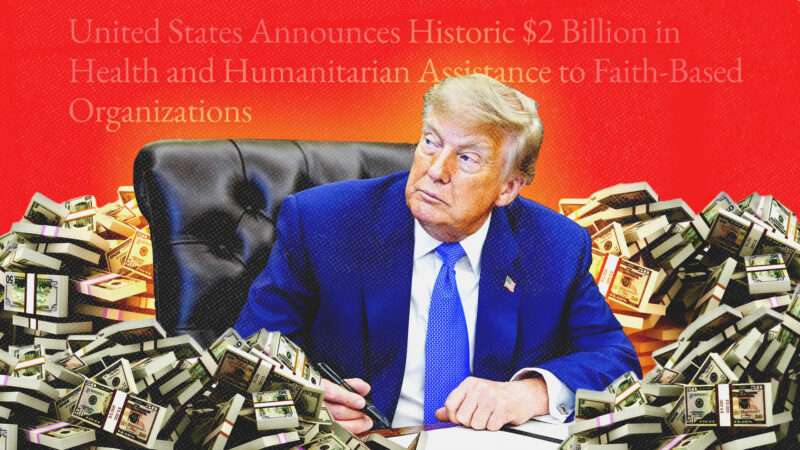
The U.S. Agency for International Development (USAID) may be dismantled, but billions of taxpayer dollars are still flowing overseas.
Last week, the Trump administration announced that it will direct nearly $2 billion in humanitarian funding toward faith-based organizations, including $1.4 billion through its America First Global Health Strategy. Three Christian organizations—World Vision, Compassion International, and Samaritan's Purse—are among the largest recipients, with the State Department calling it "the largest allocation of global health foreign assistance to faith-based organizations in over 20 years."
Of the nearly $2 billion, $850 million will go to a World Vision-led global consortium, $570 million to faith and community-based health facilities through foreign governments, $300 million to Samaritan's Purse, and $238 million to a World Vision and Compassion International humanitarian consortium.
Samaritan's Purse, which will receive the funding over two years, explicitly describes itself as an "evangelical Christian organization" that provides "spiritual and physical aid." Its mission statement says it helps "meet the needs of people…with the purpose of sharing God's love through His Son, Jesus Christ" and "the organization serves the Church worldwide to promote the Gospel of the Lord Jesus Christ."
This is not the first time the group has received federal money. From 2021 to 2025, Samaritan's Purse was awarded $90 million from USAID, according to the Brookings Institution. Still, it has faced its share of controversies over the years.
The organization requires employees to oppose same-sex marriage, and its CEO, Rev. Franklin Graham, has faced criticism for some of his statements on gay issues and Islam. This includes social media posts saying, "We should stop all immigration of Muslims to the U.S." and "Every Muslim that comes into this country has the potential to be radicalized." Graham is also an ally of President Donald Trump and defended the president after he created an AI-generated image depicting himself as Jesus in April, supporting Trump's claim that "he thought it was a doctor."
Its "Operation Christmas Child" initiative—which sends shoeboxes full of toys and treats to impoverished children worldwide—has been criticized for sending Christian missionary messages to Muslim countries in the hope of converting poor children. "Angella received an Operation Christmas Child shoebox filled with presents last year at this time," the charity's website reads. "Since then, she's led her Muslim family to Christ."
In 2025, MinistryWatch downgraded Samaritan's Purse from "Give with Caution" to "Withhold Giving" after the organization left the Evangelical Council for Financial Accountability because it did "not meet board composition recommendations," according to MinistryWatch.
World Vision, which will lead a consortium eligible for up to $850 million over five years, also describes itself as a "Christian charity" that partners with "pastors and Christian leaders throughout the world." They aim to "strengthen local churches…to support sustained spiritual and physical transformation." Likewise, Compassion International "partners with local churches in impoverished communities" to introduce "vulnerable children to Jesus as [they] meet their critical needs."
While these charities may provide valuable humanitarian assistance, it is unclear why American taxpayers should be compelled to finance their work. What's equally baffling is the administration's seeming insistence that foreign aid go only to Christian groups.
Through the America First Global Health Strategy, the State Department is mobilizing $1.4 billion in country-specific grant programs. The State Department's official Q&A for its Nigeria global health funding makes its preference for religious organizations explicit: "there should be a priority placed on engaging local Nigerian organizations with a strong emphasis on faith-based and community-based providers."
Similarly, in the Ivory Coast, the State Department has made sustaining "Integrated Service Delivery in Faith- and Community-Based Facilities" one of four explicit objectives. Applicants are told to place a "strong emphasis on faith-based and community-based providers." The department also envisions a direct role for religious institutions in delivering public health programs, including "the involvement of places of worship supporting maternal and child health week."
The State Department claims that faith-based organizations spend taxpayer money more efficiently than secular groups and that their efforts reach frontline communities better. The department does not, however, provide supporting data or a methodology for those figures in its announcement, and there is no reason to believe that faith-based NGOs are any less wasteful than nonreligious organizations.
Prioritizing faith-based organizations for federal funding could also pose a constitutional problem. Under the First Amendment's Establishment Clause, the government is prohibited from taking "actions that unduly favor one religion over another," according to the Legal Information Institute. It also prohibits "the government from unduly preferring religion over non-religion, or non-religion over religion." While it is unclear whether this funding round violates the Constitution, the State Department's guidance does explicitly prioritize faith-based providers' access to taxpayer dollars.
"The administration is openly restructuring American foreign assistance around religion," said the Freedom From Religion Foundation Copresident Annie Laurie Gaylor in a press release. "Taxpayers should not be forced to bankroll an administration's campaign to elevate and subsidize religion."
The Trump administration promised to cut wasteful overseas spending, but replacing one type of ideologically motivated spending with another is hardly a victory for taxpayers.
The post Trump Promised To End Foreign Aid. Now He's Giving Christian Groups Nearly $2 Billion. appeared first on Reason.com.




 Bengali (Bangladesh) ·
  English (United States) ·