

Consolidation phases are where positioning happens. Prices stop trending, volume thins out, retail attention drifts elsewhere, and the assets that will lead the next expansion quietly change hands. That is roughly where the crypto market sits in early August 2026.
Bitcoin trades at $63,043, down roughly 28% year to date and compressing between support at $62,000 and a descending trendline that has capped every rally since 21 July. Most large-cap altcoins are 32% to 44% lower on the year. The screen below focuses on tokens priced under $5, with modest market capitalisations and deep drawdowns, but the selection is driven by identifiable catalysts rather than by price weakness alone. A token being cheap is not a thesis.
Why is the crypto market consolidating right now?
Bitcoin trades at $63,043 as of 13:11 UTC on 2 August, up a marginal 0.12% on the session, and the three-hour chart shows a textbook compression pattern.
The structure has four defined boundaries:
Descending trendline resistance. Since the $66,803 high printed on 21 July, Bitcoin has produced a clean sequence of lower highs. That trendline has rejected every rally attempt for nearly two weeks.The 200-period EMA at $63,969. It supported price through most of July and flipped to resistance around 30 July. Bitcoin has traded beneath it since.Horizontal resistance at $65,000, a level lost in late July that now sits above both the EMA and the trendline.Support at $62,000, where selling was absorbed on both 25 July and 1 August, with major support far below at $58,000, the base of the early-July advance.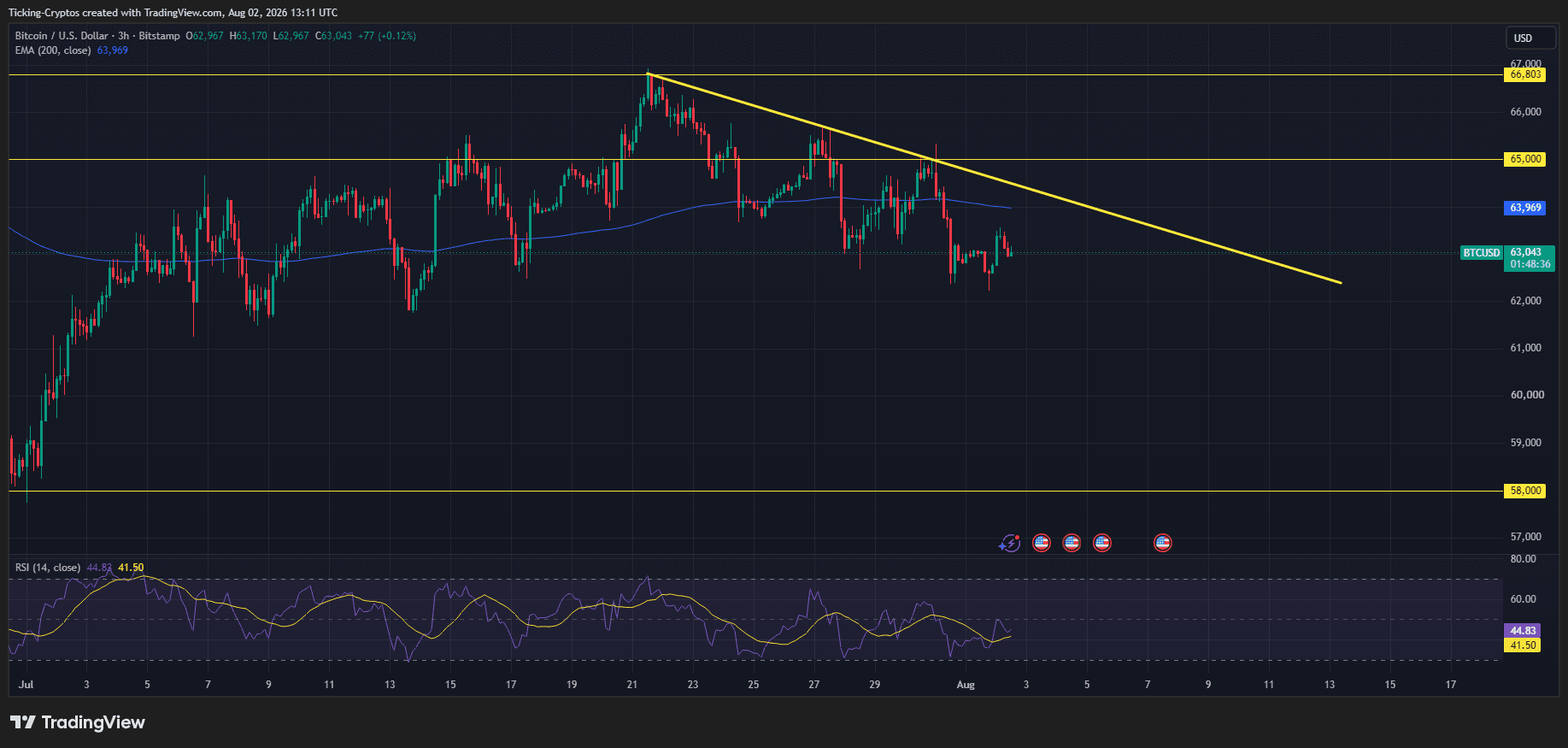
The RSI reads 44.83 against its own 41.50 average. That is below the neutral 50 line, but turning up from the lows rather than deteriorating. Sellers are largely exhausted, buyers are absent, which is the definition of consolidation.
The important detail is that this range is closing. The descending trendline is falling toward the $62,000 horizontal support, which means the two boundaries converge over the coming fortnight and force a resolution rather than allowing an indefinite drift. A break above the trendline and the $63,969 EMA opens $65,000 and then the 21 July high at $66,803. A loss of $62,000 puts $58,000 in play, roughly 8% lower, and altcoins would almost certainly fall harder than that.
Three features define this phase. Volatility has compressed, with Bitcoin absorbing a hawkish Fed, a $70 million wallet exploit and a stalled regulatory bill in a single week while declining only about 2%. Institutional flows have stabilised without turning positive, as July closed with $172.4 million of net inflows into US spot Bitcoin ETFs, ending two months of outflows but nowhere near the pace that drove previous advances. And altcoin dispersion has widened, with Cardano up 12.36% over the past week while Hyperliquid fell 11.02%, which is characteristic of a market trading on individual catalysts rather than a single directional impulse.
That last point matters most for this article. When correlation breaks down, token-specific developments start to determine returns.
Which macro forces are actually driving altcoin prices?
Monetary policy is the dominant variable. The FOMC held rates at 3.50% to 3.75% on 29 July, but split 9-3, with Beth Hammack, Neel Kashkari and Lorie Logan all voting for a 25 basis point hike. It is the sharpest committee split since September 2016. CME FedWatch now assigns a 61.4% probability to a September hike, up from 50.6% a month earlier. Higher real yields compress valuations across long-duration risk assets, and altcoins sit at the far end of that spectrum.Geopolitical risk is persistent but increasingly discounted. The conflict involving Iran that escalated with joint US and Israeli strikes in late February remains unresolved, and Brent crude has carried a geopolitical risk premium throughout 2026, trading above $90 in July. The Russia-Ukraine war continues into its fifth year and is currently occupying Senate floor time through a sanctions bill. The important nuance is that markets have largely adapted. Analysts increasingly describe crypto as behaving like a liquidity sponge, expanding when global money supply and risk appetite rise and contracting when real rates climb, largely regardless of the headline conflict situation. War headlines produce sharp intraday moves that tend to mean-revert. Rate expectations produce trends.Regulatory clarity has been deferred. The CLARITY Act has cleared the House and the Senate Banking Committee, but no floor vote is scheduled, and Majority Leader John Thune does not expect one before the recess beginning around 7 August. Polymarket odds on 2026 passage have fallen from above 80% in February to roughly 35%. For altcoins specifically, this is the most consequential of the three, because the bill would have resolved the token classification question that keeps most regulated institutions away from anything other than Bitcoin and Ethereum.Security risk has repriced. An attacker drained 1,082.65 BTC, worth roughly $70.2 million, from 1,196 Coldcard-generated addresses on 30 July, exploiting a firmware flaw that allowed seeds to be reconstructed offline. Blockaid reported that crypto projects lost more than $1 billion to hacks in the first half of 2026. This raises the risk premium across the sector, and it disproportionately affects protocols holding large amounts of user capital.What are the top 5 altcoins to watch in August 2026?
1. Ondo (ONDO)
Price: around $0.38 to $0.41 | Market cap: approximately $1.9 billion | Down roughly 81% from its $2.14 all-time high
$Ondo has the most concrete institutional pipeline of any token on this list. Its DTCC-linked tokenization initiative went live in July 2026, involving BlackRock, J.P. Morgan and Goldman Sachs in tokenizing Russell 1000 equities and Treasury bills. A separate cross-border settlement pilot with J.P. Morgan's Kinexys platform, Mastercard and Ripple completed in under five seconds. The protocol expanded tokenized securities on Solana with round-the-clock minting and redemption, and launched Ondo Perps for perpetual futures tied to equities and commodities. Total value locked sits near a record $3.5 billion across more than 205,000 holders. A governance vote to permanently burn 100 million ONDO, equal to 10% of total supply, concluded on 25 July.
The risk: Ondo is the clearest example in this market of platform growth failing to translate into token performance. TVL hit record highs while the price stayed flat, a documented disconnect. Roughly half the 10 billion total supply is still to enter circulation, which means dilution remains a structural headwind regardless of adoption.
2. Sui (SUI)
Price: around $0.72 to $0.78 | Mid-cap | Well below its all-time high
$Sui recorded a genuine institutional milestone on 23 July when Abu Dhabi sovereign wealth fund Mubadala tokenized a $75 million private markets fund directly on the network. In the same week, Hashi launched a Bitcoin lending testnet targeting institutional BTC-backed credit markets built on Sui. The pattern suggests a network positioning for regulated financial products rather than retail DeFi activity. Price action has been more constructive than the broader altcoin picture, with SUI reclaiming a key technical level in late July alongside rising on-chain activity.
The risk: the technical picture is a recovery attempt off cycle lows, not a confirmed trend reversal. Sui also tends to track broader altcoin liquidity and Bitcoin dominance more closely than it moves on its own news, which limits how much the Mubadala headline can do in a flat tape.
3. Stellar (XLM)
Price: around $0.18 | Roughly 79% below its 2018 all-time high of $0.94
$Stellar has assembled an unusually credible institutional validator set. MoneyGram, Figure Markets and Range all joined as Tier 1 validators in July. Tradable has committed to bringing up to $1 billion in tokenized private credit to the network. Most significantly, the DTCC has confirmed plans to connect its tokenized securities platform to Stellar, with $XLM expected to serve as the settlement asset. The network activated Protocol 27 following a 8 July vote, introducing authentication delegation, and reported more than $2 billion in real-world assets issued in Q1 2026 alone. Stablecoin supply on the network has grown almost 300% over two years.
The risk: the DTCC rollout is targeted for the first half of 2027. That is a long wait, and long-dated catalysts are precisely what a market with a 61.4% probability of a September rate hike discounts most heavily. XLM has also repeatedly failed to hold above the $0.20 resistance level.
4. Arbitrum (ARB)
Price: around $0.08 | Market cap: approximately $517 million | Roughly 97% below its $2.39 all-time high
$Arbitrum presents the sharpest divergence between network usage and token price in this group. Robinhood Chain launched its mainnet in early July using Arbitrum's technology, generating over $500 million in daily trading volume at peak, 17 million transactions in its first week and 350,000 addresses. The network surpassed Hyperliquid to reach eighth place among all chains by total value locked at approximately $1.2 billion, and leads all Layer 2 networks in Aave v3 borrowing and lending activity with $728 million in TVL. Usage has held up through a period of severe token weakness.
The risk: the reason for that divergence is dilution, and it is ongoing. Arbitrum unlocked approximately 92.65 million tokens in mid-July, most going to team, advisors and investors, with further unlocks scheduled through the remainder of 2026. Sustained selling pressure from vesting is the direct explanation for the price performance, and nothing in the schedule changes before year-end.
5. Ethena (ENA)
Price: around $0.083 | Market cap: approximately $790 million | Roughly 94% below its $1.52 all-time high
$Ethena is the highest-risk name here and belongs on the list for one reason: the institutional distribution is real. BlackRock integrated Ethena's USDe into its Aladdin risk management platform. Janus Henderson took a position in ENA and plans to use staked USDe for treasury cash management, adding to existing relationships with Anchorage Digital and Securitize. The potential fee-switch activation would convert ENA from a pure governance token into a cash-flow-linked asset by directing protocol revenue to stakers, which is the single change most likely to re-rate the token.
The risk, and it is substantial: the fundamentals are deteriorating, not improving. Gross protocol revenue fell 32% quarter over quarter to $65.06 million in Q1 2026. USDe supply has fallen from a $14.5 billion peak to roughly $5.92 billion. Daily active users have dropped to around 1,200. Ethena completed a 172 million token unlock on 4 July with further releases scheduled for August, and roughly 40% of the 15 billion maximum supply remains to be distributed. Ethena's model is also funding-rate dependent, meaning its yield compresses precisely when market sentiment turns negative. This is a speculative position on the fee switch and institutional distribution outrunning a shrinking protocol, not a bet on current performance.
Comparing where to trade these? Fees and spreads matter more in a range-bound market than in a trending one. 👉 See our crypto exchange comparison
What are the risks of buying altcoins during consolidation?
Consolidation does not guarantee an upside resolution. Ranges break in both directions, and a Bitcoin close below $62,500 would likely drag every token on this list lower regardless of individual catalysts, since altcoin correlation to BTC rises sharply during drawdowns.
Three risks deserve specific attention this month. Token unlocks affect three of the five names here, with ARB, ENA and ONDO all carrying active or imminent dilution schedules. The September rate decision is a binary event that markets currently price at 61.4% for a hike, and altcoins are the highest-beta expression of that outcome. And a deep drawdown is not automatically an entry point, since roughly 94% of major tokens launched since 2024 now trade below their launch price, with a median return around -95.7%. Most assets that fall 90% continue falling.
The immediate calendar is dense: US payrolls on 7 August, the Senate recess the same day, and CPI on 12 August. All three land before any of the catalysts described above have time to develop.




 Bengali (Bangladesh) ·
  English (United States) ·