

Microrobots controlled by magnets can sweep drugs towards hard-to-reach blood clots in the body, boosting the efficacy of these life-saving treatments, early tests in animals suggest.
In tests with pigs, the microbots helped to dissolve clots around 10 times faster than medication alone. The research team is now working on further safety testing to ready the technology for eventual human trials.
"The whole construct is inspired by nature," said lead researcher Simone Schürle, professor of medical microsystems at ETH Zürich. "There are these tiny bacteria that have little magnetic backbones which they use to navigate with the Earth's magnetic field, and we were really struck by the physics and the properties of them when exposed to rotating magnetic fields," Schürle told Live Science.
ETH Zürich announced the research in a statement on Nov. 9. It has not been described in a peer-reviewed study yet.
Tiny robots tumbling through blood vessels
Left untreated, blood clots can cause life-threatening damage. These blockages can restrict the flow of blood to the body's key tissues, triggering serious cardiovascular events, such as heart attacks or strokes, which starve cells of oxygen.
Doctors can either remove clots manually with tools or deliver clot-dissolving drugs, called thrombolytics, close to the site of the blockage. However, getting these medications through the final few millimeters of their journey is often the hardest part.
"When a pipe becomes blocked in a branched pipe system, the fluid encounters greater resistance and instead flows through alternative routes where it can pass more easily," Schürle explained. "So when you then try to bring in drugs to dissolve the clot, they won't flow into this area because it's occluded [blocked off]."
This is where microbots can help. The bots are tiny particles whose movements can be controlled by external magnets, which send them rotating and tumbling through blood vessels. These bots can redirect the interrupted blood flow and thus carry essential drugs straight to their target, Schürle and her team say.
Each bullet-shaped microbot contains a magnetic backbone of iron oxide nanoparticles, which is surrounded by a protective sheath of hydrogel polymer. When exposed to a rotating magnetic field, the microbots essentially start to somersault through the blood vessel, creating little vortices that help carry the drugs along with them.
Crucially, the bots' rigid backbone ensures that they spin predictably, while the gel body prevents the particles from sticking together and forming a clump.
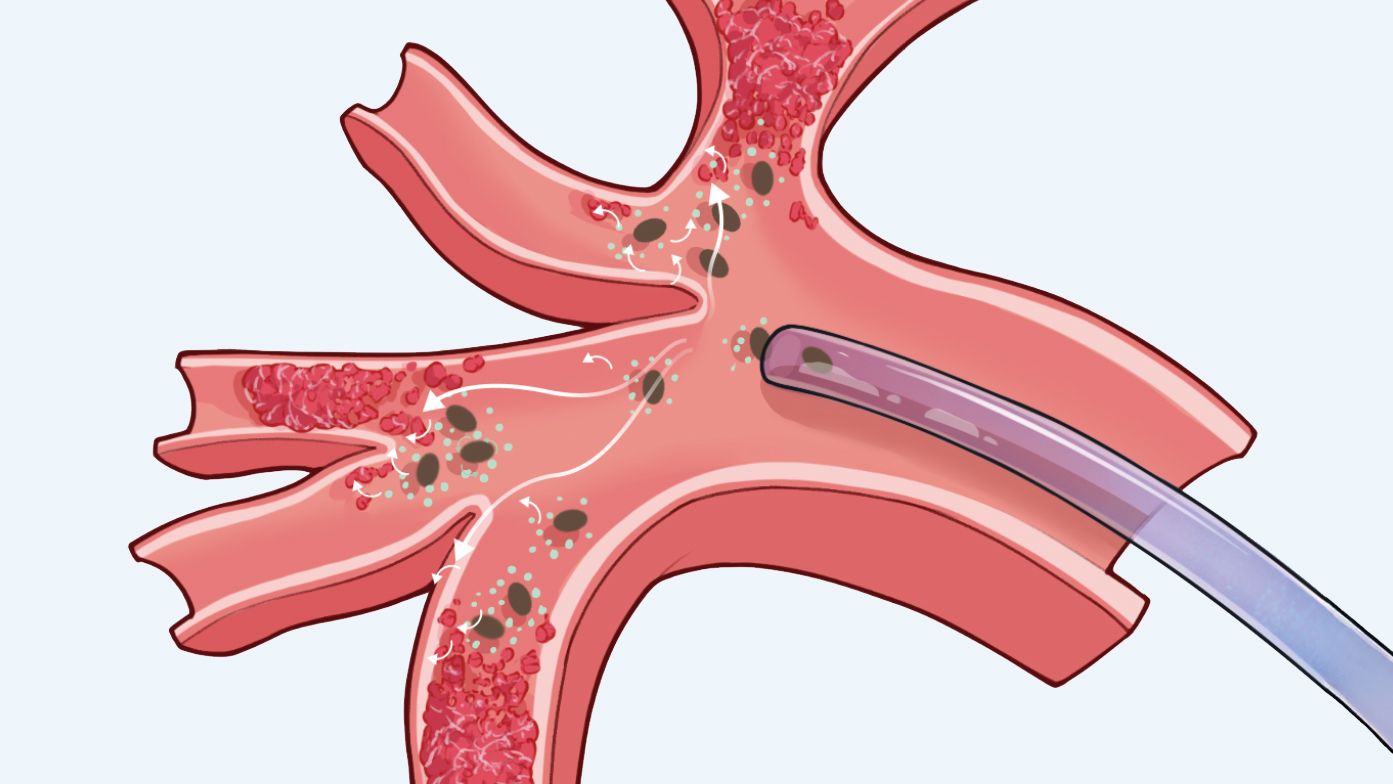 ETH News
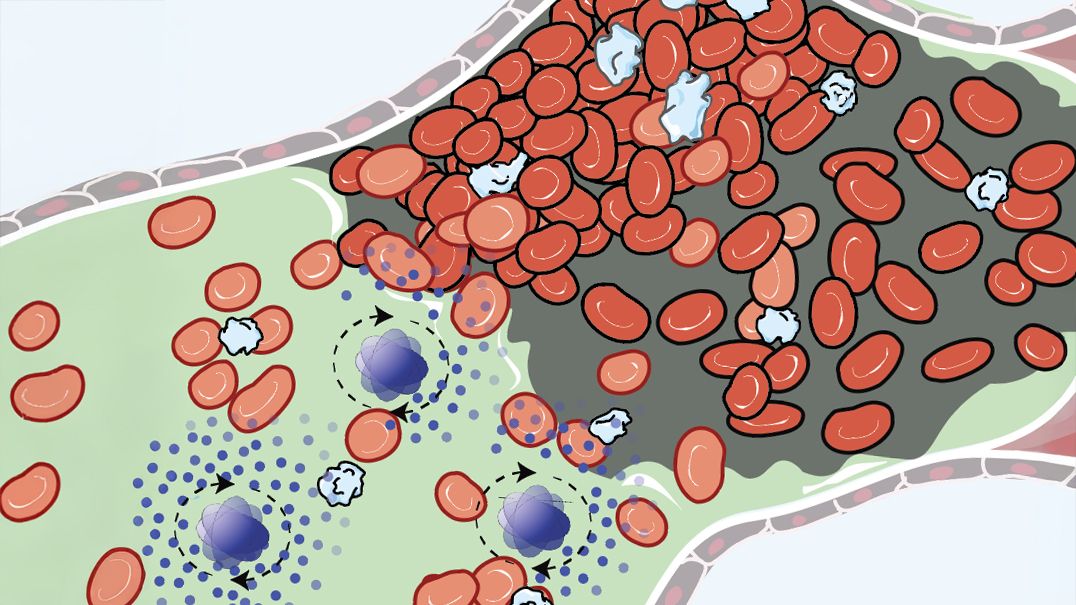 ETH News
The team first tested the microbots in a silicon model of a blood vessel that contained clots of pigs' blood. Aided by the rotating microparticles, a thrombolytic drug dissolved the blockages around 10 times faster than medication alone did. That's a potentially life-saving difference, the researchers said.
They then repeated the experiment in live pigs, placing clots in vessels in each of the animals' kidneys. "When we introduced our micro-robots with a conventional, state-of-the-art drug, we could reperfuse [restore blood flow to] a much larger area than if only the drug was there," Schürle said. "The next step is doing safety studies over a longer time and in larger animals."
Earlier safety studies in mice showed that both the iron oxide and the gel sheath polymer safely break down in the body within a few weeks. However, the team will now need to demonstrate that the device is safe in larger mammals before it can be trialed in human patients; their latest test in pigs did not look at how the device broke down or how the pigs fared after the clots were dissolved.
Ultimately, the researchers hope that the bots could be injected into the body alongside the thrombolytic medicine. Once inside, they'd be controlled by targeted electromagnets, making the technique easy to integrate into existing clinical procedures for treating clots.
The team's research is still undergoing peer review, but Schürle has applied for a patent for the microbots' production, which uses a droplet-based microfluidics technique to form each individual particle.
"It's a very cheap, high throughput method to produce the micro-robots," she said. "It's about improving the [clot-dissolving] procedure where it is lacking and helping the drugs travel the last millimeters to be really effective."
This article is for informational purposes only and is not meant to offer medical advice.




 Bengali (Bangladesh) ·
 English (United States) ·