
 1 month ago
49
1 month ago
49 
I was once a different version of myself. I was a child and then a young adult in a conservative, Christian community. Existing in that environment required morphing and shrinking in ways that I find painful to think about now. But one thing I could never fully deny was my interest in sex, that thing Garth Greenwell calls a dense and complicated act of “self-making.” My doomed attempts not to think about sex became a way of thinking about it often, of keeping on the periphery of my awareness both my interest and the threats that lay within it—namely, my kinks and my queerness.
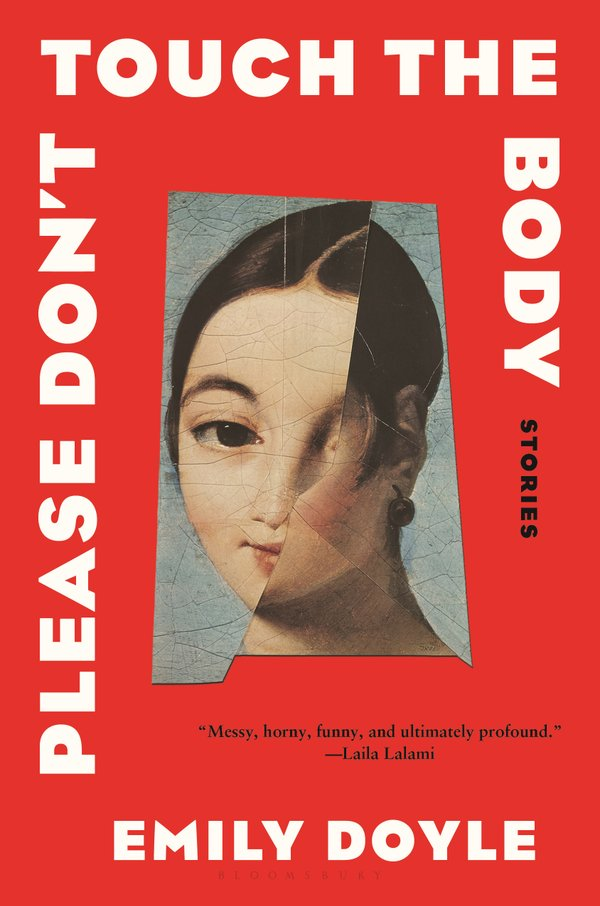
So it is no accident that writing about sex is now one of my acutest pleasures. In my debut collection, Please Don’t Touch the Body, I focus on delights and pains implicit in the times before and after sex—which in many ways are also sex. A caregiver attempts to reach out to an almost-lover while being haunted by a ghost. A young girl works up the courage to kiss her neighbor only for that neighbor to reject her. Two older women pleasure each other in order to distract from the fact that one of the women is ill. In each of these stories, I’m fascinated by how desire can ripple outward and inward, altering our relationships to ourselves and others.
While writing Please Don’t Touch the Body, I found myself searching for sex scenes that aren’t just sexy, scenes that prioritize the discoveries and obfuscations and exchanges of power involved in sex as much as its pleasure. For this, I turned to the works of other queer writers. I bring eight of their books to you now. All of them share, I think, a consciousness that comes from being unable to take roles within sex for granted, a consciousness that is as concerned with the mind as it is the body, and which can, depending on the book, produce stories ranging from the outright erotic to the deeply unsettling.

Fantasian by Larissa Pham
When the protagonist of Fantasian happens upon a woman named Dolores at a college party, she’s struck by how similar they are, their resemblance so deep as to be disorienting. What follows is a tale of carnival confusion, with scenes that are both overtly arousing and psychologically dense: “I suck on her clit, flicking at it featherlike in small shallow movements, and she moans into my pussy and I think to myself now we have closed a circuit.” As the protagonist and Dolores touch each other, the boundary between self and other both hardens and collapses, linking the two women in a loop of desire. Later in the novella, the protagonist assumes Dolores’s identity, easily fooling even those closest to the women, raising questions about what it means to be an individual in a world that often flattens difference.
Mrs S by K Patrick
From the opening lines of Mrs S, sex seems inevitable. The narrator, a nameless teacher at an elite school, watches a woman argue with her gardener. The woman turns out to be the titular Mrs S, the headmaster’s wife. From that moment, the narrator cannot look away from Mrs S. Their sex, when they eventually have it, is a negotiation between the narrator’s dueling desires to be seen and to hide, driven by an increasingly unstable relationship to gender. In fact, every interaction between the narrator and Mrs S is fraught with stakes both personal and mysterious, even (or especially) a moment when Mrs S asks if she can check the narrator for ticks: “I turn, reluctantly. Her hands pause. May I? Yes.” Here is a push and pull, a struggle evident in the shortening of each sentence, ending in yes. Yes, of course. Yes.
What Belongs to You by Garth Greenwell
What Belongs to You follows an American teacher living in Bulgaria as he grapples with his infatuation with a local hustler named Mitko. Through his interactions with Mitko, the protagonist’s childhood hurts surface in ways that lead to both humiliation and ecstasy. Although the protagonist knows their relationship is unsustainable, he can’t help but try to sustain it, as if by doing so he might reach, at last, permanent gratification. As Greenwell points out on David Naimon’s Between the Covers podcast, What Belongs to You contains only about three pages of explicit writing about sex. And yet longing permeates every interaction—the longing for another’s body, yes, but also the longing to find a home in an inhospitable world.
The Chronology of Water by Lydia Yuknavitch
There is no other book like The Chronology of Water—a chaotic, visceral memoir about the attempts of a girl, and then young woman, to make herself known. Throughout, scenes of childhood sexual assault merge with pregnancy loss, with drug-and-alcohol-hazed college sex, with the intensity of her first attempts to tell her story, with the revelation of squirting during masturbation, with her initial flames of queer desire, with her eventual relationship with her husband, with the death of her abusive father with, with, with. In one account, Yuknavitch describes with engrossing specificity a sadomasochist play party: “I saw a woman’s thighs pierced with tiny blue capped needles – 20 up one thigh and 20 down the other – her eyes were streaming with tears, her endorphin rush coming at those around her like a tsunami, her cunt gushing.” In The Chronology of Water, more is more. Moments from which other authors might glance away bashfully Yuknavitch seems to relish. After reading the book, I recommend watching Kristen Stewart’s mesmerizing film adaptation of the same name, which is just as messy and explosive.
In the Dream House by Carmen Maria Machado
In the Dream House is a genre-bending memoir about Machado’s relationship with her abusive ex-girlfriend. At one point, Machado says, “I didn’t know what it meant to be afraid of another woman. Do you see now? Do you understand?” Throughout, Machado confronts the difficulty not just of telling a painful, personal story but also of telling a story with almost no literary examples. She describes, in turn, moments of intimate joy—“A week after you get back from Savannah, you are fucking on your bed and you come and she says, ‘I love you.’”— and terror—“you saw underneath it last night, when you were so afraid and cowering, and she was screaming, and you were hiding from her, hiding from the woman who once told you she loved you.” Balancing past tenderness with the increasingly destabilizing force of fear, Machado reaches continually for different forms—the unreliable narrator, the soap opera, the romance novel—seeming to search for the right narrative, the one that will at last make the reader see and understand how sex and abuse can blur.
Exhibit by RO Kwon
On its surface, Exhibit is about a photographer named Jin who risks the relative stability of her marriage to become the submissive of a famous, injured ballerina. Beneath the surface, Exhibit is about hauntings—not just a literal haunting represented through sections featuring an ancestral ghost, but also hauntings of desire and shame, and even hauntings of the sentence. Exhibit’s prose is at once revealing and concealing, punctuating abstracted sex scenes with vivid detail—spirits appearing, briefly, in a dark window. After a moment in which the ballerina strikes Jin with a belt, she traces the faded bruise on Jin’s thigh. Jin shivers and thinks, “I had thought I’d be fine, not having this.” Exhibit asks the reader to pay close attention so as not to miss submerged truths about the story and oneself.
All Fours by Miranda July
In All Fours, a woman plummets into perimenopause, which the protagonist succinctly describes as “the cliff.” At different points, the sex in the book—or more often, near-sex—involves holding another person’s urinating penis, an existential crisis with a seemingly wise older woman, and (most memorably) the insertion of a tampon. Throughout, bodies collide in ways that seem more concerned with intimacy than with what we might define as sex. Consider, for instance, the moments following the tampon: “We looked at each other in the mirror, very seriously and then slowly smiling. Sex was great, but this. This was something we’d never do with anyone else. Our thing.” Encounters are sometimes awkward, sometimes steamy, and always surprising. All Fours is equal parts celebration and panic, which just about captures my feelings about what awaits my body and spirit beyond “the cliff.”
Maurice by EM Forster
R.O. Kwon on Writing About the Desire for Queer, Kinky Sex and the Cost of Being an Artist
The author of “Exhibit” talks about her struggles with shame, books as an antidote to loneliness, and choosing to be child-free

Maurice follows the seemingly conventional life of a young protagonist as he struggles privately with his attraction to other men. I’ll spoil Maurice for you now: It ends happily. The facts of Maurice’s publishing are sad—completed in 1914, the book was not actually released, due to fear of legal prosecution, until 1971, after Forster died—but its story is ultimately joyful. The least sexually explicit book on this list (although it is far from being without sex), Maurice still demands inclusion because it was written during a time when the very happiness of Maurice’s ending was what made it too risky to publish. In fact, Forster wrote, “If it ended unhappily, with a lad dangling from a noose or with a suicide pact, all would be well, for there is no pornography or seduction of minors. But the lovers get away unpunished and consequently recommend crime.” So while each of the books on this list represent the complexity of queer sex in different ways, I’ll conclude by recommending, just as Maurice does, the crime of happiness, and of queer happiness especially.
The post The Best Queer Sex Scenes Are About More Than Just Sex appeared first on Electric Literature.




 Bengali (Bangladesh) ·
  English (United States) ·