

We just got an amazing new view of SpaceX's Starship vehicle, thanks to one of the company's next-gen Starlink satellites.
Starship, the biggest and most powerful rocket ever built, launched on its 13th test flight from South Texas last Friday (July 24). The suborbital jaunt was similar in many respects to past Starship test missions, with one big exception: This time, the vehicle deployed a batch of functional, next-gen Starlink internet satellites into space.
Six of those "Starlink V3" spacecraft carried cameras, so that SpaceX could get good views of the heat shield on Starship's upper stage, which is known as Starship, or simply Ship. The satellites did that job and more, capturing amazing views of Ship as it cruised away from them high above Earth.
View of Starship in space from a Starlink V3 satellite on Flight 13.This composite is made of imagery from four separate cameras on a single satellite. Six of the satellites were equipped with cameras to scan Starship’s heat shield and transmit imagery down to operators to… pic.twitter.com/sNTHHz5vLrJuly 31, 2026
SpaceX shared one such view on X Friday evening (July 31) — a 65-second video that stitches together imagery taken by four different cameras on a single Starlink V3 satellite.
The video starts with an up-close view of the shiny, 171-foot-tall (52 meters) Ship. We see more of the vehicle as the footage rolls and the two spacecraft get farther and farther apart. Toward the end, we see Ship in its entirety, and we get a sense of its activity; three of its six Raptor engines are firing, and small puffs of white vapor indicate that the vehicle is engaging its fine-tuning reaction control thrusters.
Like all Starship test missions to date, Flight 13 targeted a suborbital trajectory. So the 20 Starlink V3 satellites, the first ever to reach space, did not stay up for long; they came back down to Earth about 20 minutes after deploying into the final frontier.
Their successors will get higher — and there will be many of them. According to a filing with the U.S. Federal Communications Commission, SpaceX wants to operate a megaconstellation of 100,000 Starlink V3 satellites.
Starship will be key to building and maintaining this constellation, which will require many launches of the brawny, fully reusable rocket. (SpaceX currently operates a constellation of nearly 11,000 Starlink satellites, but those V2 craft are considerably smaller than the 4,400-pound V3 iteration.)
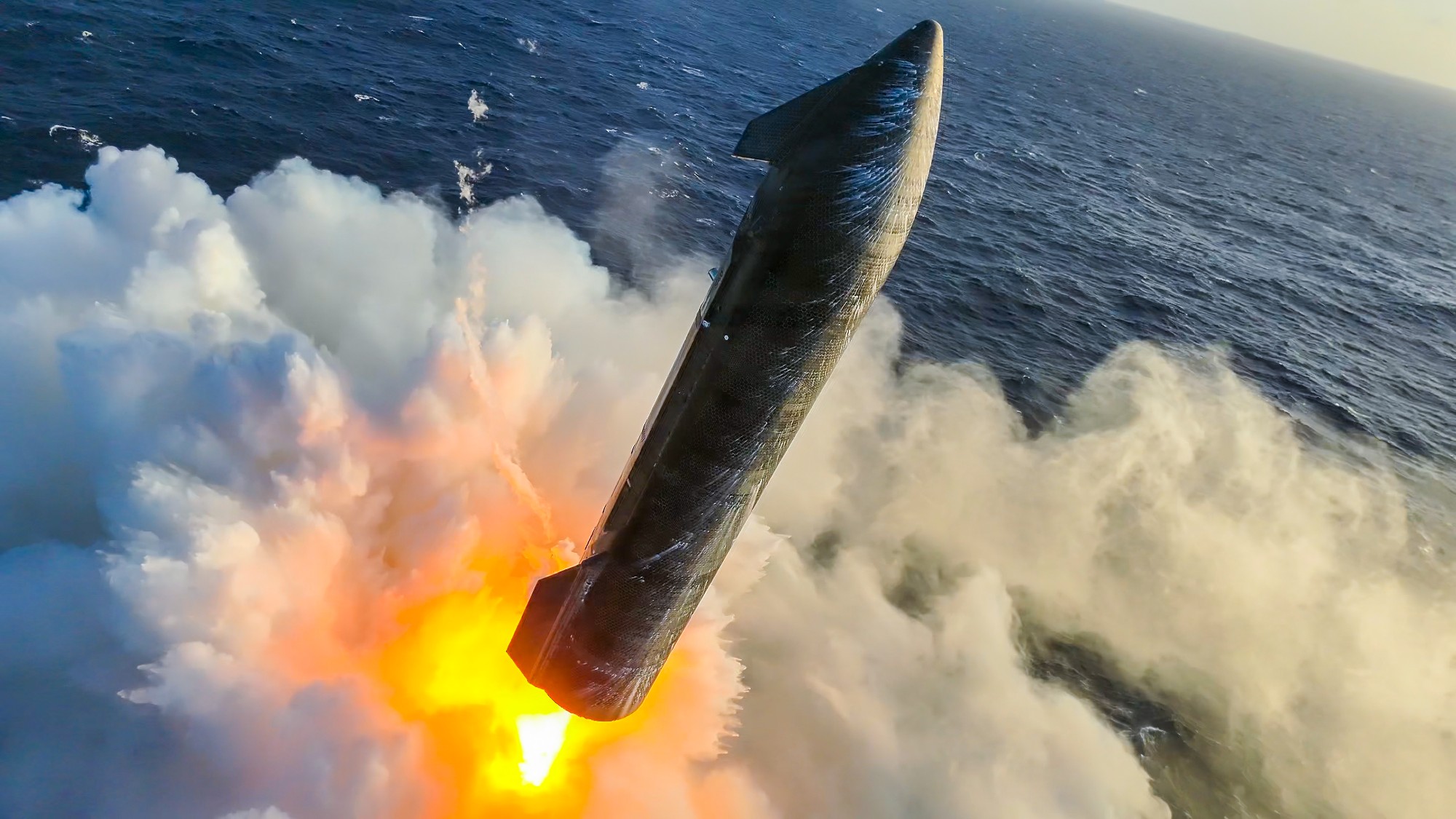
Ship seems to have checked all of its boxes on Flight 13. After deploying the satellites and successfully reigniting one of its Raptors in space, it splashed down on target in the Indian Ocean off the coast of Western Australia about 65 minutes after liftoff.
The vehicle survived its harrowing return trip through Earth's atmosphere in one piece and remains intact today, as far as we know; SpaceX recently shared a photo of the vehicle bobbing in the Indian Ocean five days after splashdown.
But Starship's giant first-stage booster, known as Super Heavy, had a few issues on Flight 13. Its landing burn employed only five of a planned 13 Raptor engines, for example, and the booster hit the waters of the Gulf of Mexico at a higher velocity than intended. (Super Heavy has a total of 33 Raptors, all of which fire at liftoff.)
Starship remains in the development phase, but SpaceX wants to get the megarocket operational soon. It's slated to fly on NASA's Artemis III astronaut mission to low Earth orbit in mid-2027 and to land a crew near the moon's south pole on Artemis IV in late 2028.




 Bengali (Bangladesh) ·
  English (United States) ·