

Chocolate-chip sea stars are famous for the rows of dark, pointy bumps that cover each of their arms. The animals really look like they’re dotted with chocolate chips. But what’s inside their arms is even more surprising, a new study finds.
Researchers have discovered tiny structures deep inside the skeleton at the tip of each arm. These channels work like mini fiber-optic cables. That’s the tech that carries internet signals around the world. In a sea star, these bony structures collect and channel light deep into the animal’s body. They might help a sea star find its way around — if enough light can get through its skin.
The overall effect “looks like short fiber-optic cables made out of their skeleton,” says Sönke Johnsen. “I was really impressed by what they found.” A biophysicist, he studies how animals sense light. He works at Duke University in Durham, N.C. and did not take part in this study.
The chocolate-chip sea star (Protoreaster nodosus) lives in shallow tropical waters. Its five arms grow out from a central disk. A network of small, interlocking plates make up its skeleton. Each plate is made of a chalky mineral called calcite. At the tip of each arm sits a heart-shaped piece called a terminal plate.
Ling Li wasn’t looking for light-guiding structures when he started studying these animals. He’s a materials scientist at the University of Pennsylvania in Philadelphia. His team wanted to know how sea stars build such strong calcite skeletons. It’s a weak and brittle mineral of calcium carbonate, the same stuff used in some classroom chalk.
His team scanned sea stars’ terminal plates with an X-ray machine. This revealed a surprise. Each plate held 90 to 100 cone-shaped structures. Each extends deep into the skeleton. All the cones aim toward a hollow space inside the plate.
“It seems like something purposely made,” Li says. “Very prominent, very consistent.”
Light collectors
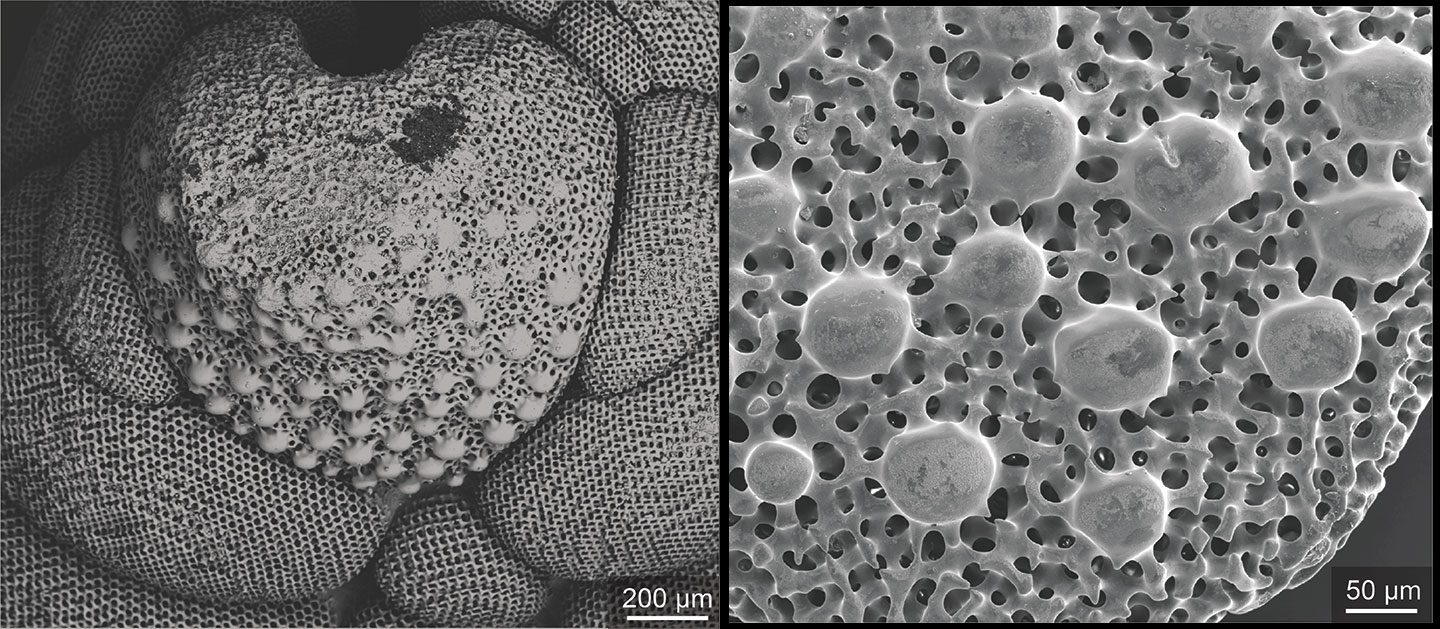
Left: An electron microscope image shows a heart-shaped piece of the skeleton at the tip of a sea star’s arm. Rounded bumps cluster across the surface of this terminal plate.
 Liuni Chen and L. Li
Right: An extreme close-up of the terminal plate shows the rounded tops of the light-channeling cones. Each dome is a point where light enters a cone.
Tiny cables of bone
Each cone is built from a single crystal of calcium carbonate. This mineral bends light more than the surrounding seawater does. Scientists describe it as having a higher refractive index. That means that light hitting the wide part of a cone refracts — bends — inward.
Its angle and the high refractive index make the light bounce back — or reflect — off the cone’s inner walls. This is called total internal reflection. Light bounces within the crystal until it exits out the narrow end of a cone.
“It’s the same physical phenomenon as fiber optics,” says Pupa Gilbert at the University of Wisconsin–Madison. She was not involved in the work. She does, however, study biomineralization (By-oh-min-er-al-ih-ZAY-shun). It’s how living things build structures out of minerals.
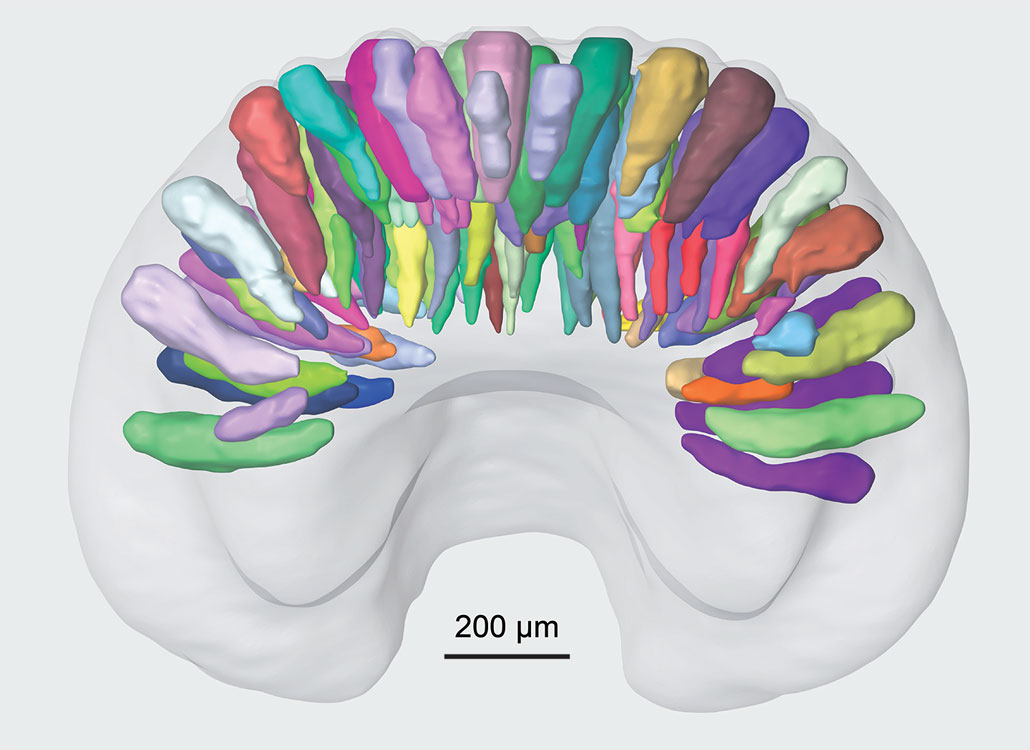 This 3-D reconstruction shows the heart-shaped bony plate at the tip of a sea star’s arm. Each colored shape is one of the roughly 90 to 100 cone-shaped structures scientists found hidden inside. Liuni Chen and L. Li
Each cone transmits about 70 percent of the light that enters it. As light reaches the narrow part of a cone, it’s “concentrated and intensified,” Gilbert says.
All cones in a terminal plate work together, gathering light from one-third of the field of view around it. As cones funnel that light in toward a cavity below, they amplify its intensity as much as eight times.
Li’s team tested the cones in the lab to confirm they channel light. When they shined light at a terminal plate, a bright spot appeared in the cavity below. Other bits of the sea-star skeleton had no such effect. Light shined on them simply scattered. Only the terminal plate’s cones focused light this way.
Li and his team shared these findings on June 8. Their work appears in Proceedings of the National Academy of Sciences.
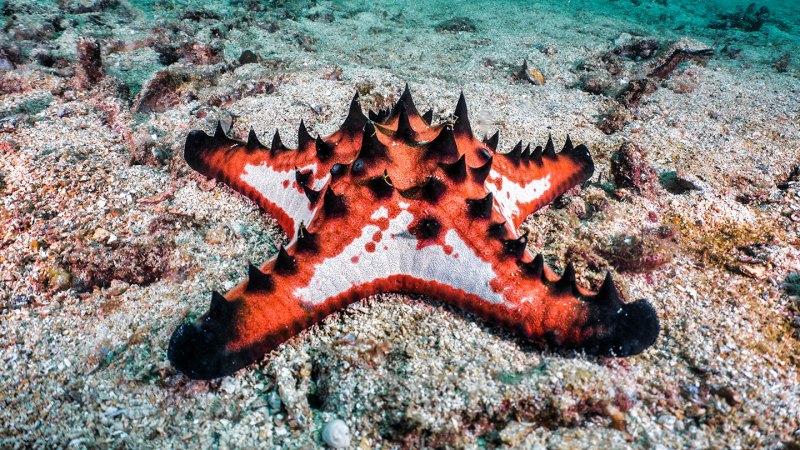 Like other sea stars, the chocolate-chip species can move toward light. Tiny, light-channeling structures in the tips of its five arms might explain how it navigates. Placebo365/E+/Getty Images Plus
Why does the sea star do this?
Sea stars move toward light. It’s a process known as phototaxis (Foh-toh-TAK-sis). Li’s team thinks the cone arrays might explain how they do this. A sea star could compare how much light is reaching the light-collecting plates at the tips of each arm.
“They can compare the illumination level in different directions,” Li says. “So they can detect which side is darker, which side is brighter.” The brightest light would point them to the light’s source.
His team doesn’t know for sure that the animals use the cones this way. For one thing, no one has yet found light-sensitive cells beneath the cones. These would make the light signal useful to the animal. Right now, Gilbert says, “The light detector is the part that’s missing.”
“The optical stuff is interesting,” says Samuel Powell. “But,” he adds, “it doesn’t seem biologically relevant, as far as I can tell.” Powell has spent years studying vision in marine animals. He used to work at the University of Queensland in Brisbane, Australia.
A simple experiment, he says, could help show whether sea stars use their cones to detect light. “Just shine light at the animal. Does it respond?” If it does, that would suggest those cones indeed are helping the animal sense light.
Li’s team plans something like that. In a future study, they aim to cover four of the sea star’s five arms to see if one is enough to use in navigating toward light.
A bonus: tougher armor
Even if the light-sensing idea doesn’t pan out, the cones have one confirmed benefit: strength. Computer models show that these structures about triple the stiffness of the terminal plates compared to other parts of the skeleton.
“A three-times improvement in strength without adding that much material is pretty neat,” says Powell.
Where this bonus strength shows up may be strategic, Johnsen says. “This structure is in the very tip of the arm, which looks quite pointy and thorny,” he notes. The tips are the animal’s most exposed parts. They are the first things to scrape against rocks or catch a predator’s attention. “Having the tips of your spines be extra strong seems like it makes a lot of sense,” Johnsen says.
When engineers design a material, they may build it to be strong, or to transmit light. Rarely would they try for both at once, notes Gilbert. But the sea star may show a way to do just that.
What excites her most is that the cones may do both jobs — channel light and reinforce the skeleton — with a single structure, made of a single material. “You don’t have to make those hard choices,” says Gilbert. “You can find the best compromise and have the same structure perform different functions.” Engineers could use this idea to build lightweight materials that carry loads and deliver light at the same time.
Do you have a science question? We can help!
Submit your question here, and we might answer it an upcoming issue of Science News Explores


 Bengali (Bangladesh) ·
  English (United States) ·