
 1 hour ago
9


Spot silver was $49.1465 and had dropped 5.79% on the day, according to Investing.com. Over the week, the metal depreciated by 8.89%, while it fell by 18.70% from the beginning of October.
The selling came after the Federal Reserve on Oct. 28 raised interest rates in its policy meeting and reignited inflation fears. With the prospect of silver’s recovery being determined by the interplay between monetary policy, political uncertainty and industrial demand before December, investors are now considering all three factors.
October Fed Decision Leaves December Rate Risks Unresolved
On October 28, the Federal Reserve left its benchmark interest rate policy unchanged at 3.75%–4.00%. The vote was 10-2 to decide, with two policymakers deciding to raise a quarter point. The Fed pointed to “resilient economic activity,” solid productivity and “elevated inflation.
Federal Reserve publishes statement of the FOMC meeting
The ruling did not put an end to hopes for additional narrowing. If inflation continues and economic growth remains robust, then rates may remain high and offer a higher opportunity cost of having no income generated from silver. Rising borrowing costs can also strain industrial demand by reducing economic activity.
The next meeting of the FOMC is December 8-9. Investors will be watching the inflation reading, employment data and the outlook of the policymakers for clues as to the next move. A rate rise would likely put pressure on silver, whereas a rate hold will help its recovery if inflation also slows.
Technical Indicators Show Deepening Selling Pressure
Silver has fallen from just above $53 to around $49.15 on the chart that was provided by Investing.com. The metal dabbled around the $48.90 mark before settling again at the end of the session. During the previous month, it lost 18.70%, and during the past six months, it lost 33.40%.
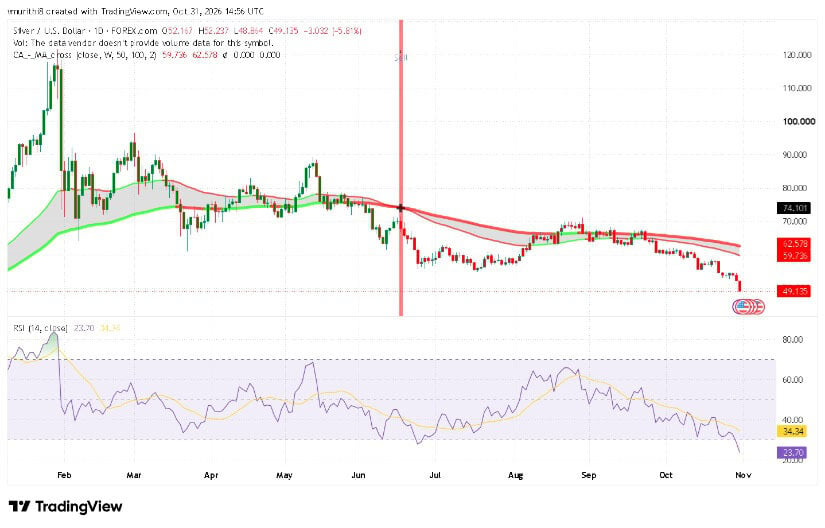 The silver price was $49.135 on TradingView on October 31, falling 5.81%. The price is trading below its 20-day moving averages, $59.736 and $62.578, respectively. Both were trending down, and that was a continuation of the bearish trend. Source: TradingView
RSI dropped to 23.70, which was below its signal average of 34.34. Readings below 30 typically represent oversold conditions. But oversold readings are not always accompanied by an immediate turnaround, especially during prolonged periods of selling.
The next downside reference is the $48.86 intraday low. Silver may be further trying to break below the level, suggesting a continued decline in the price of the precious metal. A recovery above $50 would signal initial stabilisation, and a recovery of $59.74 would show more that things are going well.
Midterm Elections Add Uncertainty to December’s Silver Outlook
Another market catalyst is coming up on Tuesday, November 3, with the US midterm elections. Congressional changes may impact fiscal talks and trade negotiations as well as investor expectations. But election results are not the sole factor affecting silver prices; their impact is tied to how they affect the dollar, Treasury yields and economic expectations.
Silver has upside potential in November as markets should price in further monetary policy tightening and inflation may hold. Silver is used in the manufacturing sector, so if consumers don’t have the money to invest, continued weakness in industrial demand could pressure prices.
There are two general cases for December.
Should inflation slow and the Fed hint at an end to the rate-hike cycle, silver may find support around the $55 level and continue to rally to the $60 level. If expectations of rates increase and inflation continues to persist, prices may reach the low end of the $48 range or drop further.
These levels are not guaranteed, but depend on the scenarios. Before identifying a rebound, investors need to watch the dollar, real yields, industrial demand and the December Fed decision.




 Bengali (Bangladesh) ·
 English (United States) ·