

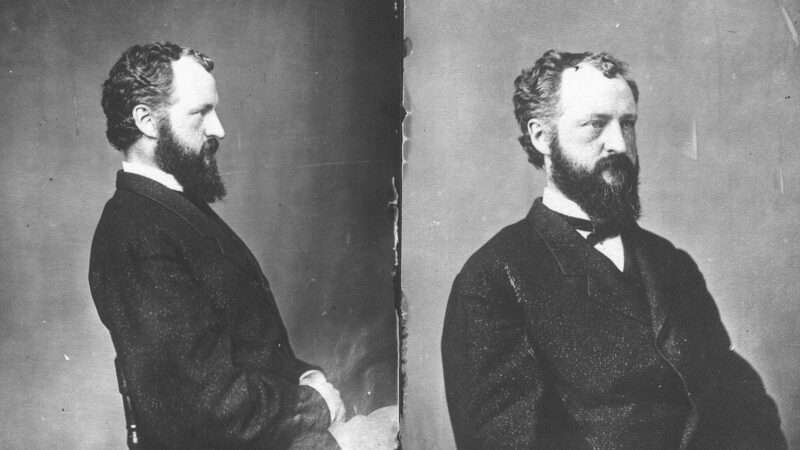
It was May 7, 1873, and President Ulysses S. Grant had a big job opening that he needed to fill and soon. Salmon P. Chase, the great antislavery lawyer who had been appointed chief justice of the United States by President Abraham Lincoln, had just died at his home in Washington, D.C., after suffering what was probably a stroke. That left a vacancy atop the highest court in the land. Who would Grant pick to fill it?
Roscoe Conkling was a U.S. senator from New York and the undisputed boss of the Empire State's notorious Republican political operation. To say that Conkling knew a thing or two about dispensing political favors via patronage and graft would be a staggering understatement. "We are told the Republican party is a machine," Conkling declared. "Yes. A government is a machine…a political party is a machine." According to the journalist George Smalley of the New-York Tribune, Conkling once "talked long on, or rather against, civil service reform and in favor of the practice summed up in the maxim that to the victors belong the spoils."
Conkling was also a steadfast political ally of Grant's, and the president thus offered him the job of chief justice as a sort of thank you for services rendered to the Grand Old Party. This was not such an unusual move at the time, as plum judicial appointments often went to politicians in those days rather than to purely legal figures. But the Conkling pick was still an eyebrow-raiser given the senator's scurrilous renown as a master of the spoils system.
In the end, Conkling lived up to his low reputation by turning the job down. "I could not take the place," he explained about declining to serve as chief justice, "for I would be forever gnawing my chains." Conkling was quite content to remain exactly where he was, shaping national affairs and operating the levers of power from his prized perch in the Senate.
Remarkably, that offering from Grant was not even the last time that Conkling was gifted a Supreme Court appointment. In 1882, President Chester A. Arthur, a former crony of Conkling's who had once helped to rake in the spoils as collector of customs at the Port of New York, nominated Conkling to serve as an associate justice of the Supreme Court. And the Senate then dutifully confirmed Conkling by a vote of 39 to 12. If he had wanted it, the SCOTUS job would have been Conkling's for life.
But old Roscoe apparently still preferred a life of wheeling and dealing to the "chains" of a Supreme Court seat. Five days after the Senate confirmed him, he officially rejected it.
It's hard to imagine a saga like that unfolding today. Not the part about a corrupt politician exploiting the system (that's not hard to imagine at all), but the part about a canny political tactician recognizing that he could wield far more power from the Senate than he ever could from the Supreme Court.
In our own time, after all, Congress is effectively AWOL while virtually every political fight that matters on the federal level is being fought between the executive and the judiciary. I wonder if an ambitious rogue of Conkling's caliber would even bother to stick around in today's poor excuse for a Congress, given the fact that the legislative branch is now barely worth mentioning except as an object of pity or scorn.
Congress was once a powerful player in American life. But as the Conkling story shows, that era now feels like something out of ancient history.
The post Roscoe Conkling, the Political Boss Who Twice Declined a Supreme Court Appointment appeared first on Reason.com.





 Bengali (Bangladesh) ·
  English (United States) ·