

What You Should Know
The U.S. Food and Drug Administration (FDA) has cleared Roche’s Elecsys® Phospho-Tau (217P) Plasma (pTau217) blood test, developed in strategic collaboration with Eli Lilly and Company.It is the first and only FDA-cleared, single-biomarker blood test supporting both rule-in and rule-out assessment of amyloid pathology associated with Alzheimer’s disease using the exact same validated clinical cutoffs across both primary care and specialty neurology settings.The test is indicated for individuals 55 years of age and older presenting with signs, symptoms, or clinical complaints of cognitive decline, categorizing results into positive, intermediate, or negative likelihood of amyloid pathology.The assay eliminates the immediate need for expensive amyloid positron emission tomography (PET) imaging or invasive cerebrospinal fluid (CSF) lumbar punctures for initial triage, triaging patients earlier in disease progression.Elecsys pTau217 runs on Roche’s installed base of more than 4,500 cobas® immunoassay instruments across U.S. clinical laboratories, enabling rapid nationwide scaling without requiring new hardware procurement.Historic FDA Clearance for Elecsys pTau217 Blood Test
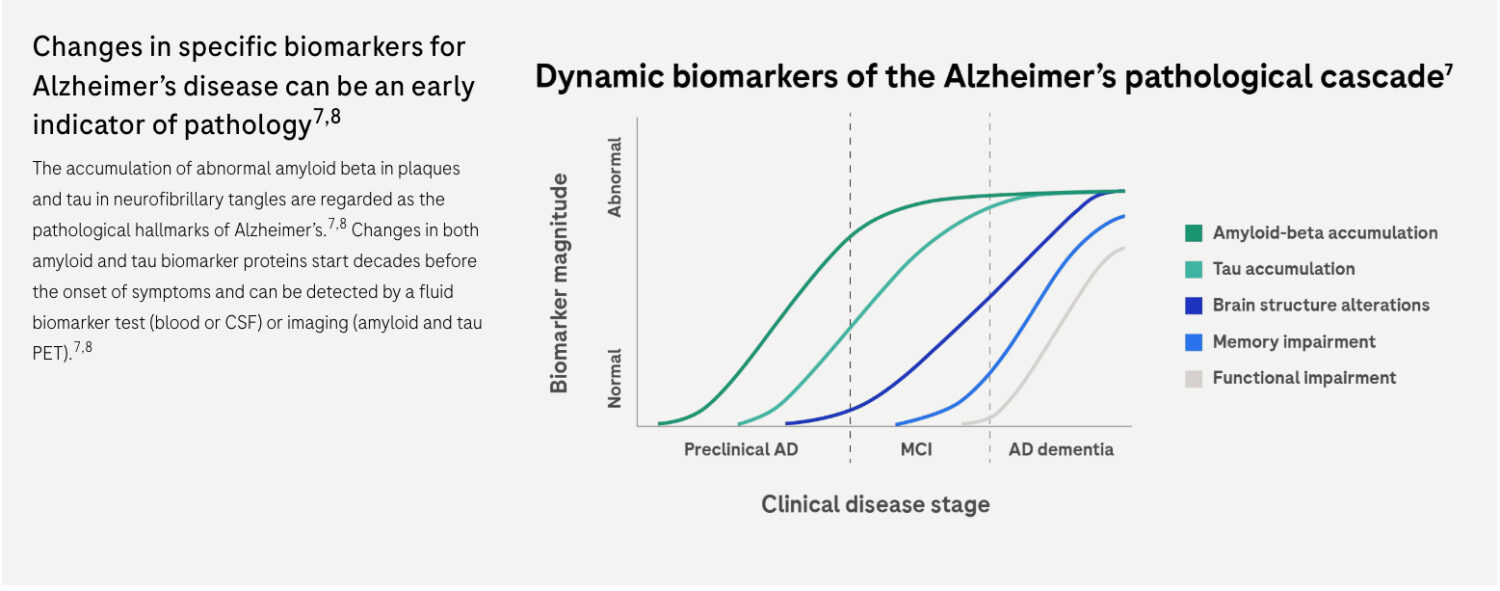
Diagnosing Alzheimer’s disease has historically run into an operational bottleneck: roughly 75% of dementia cases go undiagnosed globally, largely because confirming brain amyloid beta pathology has required either an invasive lumbar puncture for cerebrospinal fluid (CSF) or an expensive, hard-to-access amyloid PET scan. Because primary care clinics lack objective, routine screening tools, patients often spend months on neurology waitlists, missing the early therapeutic window when disease-modifying therapies are most effective.
To solve this access gap, Roche and Eli Lilly have received FDA 510(k) clearance for the Elecsys® Phospho-Tau (217P) Plasma (pTau217) blood test. It is the first and only FDA-cleared, single-biomarker plasma assay designed to both rule in and rule out amyloid pathology across primary and specialty care settings using identical numerical cutoffs.
What Changes for Clinical and Laboratory Workflows
Routine Blood-Based Triaging: Evaluated in patients aged 55 and older presenting with cognitive symptoms, the test replaces spinal taps and baseline PET scans with a standard peripheral blood draw that yields a three-tier result (positive, intermediate, or negative likelihood of amyloid pathology).Immediate Scalability Across 4,500+ Analyzers: The assay runs natively on Roche’s existing installed base of more than 4,500 cobas® analyzers in the U.S. (with distribution supported by national reference labs like Quest Diagnostics and Labcorp), removing the need for health systems to buy new capital equipment.Streamlined Referral Pipelines: Primary care physicians can objectively rule out amyloid involvement in non-Alzheimer’s cognitive decline, while accelerating high-probability patients toward confirmatory imaging, neurology consults, and anti-amyloid therapies.Portfolio Alignment: The diagnostic complements Lilly’s neuroscience portfolio and Roche’s investigational pipeline, including trontinemab (a Phase III Brainshuttle monoclonal antibody) and nivegacetor (an oral Phase II gamma-secretase modulator).
“For decades, clinicians have faced significant challenges in accurately diagnosing Alzheimer’s disease in its early stages. While PET imaging and cerebrospinal fluid biomarkers can confirm amyloid pathology in patients with cognitive impairment, these approaches may be costly, invasive and not readily accessible for many patients,” said Jared R. Brosch, M.D., Neurologist, Indiana University Health. “Advances in blood-based biomarkers have the potential to transform the diagnostic pathway by expanding access to evaluation for Alzheimer’s across a variety of care settings. As these tools become available, clinicians may be able to evaluate more patients earlier in the disease course, improving diagnostic confidence and helping patients and their families make more informed decisions at a critical time.”



 Bengali (Bangladesh) ·
  English (United States) ·