
 1 month ago
28
1 month ago
28 
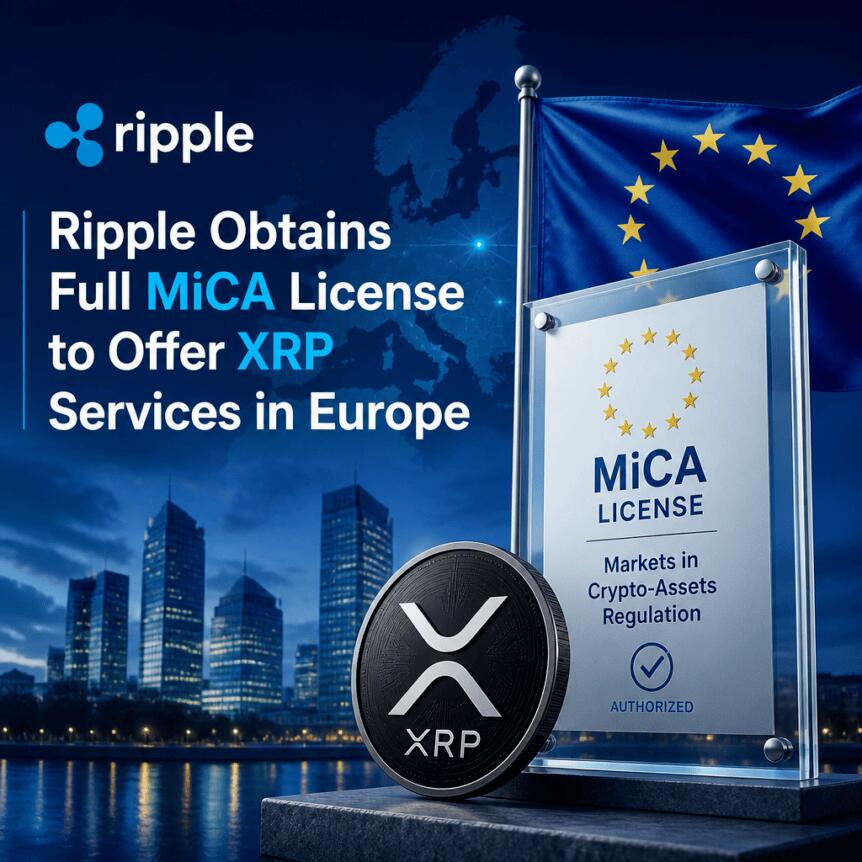
Ripple has received full authorization under the European Union’s Markets in Crypto-Assets (MiCA) framework after Luxembourg’s financial regulator granted the company a Crypto Asset Service Provider (CASP) license. The approval follows Ripple’s preliminary CASP approval earlier this year and, according to the company, completes its transition into the “post-transitional” MiCA regime.
The CASP authorization, combined with Ripple’s existing Electronic Money Institution (EMI) license, allows the blockchain payments firm to provide regulated crypto-asset services across the European Economic Area (EEA) under EU rules.
Key takeaways
Ripple secured a CASP license in Luxembourg, completing its full MiCA authorization after preliminary approval in June. The authorization enables regulated crypto-asset services across the EEA, supported by Ripple’s existing EMI license. Ripple says it is among a relatively small group of firms fully authorized under MiCA. MiCA enforcement has begun across the EU, with ESMA maintaining an updated register of licensed providers and national regulators handling supervision. ESMA’s latest CASP register shows licensed providers rising to 280 after 37 firms were added following the July 1 transition deadline.Ripple’s MiCA authorization and what it enables
Ripple said it has now obtained full authorization under MiCA after Luxembourg’s regulator granted it a CASP license. The company previously received preliminary approval in June, and Ripple framed the new authorization as the end of its transition period under the EU framework.
In a statement, Cassie Craddock, Ripple’s managing director for the United Kingdom and Europe, said the CASP authorization means Ripple is “fully compliant” with MiCA and prepared to scale its operations.
For market participants, the practical significance of a MiCA CASP license is that it positions a crypto-asset service provider to operate as a regulated entity inside the EU’s MiCA system. Ripple’s mention of its additional EMI license is notable because it reflects that the company is not relying solely on the crypto-asset authorization path; instead, it brings together licensing coverage that can support a broader regulated service offering.
From transition to enforcement: MiCA’s July 1 deadline
Ripple’s authorization comes after the EU’s MiCA transition period ended on July 1. Under the framework, firms offering regulated crypto-asset services in the bloc needed authorization; otherwise, they were expected to stop offering such services.
MiCA also introduces an important structural change for authorized providers: in many cases, a single authorization can support “passporting” across the EEA, reducing the need for separate approvals in each member state. That is the mechanism Ripple is effectively leaning on, given its statement that it can offer regulated crypto-asset services across the EEA.
While licensing outcomes have improved since the deadline, the enforcement phase is now active. ESMA coordinates aspects of supervision through the register of authorized entities, but the day-to-day regulatory enforcement is carried out by national authorities—meaning implementation and pressure levels can differ across EU member states.
ESMA register update: licensed CASPs rise to 280
According to ESMA’s updated register, the number of licensed crypto-asset service providers stands at 280. The figure increased from 243 a week earlier after 37 additional companies were added, including Standard Chartered, FalconX and Sygnum Europe, as reported in the coverage linked from Cointelegraph.
This incremental jump matters for investors and counterparties because ESMA’s register acts as a key reference point for determining which entities are authorized to operate under MiCA. However, the register’s growth also highlights the uneven pace of authorization as firms work through licensing processes close to major deadlines.
Not all major players secured authorization before July 1. The source notes that Binance withdrew its MiCA application in Greece ahead of the transition and said it would pursue authorization elsewhere while working toward compliance.
Regulators step up: Belgium highlights unauthorized providers
With MiCA moving into enforcement, regulators at the member-state level have begun taking action. Belgium’s Financial Services and Markets Authority (FSMA) has already started applying the new rules.
On Monday, FSMA identified six crypto-asset service providers that it said were operating without authorization and added them to its list of unauthorized crypto-asset service providers, according to the coverage linked from Cointelegraph. The regulator also issued warnings to consumers and market participants about unauthorized platforms, underscoring that the transition is no longer a planning phase—it is an active compliance test.
For users and institutions working with EU-facing crypto service providers, this is a reminder that regulatory status is becoming a central operational variable. Authorization and supervision may be decisive factors for risk management, counterparties, and product availability.
Looking ahead, the key watch items are how quickly the authorization gap closes across remaining providers, how national regulators interpret and apply MiCA enforcement in practice, and whether additional major exchanges and service platforms reach full CASP authorization under the EU framework.
This article was originally published as Ripple Obtains Full MiCA License to Offer XRP Services in Europe on Crypto Breaking News – your trusted source for crypto news, Bitcoin news, and blockchain updates.




 Bengali (Bangladesh) ·
  English (United States) ·