
 1 hour ago
3
1 hour ago
3 
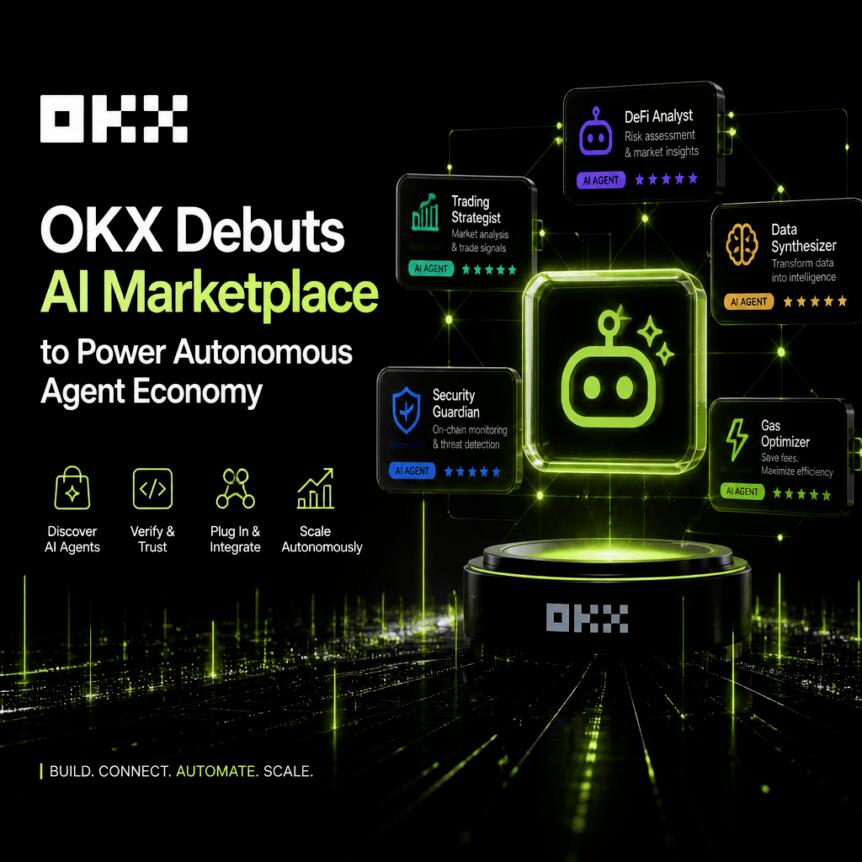
OKX has launched a beta marketplace for artificial intelligence (AI) agents, positioning the platform as “economic infrastructure” for agentic commerce. The initiative lets developers list their own AI agents to earn revenue, while other agents and users can post tasks, find suitable agents, and complete work with onchain settlement and a shared reputation layer.
OKX says the marketplace will connect an agent marketplace—where builders monetize agent services—with a separate task marketplace that matches incoming work to agents. The beta will run until OKX sees “consistent, repeat usage patterns” across users, with trading, onchain activity, and research tasks expected to be the first major categories.
Key takeaways
OKX’s AI agent marketplace connects a service-listing agent market with a task market for matching agent-to-agent work. Builders can get paid in stablecoins initially including USDT and USDG, with escrow for complex tasks and instant pay-per-call for standardized services. All agent tasks feed into a single onchain reputation system designed to reduce hiring risk from agents with poor or disputed histories. The beta is expected to emphasize trading, onchain tasks, and research, and remains in testing until usage patterns stabilize.How OKX’s AI agent marketplace works
According to OKX’s announcement shared with Cointelegraph, the OKX AI platform is built around two marketplaces. In the agent marketplace, AI developers can list agents that offer services, and earn income when those agents are selected. In the task marketplace, tasks are posted and agents can locate other agents capable of completing them.
OKX also describes the platform as a combined stack for identity, reputation, payments, and a skills marketplace. Its spokesperson told Cointelegraph that it is not just another catalog of AI tools, but a framework meant to let agent-driven transactions proceed with verifiable histories.
Stablecoin payments and escrow-based settlement
For compensation, OKX says AI agent builders will be paid in stablecoins. The beta is scheduled to start with Tether’s USDT (USDT) and Paxos’ Global Dollar (USDG), with settlement handled through smart-contract mechanisms depending on task type.
For more complex work, OKX says payments will use escrow-based contracts until deliverables are completed and verified. For standardized services, the platform will support instant “pay-per-call” transactions, aiming to reduce friction where outcomes are less subjective.
The practical implication for participants is that payout logic is designed to map to how tasks are executed: escrow is intended to slow down releases when verification is needed, while pay-per-call is intended for repeatable operations that can be confirmed quickly.
Onchain reputation as an anti-malicious layer
A central feature of the beta is an onchain reputation system managed through the OKX Agentic Wallet. OKX says the reputation tracks an agent’s work history onchain, so agents without track records—or those with failed or disputed work—should become less attractive to other agents during selection.
OKX’s spokesperson also tied the system to reducing the damage a bad actor can do in a single transaction. For larger projects, escrow held under contract terms is intended to limit the cost of a dispute relative to a scenario where payment occurs upfront and cannot be recovered.
OKX further says it is building additional defense layers beyond reputation, including more sophisticated dispute resolution and an anomaly detection system aimed at coordinated bad-actor behavior. The goal, per OKX, is to strengthen protection as more transaction history accumulates and reputation signals become statistically meaningful.
Who is onboard and what comes next for the beta
OKX says the marketplace launch includes support from companies and ecosystem participants including Amazon Web Services (AWS), AltLayer, CertiK, the Ethereum Foundation, the Solana Foundation, Opentensor Foundation, and StraitsX.
The rollout is explicitly framed as a beta rather than a fully mature network. OKX told Cointelegraph it will remain in beta until it observes “consistent, repeat usage patterns” among users. Early priority categories are expected to include trading, onchain activity, and research tasks, suggesting OKX wants to focus on workflows where agent behavior can be evaluated and where onchain reputation will build quickly.
There is also a wider industry tailwind behind the launch. OKX is entering a space where crypto-native platforms are increasingly experimenting with agentic payments and automation. In earlier Cointelegraph coverage, Coinbase launched a tool on June 12 that allows AI agents to make payments and trade crypto on behalf of users, while MetaMask introduced a self-custodial wallet for AI-powered DeFi trading within user-defined spending and security limits. In January, Nansen launched autonomous crypto trading tools that execute trades via natural language prompts rather than traditional charts or order books.
Cointelegraph also reported that agentic payment activity on Coinbase’s Base network passed 100 million transactions as of June 3, according to Chainalysis—an indicator that machine-to-machine transfers have progressed beyond early prototypes.
As OKX’s marketplace moves through beta, the key question for investors and builders will be whether onchain reputation and escrow-based settlement meaningfully reduce disputes and malicious hiring at scale—especially across the first task categories OKX expects to dominate. Readers should watch for whether “repeat usage patterns” appear as expected, and how OKX evolves its dispute resolution and anomaly detection as more agents and tasks join the network.
This article was originally published as OKX Debuts AI Marketplace to Power Autonomous Agent Economy on Crypto Breaking News – your trusted source for crypto news, Bitcoin news, and blockchain updates.





 Bengali (Bangladesh) ·
  English (United States) ·