

For years, scientists have been calculating how much matter should exist in our universe. But more than half of it didn’t appear to be showing up in telescope images. Now an explanation for why is emerging. The “missing” matter is just too diffuse — or spread out — to see. Some of it may not even be made of complete atoms.
“The missing matter exists as a thin gas that’s very spread out,” says Haochen Wang. Wang works at the Massachusetts Institute of Technology in Cambridge. A PhD student in astrophysics, he led the new study. Think of the missing matter, he says, as faint clouds. They’re huge, stretching far beyond the edges of galaxies.
This missing matter is considered ordinary. By that, scientists mean it’s made of everyday particles called baryons. Those include the protons and neutrons that make up stars, planets and people. Ordinary matter is quite different from another type of unseen stuff called “dark matter.” That’s a mysterious substance that doesn’t emit, reflect or absorb light at all. (Scientists only know it’s there because its gravity pulls on other things.)
In some spots, Wang says, the unseen ordinary matter is so spread out that there’s less than one proton or electron in a space about the size of a washing machine. That, he explains, is why finding it has proven “such a hard puzzle to solve.”
Radioing in the solution
To find this diffuse matter, Wang’s group focused on fast radio bursts, or FRBs. Each of these very intense bursts of radio waves lasts about one-thousandth of a second. They flare up somewhere in the far-off universe, then vanish.
As an FRB races toward Earth, it passes through the gas floating between galaxies. That gas, the missing matter, stretches out an FRB’s radio light, Wang explains.
This separates a distant FRB’s light into distinct wavelengths. It’s a bit similar to the way a prism splits white light into a rainbow. When radio waves travel through gas, those with longer wavelengths move more slowly than shorter-wavelength ones. And the difference in their speed grows ever larger as FRBs travel through more matter.
Overall, that change in speed still “is a really small effect,” says astrophysicist Liam Connor. He works at Harvard University in Cambridge, Mass. But “over billions of years of traveling through this … matter, it becomes a detectable effect here on Earth.”
Telescopes pick up a stretched-out signal, where short-wavelength radio waves arrive first, and longer wavelengths trail behind. “The more missing matter the signal goes through,” Connor says, “the more stretched it gets.”
The new findings appear in the July Physical Review Letters.
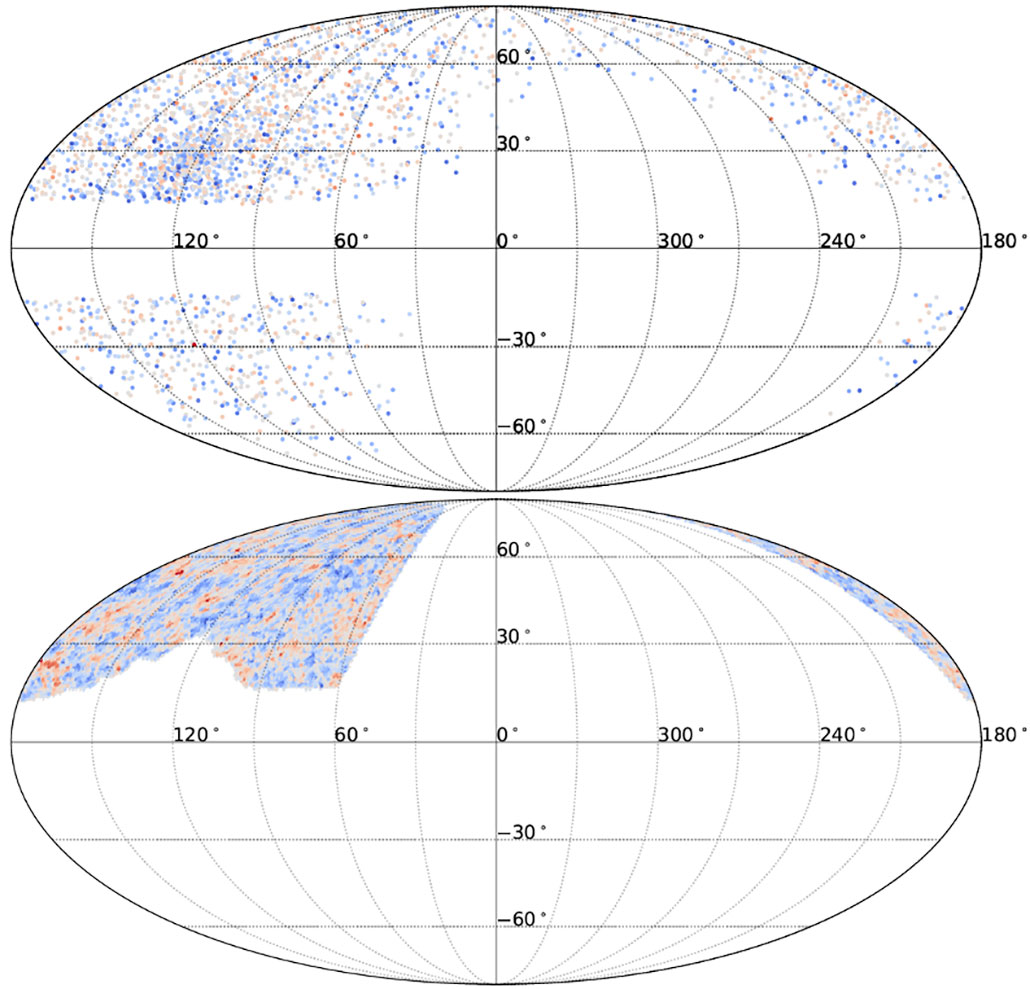 The upper map shows where fast radio bursts have been spotted across the sky. The lower map shows how galaxies are spread across the sky. The new study found a significant correlation between the two maps. The comparison turned up formerly missing “ordinary” matter in our universe. H. Wang/CHIME/FRB and DESI data
Builds on other work
Connor is part of a different team that’s been searching for the missing matter. Last year, his group measured how much each FRB reaching Earth had stretched. The scientists did this by comparing FRB data to a computer model.
This allowed the team to calculate how much gas the radio waves had passed through. It also pointed to roughly where that gas was. A 2025 study in Nature Astronomy estimated how much missing matter sits between, around and inside galaxies.
Also last year, another team directly detected one specific filament of hot gas. It linked several galaxy clusters and is thought to contain some of the missing ordinary matter. The team, led by Konstantinos Migkas at Leiden University in the Netherlands, used X-rays rather than FRBs to find this gas.
Do you have a science question? We can help!
Submit your question here, and we might answer it an upcoming issue of Science News Explores
Now Wang’s team has directly measured how far gas typically stretches around galaxies. Unlike Connor’s group, they did this without leaning on a computer model to fill in the picture. They say it’s the first definitive detection of the missing ordinary matter.
Vikram Ravi is hesitant to call it the first. An astronomer, Ravi works at the California Institute of Technology in Pasadena. Connor’s 2025 work, he says, at least hinted the gas was out there — even if no one had directly measured its reach. Ravi also points out that some of the new study’s numbers could be off, if the FRBs’ distances weren’t measured precisely enough.
Still, he considers the latest work “a great signpost of what is to come.”
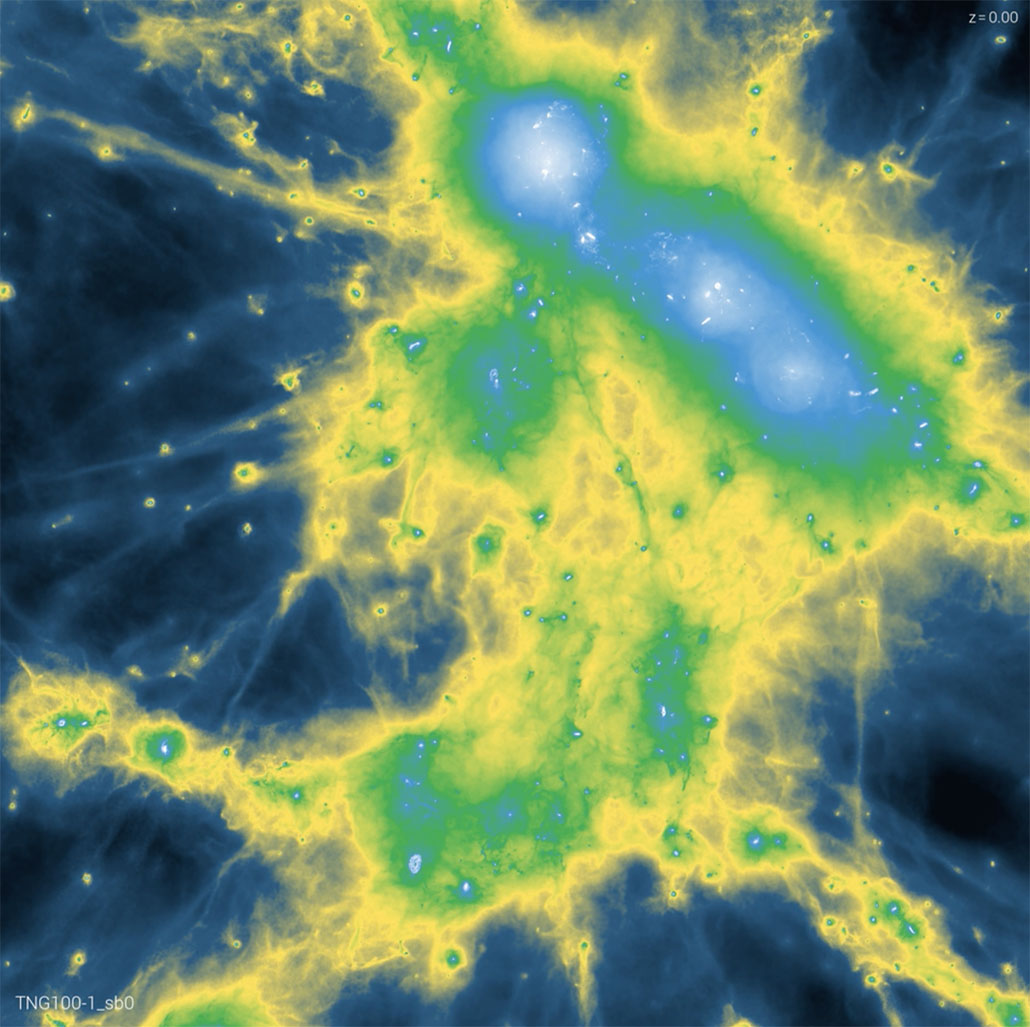 This image shows a model of how diffuse gas (colored blue, green and yellow) is spread around galaxies (white dots on the image). A new study reports that this gas extends much farther out from galaxies than earlier research had suggested.Illustris/TNG Collaboration
What the new findings show
Wang’s group studied 2,870 FRBs. All had been detected by the CHIME radio telescope in British Columbia, Canada. The team compared these bursts to the known locations of nearly 6 million galaxies. The galaxies had been mapped by the Dark Energy Spectroscopic Instrument, or DESI. It sits atop Manzanita Shrub Mountain in Arizona.
To identify where the missing gas is, the researchers lined up each stretched-out FRB across the galaxy map.
The gas doesn’t cling tightly to galaxies the way gravity alone might suggest. Instead, the diffuse matter puffs outward in thin clouds. Some clouds extend roughly 4 million light-years beyond a galaxy’s edge. That’s much farther than most computer models had predicted.
Explainer: Stars and their families
“Just like fountains that can spout water, there must be activities in galaxies that can push gas out to a large distance, despite gravity’s pull,” Wang says. What might they be? Perhaps jets, he says, that black holes blast out as they’re feeding. Or maybe they’re supernovas, explosions from dying stars. Whatever the sources, they’re exerting more force than scientists had suspected.
Victoria Kaspi is a physicist at McGill University in Montreal, Canada, who worked with Wang on the new study. She thinks their approach to mapping diffuse matter could change how astronomers study the universe. FRBs, she says, “are amazingly effective” in probing how matter is distributed across the cosmos.
Why it matters
Knowing where ordinary matter hides is important. Astronomers map it to understand how galaxies form, evolve and interact with their environment. They also use these matter maps in their search for other unknown phenomena, such as dark energy and dark matter (which is believed to make up the vast majority of our universe).
If the “normal” matter map is wrong, these bigger puzzles get even harder to solve.
The new study is “an exciting and impressive work,” says Connor. “I think it’s a sign of good things to come for the application of FRBs to mapping the cosmic baryons.”
New radio telescopes are also being built. They should be able to pinpoint FRBs far more precisely. In the coming years, these telescopes could boost the number of recorded FRBs 100 times or more.
Ravi’s team, among others, is already preparing to use larger FRB catalogs in hopes of making even sharper maps of cosmic gas.
“The more FRBs we find,” Wang says, “the more accurate our answers on the missing matter will become. That includes the powerful galactic forces shaping it.”




 Bengali (Bangladesh) ·
 English (United States) ·