

Europe's Mars Express orbiter has captured new, stunning imagery flying low over a geological region of the Red Planet shaped by ancient waterflow billions of years ago.
Mars Express launched in 2003 and is operated by the European Space Agency (ESA). It's equipped with the High Resolution Stereo Camera, which scans multiple points of perspective across regions of Mars' surface to create 3D color renderings. During a low pass on the spacecraft's highly elliptical orbit, Mars Express flew over the planet's Southern Highlands and Schiaparelli Crater — one of Mars' largest impact sites.
Schiaparelli Crater is located in a heavily cratered region of Mars' Southern Highlands, where a wetter and warmer climate supported water flows that shaped the planet's geography 3.7 billion years ago, according to ESA's Mars Express video. Schiaparelli measures more than 285 miles (460 km) across, and has a bit of fictional fame. The crater happens to be the site where astronaut character Mark Watney gets stranded in Andy Weir's "The Martian". It also shares a namesake with ESA's real-life Schiaparelli Mars lander, which crashed on Mars' surface in 2016 (but wasn't headed for Schiaparelli Crater).
The wide strip of land in Utopia Planitia imaged by Mars Express. The dark volcanic material is on the right, while grabens can be seen on the left. (Image credit: European Space Agency)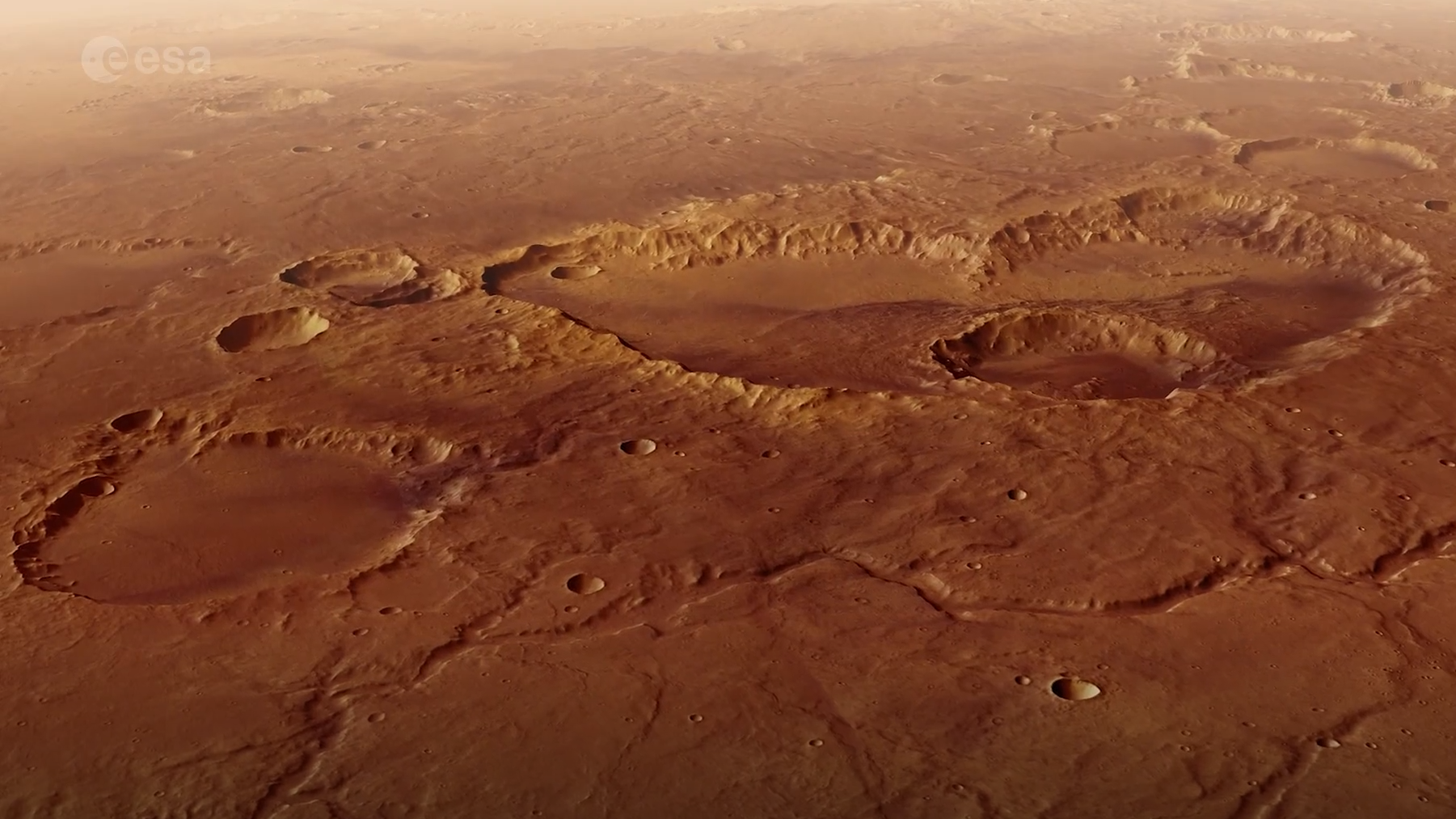
Both are named for Italian astronomer Giovanni Schiaparelli (1835–1910), who made detailed observations of Mars during the planet's closest approach in 1877. Schiaparelli created a map of "canali," Italian for "channels," he saw as dark lines across its surface, which he assumed were filled with water. That was later mistranslated by English-speaking astronomers as "canals," leading to speculation about intelligent life on Mars constructing artificial structures.
Though that hypothesis for Mars' surface features was disproven by later astronomers (to date, there have been no discoveries on Mars that suggest intelligent life once lived there), it has since been discovered that Mars once did have active bodies of water on its surface. Schiarapelli's contributions to the astronomical field were significant enough to land him the honor of a Martian crater in his name.
Despite its massive diameter, Schiaparelli is considered shallow compared to other Martian craters its size. It was once much deeper, but sediment deposited by wind and ancient water flows, volcanic eruptions and asteroid impact debris have filled the crater over the last several billion years.
In addition to showcasing Mars Express' new footage, the ESA video also provides an explanation for how the satellite uses its High Resolution Stereo Camera to observe five simultaneous viewing angles over a four-color spectrum as it flies low over the planet. The low-orbit passes allow Mars Express to capture swaths of 3D data that span hundreds to thousands of miles long and dozens of miles across. Those are then stitched together to form more complete regional maps, which can be added to scientists' increasingly complex model of the entire Martian globe.





 Bengali (Bangladesh) ·
  English (United States) ·