
 4 weeks ago
19
4 weeks ago
19 
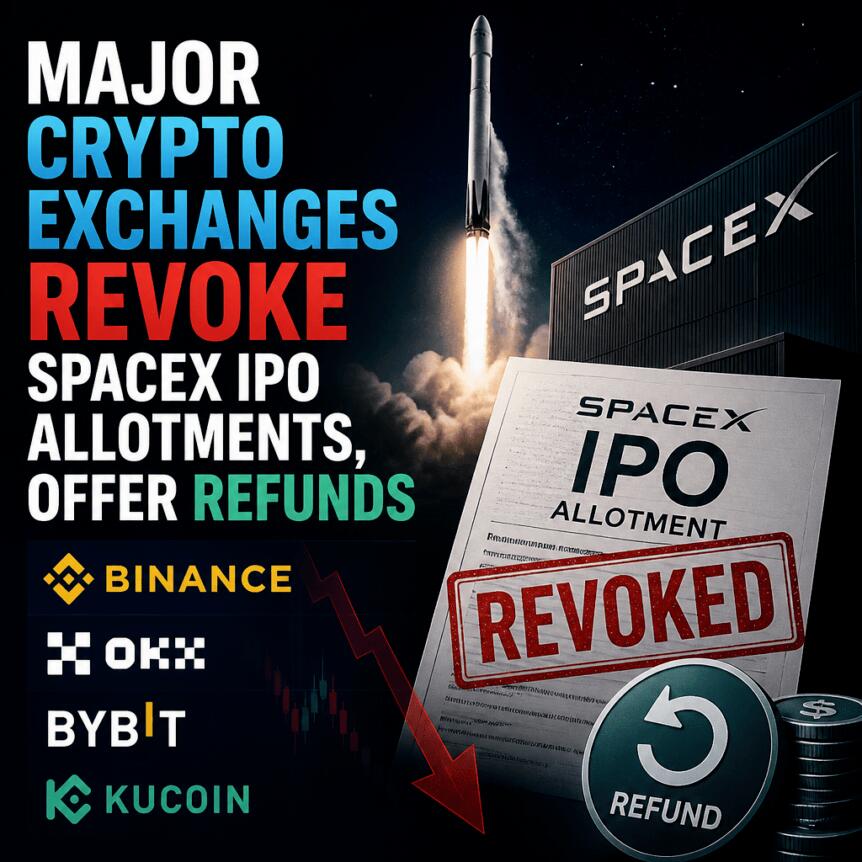
Several major crypto trading and wallet platforms have canceled their tokenized SpaceX IPO campaigns after SpaceX began trading publicly on the Nasdaq. Bybit, Binance, Bitget Wallet and MEXC all pointed to problems in securing underlying allocations, leaving subscribers without the expected access and triggering refunds in some cases.
SpaceX’s IPO, reported as more than four times oversubscribed, raised $75 billion and valued the company at more than $2 trillion on its first day. Shares opened at $150, rose from the $135 IPO price, and closed at $161.11 on Friday.
Key takeaways
Bybit, Binance, Bitget Wallet and MEXC canceled their tokenized SpaceX IPO offerings once allocations could not be fulfilled. Multiple platforms blamed xStocks’ inability to deliver the underlying assets needed to distribute SpaceX tokenized IPO allocations. Binance’s campaign had reportedly attracted more than $557 million in USDC deposits before being halted. Bitget Wallet and MEXC stated they would refund affected users.Tokenized IPO campaigns lose the allocation race
As SpaceX transitioned from private markets to public trading, crypto platforms offering tokenized access attempted to translate that demand into participation for their users. But once the IPO went live, these campaigns ran into a practical bottleneck: they could not obtain SpaceX allocations through xStocks, the entity involved in distributing the tokenized exposure.
According to Bybit’s announcement, the firm did not receive any SpaceX allocations due to xStocks’ failure to deliver the underlying assets. In that situation, Bybit said subscribed users would not receive SpaceX allocations despite the earlier subscription process.
Bybit says xStocks delivery issues stopped allocations
Bybit was among the earliest platforms to market tokenized IPO participation with its Bybit IPO Express, which included a SpaceX debut. In its cancellation message, Bybit directly tied the outcome to xStocks’ inability to deliver the underlying assets required for the allocation.
Bybit’s statement indicated that because no allocations were received, the campaign could not proceed as advertised. For users, that meant the tokenized IPO access did not materialize in the form of SpaceX allocations tied to the public listing.
Binance’s deposits were not enough to proceed
Binance also reported that it could not move forward with its tokenized SpaceX IPO campaign after citing circumstances outside its control. Earlier coverage described the initiative as attracting more than $557 million in USDC deposits, reflecting significant interest from Binance users.
Binance Wallet was also described as relying on xStocks for allocation delivery. With xStocks unable to provide the underlying assets, Binance said it was unable to proceed with the campaign, despite the apparent scale of deposits recorded before the IPO date.
Bitget Wallet and MEXC move to refund users
While some platforms framed their cancellation around delivery constraints, others emphasized remediation. Bitget Wallet and MEXC both stated that they would refund users who were affected after they were unable to secure an allocation of xStocks’ tokenized SPCX exposure.
In an X post, Bitget Wallet chief operating officer Alvin Kan said it was “disappointing that this didn’t work out in the end,” adding that the company was sending refunds. Kan also acknowledged that the episode had shaken trust within the industry, while arguing that the platform would continue and “come out of this stronger.”
MEXC similarly indicated that refunds were the next step, aligning with the broader pattern of tokenized IPO campaigns encountering execution risk when upstream allocation mechanics fail.
What this setback signals for tokenized IPO access
This episode highlights a recurring challenge for tokenized access products: they may package participation in high-demand public events for retail or crypto-native audiences, but they still depend on traditional allocation and settlement flows. When the party responsible for sourcing and distributing the underlying exposure cannot deliver, platforms can only cancel or unwind the offering.
That dependency matters now because the market conditions were unusually favorable for such products. SpaceX’s IPO drew massive interest, and reports said it was more than four times oversubscribed. Yet even with demand concentrated around a single, widely watched listing, crypto platforms were still unable to convert subscriptions into allocations.
For investors and traders, the practical takeaway is that tokenized IPO participation should be viewed as an execution-sensitive service—not only a market product. Users should watch for clarity around allocation guarantees, the identity of the upstream allocation provider, and how refunds are handled when delivery fails.
Going forward, the key question is whether platforms and allocation intermediaries can align incentives and operational readiness ahead of the next major high-profile IPO. Until then, users should expect that tokenized IPO offerings may carry additional counterparty and process risk—especially when demand is at the level seen during SpaceX’s public launch.
This article was originally published as Major Crypto Exchanges Revoke SpaceX IPO Allotments, Offer Refunds on Crypto Breaking News – your trusted source for crypto news, Bitcoin news, and blockchain updates.




 Bengali (Bangladesh) ·
  English (United States) ·