
 3 weeks ago
31
3 weeks ago
31 
Key takeaways:
25.71M ZRO tokens unlock on June 20 — 4.83% of supply, ~$23M — into a market where whales have been selling
LayerZero’s Zero L1 (Fall 2026) targets 2M TPS, backed by Citadel, DTCC, and NYSE
A fee-switch vote this month could permanently burn all protocol fees — right as new supply hits
After mainnet, ZRO becomes mandatory gas for every transaction on Zero — governance token no more
Cross-chain bridging stopped being a competitive advantage sometime around 2024. Protocols built around moving assets between blockchains eventually discovered they were competing in a commoditized market. Every major chain now supports bridging, fees have compressed, and periodic security failures continue to erode trust. LayerZero processed over $200 billion in lifetime cross-chain volume and controls roughly 85% of the cross-chain messaging market, but the company’s leadership made a calculated bet that market dominance in a low-margin category is not a durable business. The answer is “Zero” — a proprietary Layer-1 blockchain with institutional backers from traditional finance, a technical architecture targeting 2 million transactions per second, and a token model that transforms ZRO from a governance chip into mandatory network fuel.
The timing is difficult. A token unlock of 25.71 million ZRO hits on June 20 — approximately 4.83% of circulating supply entering the market at a moment when whale wallets have been reducing exposure and retail accumulation has stalled. A mandatory fee-switch governance vote is also scheduled for June 2026.Price action paints a less optimistic picture: ZRO closed at $1.0778 on June 16, sitting below all three major moving averages with the 14-day RSI signal line near 34-35 — technically close to oversold territory, but without a clear catalyst for a sustained reversal before the unlock date.
Lifetime volume
$200B+
Daily transfers
$293M
Messaging market share
85%
Total value locked
$7.54B
TVL by chain
$7.16B
$73.4M
$68.6M
Source: DefiLlama, June 2026
Why bridging alone stopped being a business
The cross-chain interoperability market is not shrinking — daily transaction volume across all protocols is growing. But the value captured by any individual protocol is being compressed by three forces: security incidents have trained institutions to treat bridge integrations as a liability rather than a feature; zero-knowledge proof systems are beginning to make native chain-to-chain communication viable without intermediary protocols; and the institutional tokenization wave requires compliance infrastructure that generic bridges were never designed to provide.
LayerZero’s response was not defensive. Rather than optimizing an existing product category, the company announced in February 2026 that it was building Zero — a new chain explicitly targeting the tokenization of traditional financial assets. The infrastructure it describes is not a crypto-native DeFi platform. It is designed for the settlement of stocks, bonds, and private credit, running at speeds that far exceed those of existing public blockchains.
The Wall Street backing that changes the story
What separates the Zero announcement from hundreds of other Layer-1 launches is the list of institutions involved. Revealed at LayerZero’s “Day Zero” event in New York, the backing includes Citadel Securities — the world’s largest market maker, handling roughly 25% of US equity volume — which made a direct strategic equity and ZRO token investment specifically to optimize high-frequency trading execution. The DTCC, which clears 99% of global securities trades, and the Intercontinental Exchange, parent company of the NYSE, are both heavily involved. Former BNY Mellon leadership and current ICE executives have formally joined Zero’s advisory board. Cathie Wood from ARK Invest has taken a personal board seat to guide the protocol’s regulatory compliance framework, not a fund allocation. Google Cloud is the primary infrastructure partner, responsible for the enterprise-grade uptime that financial counterparties require before putting live securities on any network.
Institutional capital behind Zero L1
| Citadel Securities | Equity + ZRO token investment | World’s largest market maker; ~25% of US equity volume. Optimising HFT execution on Zero. |
| DTCC | Strategic partner | Clears 99% of global securities trades. Credibility no crypto-native VC can provide. |
| ICE / NYSE | Advisory board | Former BNY Mellon and current ICE executives formally seated on Zero’s board. |
| ARK Invest | Equity; Cathie Wood on board | Guides regulatory compliance framework. Personal seat, not a fund allocation. |
| Tether | Strategic investor | Provides stablecoin liquidity infrastructure across the Zero network. |
| Google Cloud | Infrastructure partner | Enterprise-grade uptime and global validator node distribution. |
Source: LayerZero “Day Zero” event, New York, February 2026
The more important detail is how LayerZero assembled its investor base. LayerZero deliberately bypassed crypto-native venture capital in favor of institutions that already process traditional financial transactions at scale. These are not speculative bets on a token price; they are infrastructure investments in a network these firms intend to operate on.
Key events — ZRO / Zero L1, 2026
Feb 2026
“Day Zero” event — New York
Zero L1 announced. Citadel Securities, DTCC, ICE, ARK Invest, Tether, and Google Cloud revealed as strategic partners. 2M TPS target and Jolt ZK architecture presented. Live demo: 30M Ethereum-equivalent transactions verified in under 30 seconds on consumer hardware.
Ongoing
Canton Network + Particula integrations active
Tokenized bonds, digital equities, and private credit routing from Canton to 165+ public chains. Particula risk passports travel natively with assets at the protocol level — live infrastructure, not a roadmap item.
June 2026
Fee switch governance vote
Mandatory on-chain referendum every six months. If activated: all cross-chain transaction fees are permanently burned — a direct deflationary link to protocol usage volume. Community historically divided.
Token unlock — 25.71M ZRO (~$23M)
4.83% of circulating supply enters the market. On-chain data: whale wallets reducing exposure, retail accumulation stalled, futures open interest ~$85M far exceeding spot volume. Sell pressure is the base case unless organic demand expands first.
Fall 2026
Zero L1 mainnet launch
ZRO becomes mandatory gas for all Zero transactions. Three zones go live: EVM general-purpose, HFT institutional, compliance-ready payments. All 165-chain routing volume becomes a pipeline feeding Zero — every message requires ZRO.
The architecture: why 2 million TPS is a different category of problem
Standard Layer-1 blockchains are constrained by what engineers call the “universal replication requirement”: every node in the network must process and verify every transaction. Ethereum’s practical throughput under normal conditions sits at 15-30 transactions per second. Even with aggressive optimization, public chains rarely exceed 10,000 TPS without compromising decentralization by restricting who can participate as a validator.
Zero solves this by treating the network as a “multi-core world computer” that separates transaction execution from data settlement. The network launches with three parallel zones — a general-purpose EVM environment, a dedicated high-frequency trading zone optimized for institutional execution, and a compliance-ready private payments zone for regulated institutions. Each zone runs parallel compute tracks rather than a sequential block model. They don’t wait for each other.
The cryptographic layer underneath is what keeps decentralization intact at that scale. Zero-knowledge proofs generated via the Jolt virtual machine framework allow high-performance block producers to do the heavy computation and generate proofs of state changes, while validators running on Raspberry Pi-class hardware simply verify those proofs — without re-executing the transactions themselves. Verification of a ZK proof is orders of magnitude cheaper than re-execution of the computation that produced it. At the February 2026 New York demonstration, LayerZero verified 30 million Ethereum-equivalent transactions in under 30 seconds on consumer-grade devices.
Zero L1 — “multi-core” execution model
Zone 1 — DeFi / EVM
General-purpose Ethereum-compatible. Parallel compute tracks — no sequential block constraint.
Zone 2 — HFT
Dedicated high-frequency trading. Citadel Securities integration target. Sub-millisecond settlement.
Zone 3 — Privacy
Compliance-ready payments for regulated institutions. Privacy controls without leaving the network.
↓ each zone generates cryptographic transaction proofs
Jolt zk-VM proving framework
High-performance block producers generate zero-knowledge proofs of all state changes. Demo, New York Feb 2026: 30M Ethereum-equivalent transactions verified in under 30 seconds.
↓ atomic settlement — proofs passed to validators
Lightweight block validators
Consumer-grade hardware (Raspberry Pi-class) verifies proofs without re-executing transactions. Decentralisation preserved because validation is cheap enough for any participant to run a node.
2,000,000 TPS
target throughput per zone
$0.000001
target execution fee per transaction
How traditional finance connects technically to Zero
LayerZero has not waited for Zero’s mainnet to begin building institutional infrastructure. Two integrations in the current protocol already create the foundation for what Zero is intended to expand.
The Canton Network integration connects LayerZero’s interoperability layer directly to the private blockchain network used by institutional asset managers. Banks and issuers operating on Canton can now route tokenized bonds, digital equities, and private credit funds to any of the 165+ public blockchains in LayerZero’s existing network. The reverse flow also works — investors on public chains can fund Canton-ledger purchases using common public stablecoins. This is live infrastructure, not a roadmap item.
The Particula integration addresses a problem that has blocked regulated asset tokenization for years: fragmented compliance data. When a tokenized bond moves between chains, compliance records, risk classifications, and lifecycle data historically had to be tracked separately on each chain, creating audit gaps that regulators and issuers found unacceptable. Under the Particula integration, an asset’s risk passport travels natively with the token across every transfer via LayerZero’s OFT standard. Compliance data remains embedded at the protocol level rather than being managed separately by each chain’s custodian.
What happens to ZRO: from governance chip to network fuel
ZRO’s current utility is primarily governance: holders vote on protocol decisions, including the semi-annual fee-switch referendum. That is a thin economic model for a network processing $293 million per day. The Zero mainnet changes the calculus directly.
Upon launch, ZRO becomes the mandatory native gas asset for all transactions on the Zero L1 network. Every settlement, every trade, every message routed through Zero requires it. The company describes the broader effect as a “Trojan Horse” — years spent building network effects across 165 chains now become routing pipelines feeding back into Zero, where ZRO is the required medium of exchange for all of that activity.
ZRO today
ZRO after Zero L1 mainnet
–
Governance voting on protocol decisions
–
Semi-annual fee switch referendum participation
–
Speculative exposure to protocol growth
–
No mandatory demand mechanism tied to volume
+
Mandatory gas for every Zero L1 transaction
+
Required staking asset for network validators
+
All 165-chain routing volume funnels to Zero — every message requires ZRO
+
Potential burn mechanism if fee switch activates
This change in token utility is central to the long-term bull case for ZRO. ZRO moves from a thin governance instrument with no mandatory demand floor to the fuel layer of a network processing institutional settlement volume. Whether that shift is priced in before or after mainnet is the open question.
ZRO: What the Chart Says Before the Unlock
ZRO closed at $1.0778 on June 16, sitting below all three major moving averages simultaneously — the 50-day SMA at $1.2386, the 100-day at $1.5852, and the 200-day at $1.5912. All three are sloping downward. The price structure from April through early June is a consistent series of lower highs and lower lows, with the early June bottom approaching the $0.80 level before a partial recovery to current levels. The 7-day gain of 26.87% reflects that bounce from the June floor — not a structural trend reversal.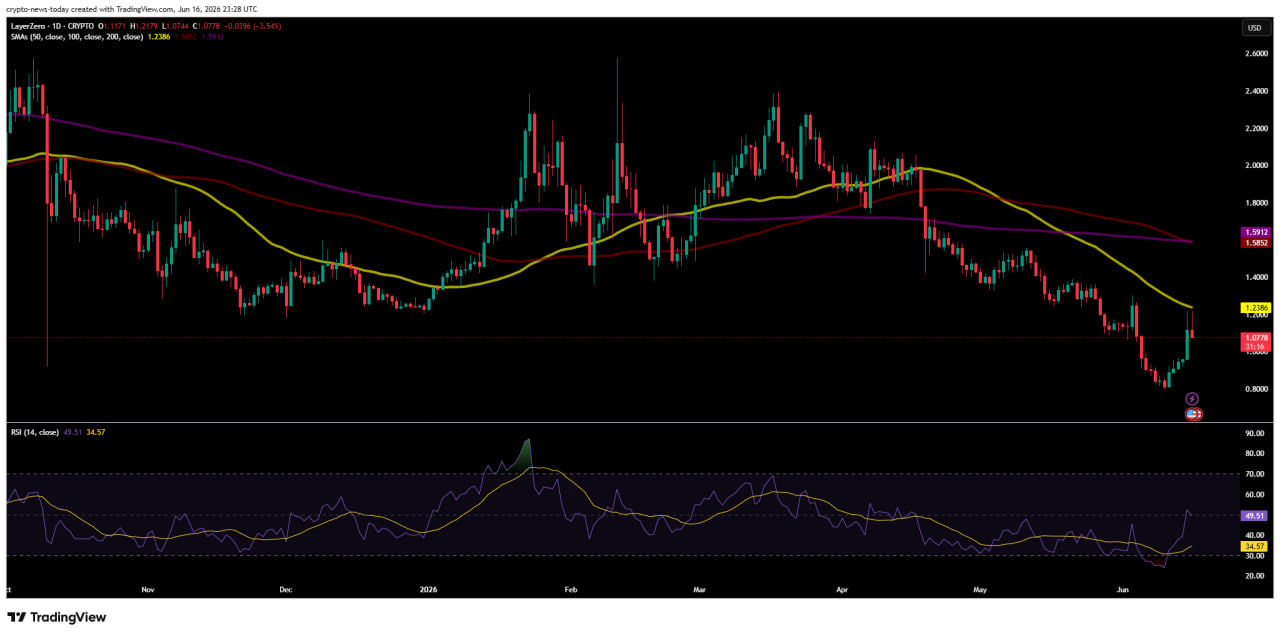
The RSI signal line at 34.57 places it close to oversold territory, but without a bullish divergence between the signal line and the June price lows, the reading does not confirm an impending reversal — it only indicates the token has sold off significantly. Open interest on ZRO perpetual futures near $85 million far exceeds spot volume, meaning short-term price movement responds more to derivatives positioning and potential short squeezes than to organic accumulation. The $1.00 level is the immediate psychological support. A sustained close below it before or around the June 20 unlock would bring the $0.80 June lows back into the picture. To the upside, the SMA 50 at $1.2386 is the first material resistance, with the SMA 100 and 200 clustered between $1.58 and $1.59 representing a ceiling that requires a significant fundamental catalyst to clear.
ZRO / USD — Daily
Close: Jun 16, 2026
$1.0778
-3.54% day · -4.86% 24h · +26.87% 7d
Moving averages — all bearish
$1.2386 ↓
$1.5852 ↓
$1.5912 ↓
Price has not closed above SMA 50 since April 2026. All three averages slope downward.
RSI (14) — near oversold
49.51
34.57
50 neutral
70 overbought
Signal near oversold but no bullish divergence from the June lows.
Key price levels
Resistance 1
$1.20
SMA 50 zone
Resistance 2
$1.58–59
SMA 100/200
Support
$1.00
Psychological
June low
~$0.80
Structural floor
Open interest on ZRO perpetual futures: ~$85M — significantly larger than spot volume. Short-term price action is more sensitive to derivatives positioning than organic demand. The June 20 unlock is the immediate structural risk.
Bull and bear case: the same data, read differently
| Institutional partners | Citadel and DTCC don’t make speculative bets — real infrastructure intent behind equity positions. | Institutions can use the network without buying ZRO. Partnership does not equal token demand. |
| Zero L1 mainnet | ZRO becomes mandatory gas. Every transaction on Zero requires it — entire 165-chain liquidity base funnels in. | Mainnet is Fall 2026. The market can price out expectations multiple times before launch. |
| June 20 unlock | If organic demand grows alongside supply, 4.83% dilution gets absorbed — as happened at earlier unlocks. | Whale reduction + stalled retail + $23M unlock = three simultaneous headwinds on a structurally weak chart. |
| Fee switch vote | Activation links protocol volume directly to supply reduction — deflationary pressure enters exactly as new supply hits. | Vote may not pass. Previous cycles show a divided community on permanent fee activation. |
| BTC dominance ~59% | Capital rotation from BTC to altcoins gives ZRO a real infrastructure narrative to attract institutional flows. | Sustained BTC dominance keeps retail capital concentrated. Altcoin demand stays thin without a macro catalyst. |
At present, three risks converge simultaneously: a large token unlock, an uncertain governance vote, and a chart that has yet to confirm a trend reversal. On-chain analysts tracking whale wallet data note that price recoveries since April have been driven primarily by futures positioning rather than spot accumulation.
The institutional story is real — Citadel Securities and the DTCC do not make performative investments — but institutional partnerships do not directly translate to token demand unless the Zero L1 network achieves meaningful transaction volume, which will not be testable until Fall 2026. The gap between now and that test is where the bear case lives. Whether LayerZero successfully converts its existing infrastructure position into a functioning institutional settlement layer will determine whether ZRO eventually trades on fundamentals rather than derivatives positioning. The architecture is credible. The institutional backing is credible. The market environment between now and mainnet is far less certain.
This article is for informational purposes only and does not constitute financial advice. Consult a professional before making investment decisions.
The post LayerZero Is Building the Blockchain Wall Street Actually Wants appeared first on Coindoo.



 Bengali (Bangladesh) ·
  English (United States) ·