
 7 hours ago
9
7 hours ago
9 
Guest post by Banafsheh Zand at Iran So Far Away
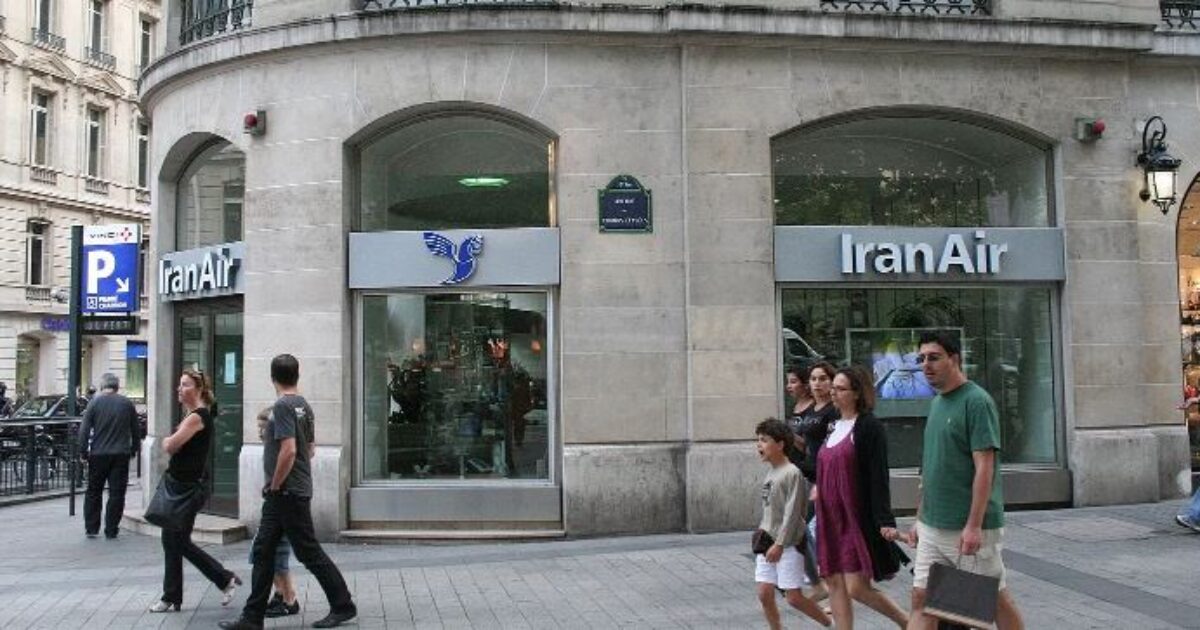
 Iran AIr’s offices in Paris.
The closing of Iran Air’s Paris office is a considerably larger story than the loss of a ticket counter. What began as a long-standing commercial lease on the Champs-Élysées became a seven-year legal and financial tangle involving some of the most expensive commercial property in Paris, banking restrictions, millions of euros in competing claims, and finally the disappearance of Iran’s national airline from European skies.
In a recent interview with Khabaronline, Iran Air chief executive Taher Abdolhai said the airline had occupied the Champs-Élysées premises since 1970. The French legal record documents the tenancy from 1991 and shows that the lease was renewed in 2010 for nine years at an annual base rent of €696,000, excluding taxes and charges. The lease followed the familiar French bail commercial 3-6-9: essentially a nine-year commercial lease structured around three-year intervals.
Iran Air Chief Taher Abdolhai was recently interviewed on Iranian television.
In June 2018, the landlords notified Iran Air that they would not renew the lease after December 31 of that year. Under French law, however, Iran Air was entitled to eviction compensation and could remain until that compensation was settled. What might have been an orderly departure instead became years of litigation over what the landlords owed Iran Air, what Iran Air owed them, and how the airline could move money through a European banking system increasingly closed to it.
The property itself explains part of the fight. The court describes premises totaling 236.10 square meters on two levels. A judicial expert later placed their market rental value at roughly €1.647 million a year, while the court calculated a hypothetical renewal value of about €1.422 million—roughly twice the €696,000 base rent Iran Air had been paying.
Iran Air argued that losing the location entitled it to €34.674 million in eviction compensation. The Paris court rejected that figure. In January 2026, it awarded the airline €2.847 million, including the principal award, replacement costs and reinstallation expenses.
But Iran Air had accumulated a substantial liability of its own. Because it remained after the lease expired, the court fixed its occupation charge at €1.28 million per year from January 1, 2019 until the premises were vacated and the keys returned, and added a €150,000 contractual penalty.
Seven complete calendar years at that rate amount to €8.96 million in gross occupation charges before payments, offsets, interest and other adjustments are taken into account. That does not mean Iran Air simply owed €8.96 million. But the scale of the problem is clear: the airline spent years fighting for an eviction award ultimately fixed at €2.847 million while incurring an occupation charge of €1.28 million for every year it remained.
The longer the dispute continued, the less valuable victory became.
Sanctions made matters worse, but they did not erase Iran Air’s legal obligations. The court was explicit that the private landlords could not be held responsible either for the length of the proceedings or for financial sanctions affecting Iran.
Those banking difficulties, however, were very real—and began almost simultaneously with the lease dispute.
In September 2018, La Banque Postale informed Iran Air that its account would be closed. Iran Air then invoked France’s statutory droit au compte, or right-to-an-account procedure. Years of litigation followed. In March 2026, the Paris Court of Appeal rejected Iran Air’s substantive claims against La Banque Postale, Crédit Coopératif and the Banque de France.
The real-estate litigation shows how those financial restrictions filtered down from international policy into the mundane business of running an office. Iran Air produced a statement from Bank Melli saying that it could not provide basic banking services because of U.S. sanctions and sought authorization to use an escrow account so funds could be transferred from Iran. The court record also shows that Iran Air eventually made several payments to the landlords’ property manager through third parties beginning in 2023.
 Iran Air Chief Executive Taher Abdolhai
Abdolhai adds another striking detail: he says nearly $2 million sent for the Paris office remains suspended in a bank in Amsterdam. That is his claim, not a finding of the French court, but it captures the larger predicament: Iran Air could owe money, possess money, and still struggle to move money.
Meanwhile, the purpose of maintaining a major Paris office was disappearing.
On October 14, 2024, the European Union imposed sanctions on Iran Air, Mahan Air and Saha Airlines, saying the carriers were involved in transferring or supplying Iranian-made UAVs and related components and technology to Russia. Iran Air’s European flights were cancelled within hours. Immediately beforehand, its remaining European routes included Paris, Frankfurt, Cologne and London.
For passengers, the consequences went beyond the disappearance of an airline brand. Euronews examined the Tehran-Paris journey after the sanctions. A direct Iran Air flight had taken about five hours and fifty minutes. One alternative through Istanbul took close to ten hours; another through Muscat about twelve. Connections meant additional tickets, possible overnight stays and sometimes airport changes—while international banking restrictions could make purchasing onward tickets abroad difficult for Iranian travelers.
By then, the Champs-Élysées office was becoming detached from the airline it represented. Abdolhai has been unusually candid about that. Asked why earlier managers continued maintaining it, he said the question should be put to them because, in his view, keeping the office had no justification. He said the premises have now been emptied and returned to the owner.
That is what makes this seemingly small real-estate dispute worth examining. It compresses several dimensions of Iran’s isolation into a single address: sanctions, banking exclusion, litigation, rising Paris property values and, ultimately, the collapse of the European air network the office had been created to serve.
By the end, the arrangement was almost inverted. Iran Air no longer had a renewed lease but remained in the premises. It was entitled to millions in eviction compensation while accumulating a far larger annual occupation charge. It said it had money available but struggled to move it through the banking system.
And eventually it maintained an Iran Air office in Paris while Iran Air itself no longer flew to Paris.
The post Iran Air’s Long Exit from the Champs-Élysées appeared first on The Gateway Pundit.





 Bengali (Bangladesh) ·
  English (United States) ·