
 2 hours ago
3
2 hours ago
3 
Key Takeaways
HYPE Tests the Channel Ceiling Near $55
Coindoo owner Filip Vantchev highlighted the test, writing:
“Price is testing the top of the descending channel once again.”
HYPE has formed a sequence of lower highs and lower lows since trading above $70 in early July. Its latest advance has now reached the upper trendline that contained the previous recovery attempts.
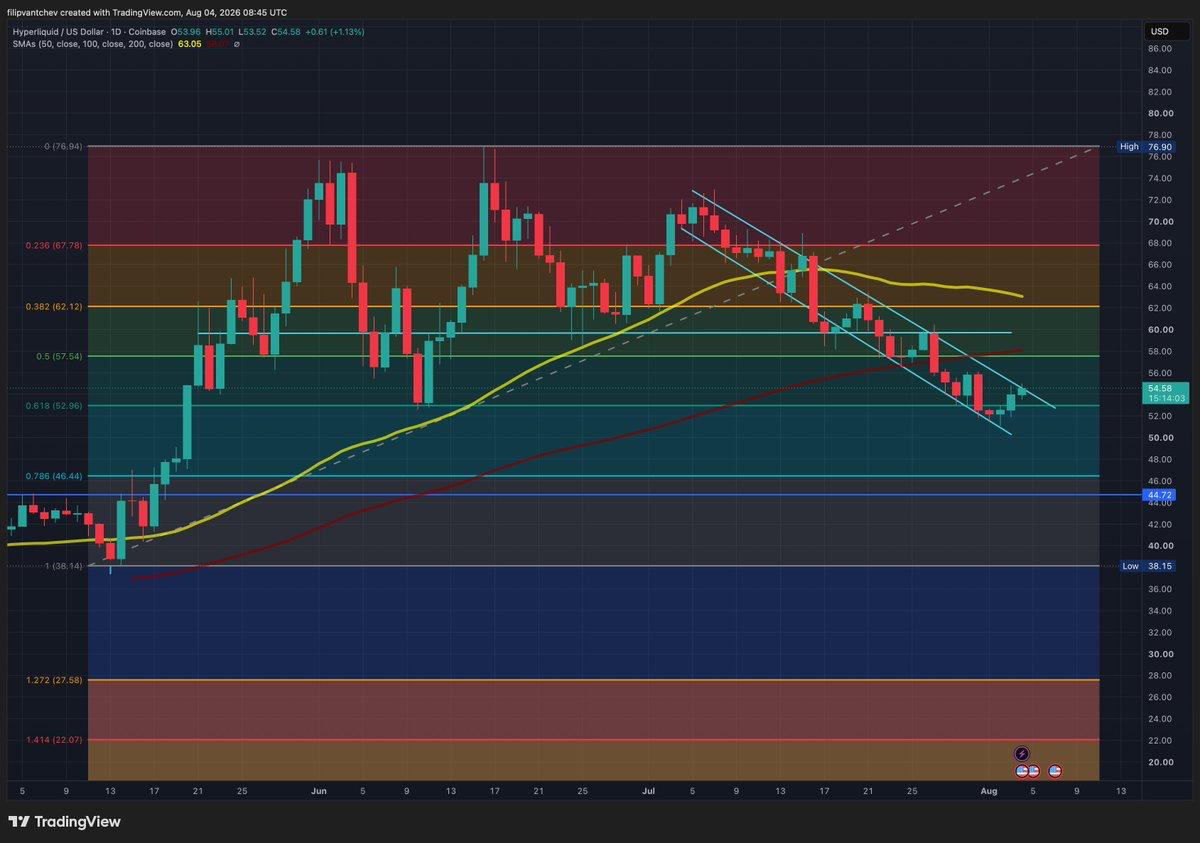 Hyperliquid daily price chart showing the testing of the ceiling.
A daily close above the channel would mark the first break from that structure. The next resistance sits at the 0.5 Fibonacci retracement near $57.5.
Above it, price would enter a wider resistance area between approximately $60 and $63. That zone includes the 0.382 Fibonacci retracement near $62, the declining 50-day simple moving average and levels that previously supported price during the July decline.
The August 4 intraday move reached the channel boundary but did not establish a breakout at the time of writing.
The Recovery Depends on Support at $53
A rejection from the upper trendline would leave the rebound intact while HYPE remains above the 0.618 Fibonacci retracement close to $53.
Price recently recovered from that level before returning to the top of the channel. Another pullback that holds above it would preserve the latest improvement without requiring an immediate breakout.
A daily close below $53 would weaken the rebound and return attention to the lower channel boundary near $51.
If that area also fails, the next visible supports sit at the 0.786 Fibonacci retracement near $46 and a previous horizontal level around $44-$45.
The chart therefore remains compressed between established support at $52.96 and the channel boundary near $55. HYPE has reached the point where another intraday test adds little unless price can close outside that range.
U.S. Spot Products Have Not Added Net Demand
The latest rebound has not been accompanied by renewed inflows through U.S. HYPE spot products.
SoSoValue history shows no positive net inflow across the 13 trading sessions from July 16 through August 3.
Nine sessions recorded outflows, while four ended with no net movement. The outflow days removed approximately $29.76 million from the products.
The August 3 session recorded another $964,320 in net outflows. The largest daily withdrawal during the period was $8.78 million on July 29.
Total HYPE Spot ETF Outflows History
| Aug 3, 2026 | -$964.32K |
| Jul 31, 2026 | -$1.83M |
| Jul 29, 2026 | -$8.78M |
| Jul 28, 2026 | -$1.24M |
| Jul 27, 2026 | -$2.89M |
| Jul 24, 2026 | -$6.89M |
| Jul 23, 2026 | -$1.02M |
| Jul 21, 2026 | -$698.04K |
| Jul 17, 2026 | -$5.45M |
These figures do not establish that fund activity caused HYPE’s decline. Investors can trade existing shares without creating or redeeming fund units, and the effect of redemptions on the underlying market depends on each product’s operational structure and timing.
They do show that the products were not supplying additional net demand during the period.
The Nasdaq documentation for the 21Shares Hyperliquid ETF, for example, states that the trust holds HYPE and tracks its spot-market value.
When assets leave spot products, their holdings may eventually decline through the creation and redemption process. The precise market impact cannot be determined from daily flow totals alone, but the absence of inflows removes a potential source of support while HYPE tests resistance.
Eole Adds HYPE to Its Corporate Crypto Strategy
Tokyo Stock Exchange Growth Market-listed Eole Inc. disclosed that it purchased approximately 1,078.25 HYPE on July 28 for ¥10.08 million, or roughly $66,000 at the time.
Eole plans to make additional purchases and increase its total allocation to ¥100 million, approximately $611,000, by the end of August. It said the timing would depend on market conditions and available liquidity.
The company described the transaction as the first publicly disclosed HYPE purchase by a Japanese listed company, based on its review of domestic corporate announcements as of July 28.
That claim comes from Eole’s own research rather than a central registry covering every listed company’s digital-asset holdings.
The purchase forms part of Eole’s wider “Neo Crypto Bank” strategy. The company believes blockchain infrastructure could eventually allow autonomous AI agents to execute payments, contracts and other financial transactions without conventional bank accounts.
Eole identified Hyperliquid’s onchain trading infrastructure, execution speed and programmable environment as potentially useful for that model. It also said it may explore lending, hedging and links between its digital-asset holdings and future services.
The company already held Bitcoin, so HYPE expands an existing corporate crypto strategy rather than starting one.

The Purchase Is Strategically Interesting but Financially Small
Eole’s plans remain a corporate thesis. The company has not yet demonstrated that its work involving AI agents will generate users, transactions or revenue through Hyperliquid.
The planned allocation would create direct demand for HYPE, but even the full ¥100 million target remains far smaller than the $29.76 million withdrawn from U.S. spot products during the latest 13-session period.
The comparison should not be treated as a direct calculation of price pressure because fund flows and a corporate treasury purchase reach the market through different processes. It does show that Eole’s planned position is not large enough to offset the recent institutional outflow total on its own.
The initial acquisition also occurred on July 28 and was announced the following day. It cannot explain the August 4 rebound by itself.
Its importance is mainly that a listed Japanese company has added HYPE to a treasury strategy previously focused on Bitcoin. The development would gain more weight if Eole completes its allocation and other public companies make similar purchases.
The Current Move Remains a Technical Rebound
The available evidence does not show that regulated fund demand or Eole’s purchase is driving HYPE through resistance.
Price has recovered from $53 and returned to the top of its descending channel, but the structure has not broken on a daily closing basis.
A close outside the channel would provide clearer evidence that the month-long decline is losing control. Until then, the move remains a rebound inside the existing structure, supported by price action rather than a visible return of institutional inflows.
The post HYPE Tests Breakout Toward $60 Despite 13 ETF Outflow Sessions appeared first on Coindoo.





 Bengali (Bangladesh) ·
  English (United States) ·