
 9 hours ago
1
9 hours ago
1 
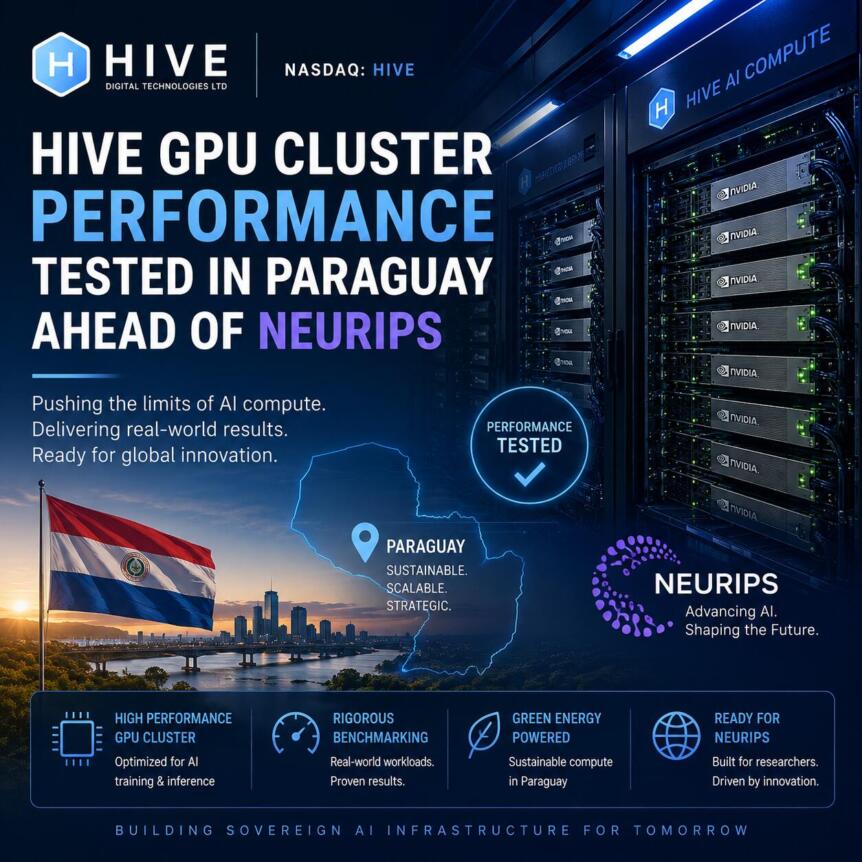
HIVE Digital Technologies said it has completed an inaugural research project using GPUs hosted in Asunción, Paraguay, in collaboration with Columbia University. The effort focused on iterative AI training runs performed remotely from New York and is now being submitted to NeurIPS, one of the major annual machine learning conferences.
For the AI infrastructure market, the development is less about a single model run and more about benchmarking and operational readiness. Independent, research-oriented testing can help quantify how well an installed GPU environment supports specific training workflows, including throughput and latency, and whether those results hold up under distributed usage patterns.
Columbia researchers use GPUs in Paraguay for NeurIPS-bound work
According to HIVE, the project centered on neural network pretraining research conducted by Columbia’s Department of Industrial Engineering and Operations Research. The team used HIVE GPU resources in Asunción while running iterative training experiments from New York.
The company framed the work as a “proof of concept” for intercontinental AI training, where researchers can run training jobs on geographically separated hardware. HIVE also said the research utilized code optimizations developed by Columbia to evaluate performance characteristics relevant to training workflows.
HIVE reported that, after normalization for each platform’s raw hardware performance, its A40 GPUs delivered training results comparable to newer-generation H100 GPUs in the targeted use case. The company described performance evaluation in terms of measured throughput and latency, along with tests for serving throughput and latency for a model configuration the team referenced as up to 1.4 billion parameters.
What the submission covers
While the filing does not provide full technical details in the release, it indicates the research addresses optimization methods for neural network pretraining under noisy conditions and explores accelerated algorithms designed to match performance characteristics of leading approaches.
HIVE’s announcement also notes that the work evaluated variants of the approach and tested performance for both training and serving settings, including standard throughput and latency tests related to LLaMA-style models. The reference to Muon in the release suggests the research is positioned within a broader trend in the field around scale-invariant optimization techniques intended to improve training efficiency and stability.
Performance benchmarks are used to plan larger HPC build-out
Beyond the academic milestone, HIVE said the measured performance data is intended to serve as a baseline for future expansion of its HPC and AI infrastructure in Paraguay, including what it describes as a “Gigafactory” for AI compute.
The company’s longer-term plan includes additional power and data center capacity at Yguazú, Paraguay. In the release, HIVE states that civil works for a 100 megawatt substation are complete, with commissioning expected during the summer and energization expected in September 2026. HIVE also said construction of a new Tier-III data center would begin in fall 2026, with an expected ready-for-service date in the second half of 2027.
For AI infrastructure operators, that timeline matters because GPU clusters require more than hardware procurement. They depend on predictable power delivery, cooling and redundancy design, network capacity, and operational workflows that can support both research experimentation and production workloads.
Why academic validation matters for AI infrastructure
GPU performance claims in the AI market are often difficult to compare across vendors, workloads, and environments. Even when systems use the same GPU model, results can differ due to software stacks, scheduling, network conditions, storage performance, and how optimizations are implemented.
In that context, HIVE’s emphasis on code optimizations and on measuring token-per-second, latency, and bandwidth reflects a practical approach to benchmarking. If the submitted NeurIPS work is presented publicly, other researchers and practitioners may be able to compare methodology, normalization choices, and evaluation settings.
However, it is still an evolving picture. A single collaborative study or an inaugural project generally does not establish a complete performance profile across all training regimes, model sizes, or operational constraints. What it can do is provide an early reference point for infrastructure readiness and for the feasibility of distributed training on installed hardware.
Market implications for Paraguay’s data center ambitions
HIVE’s expansion plan is also part of a broader push to localize AI compute capacity outside the most saturated markets. Paraguay has increasingly attracted attention due to its electricity profile and location, but the AI compute race is ultimately constrained by infrastructure, not just power availability.
By linking the research work to a planned substation and Tier-III data center, HIVE is positioning Paraguay as a location where international teams can access GPU compute for AI training. If the expanded infrastructure proceeds on the stated schedule, it may help reduce friction for researchers and enterprises seeking capacity without relying entirely on large hyperscale regions.
Still, timelines for construction and commissioning carry execution risk, and performance outcomes depend on ongoing software optimization and workload fit. The most relevant takeaway is that HIVE is using an academic collaboration to stress test both compute capabilities and the operational model for remote access to a distributed GPU cluster.
What to watch next
NeurIPS will be a key checkpoint for the work, as peer scrutiny may clarify technical assumptions and provide more granular evaluation results than the announcement itself. Investors and infrastructure buyers will likely also watch for updates on Yguazú commissioning milestones, as well as evidence that the performance baselines from Asunción translate to the scale of planned HPC deployments.
In the meantime, the release underscores an increasingly common pattern in AI infrastructure building, where operators seek credibility through benchmark-driven collaborations rather than purely marketing-led claims.
This article was originally published as HIVE GPU Cluster Performance Tested in Paraguay Ahead of NeurIPS on Crypto Breaking News – your trusted source for crypto news, Bitcoin news, and blockchain updates.





 Bengali (Bangladesh) ·
  English (United States) ·