
 1 hour ago
6


Google’s Gemini 4 Carbon focuses on complex reasoning, secure code generation, and long-running agentic tasks, while Genie 4 creates interactive environments with photorealistic visuals and native audio.
The announcements highlight two distinct areas of AI development. Carbon targets demanding technical and security workloads, while Genie 4 aims to generate dynamic digital worlds that respond to user instructions in real time. Both models are being introduced through limited-access programs before broader availability.
Gemini 4 Carbon Tops Intelligence and Cybersecurity Benchmarks
Google CEO Sundar Pichai announced Gemini 4 Carbon as the newest frontier model in the Gemini 4 family. Its release follows Gemini 4 Argon, which arrived approximately two weeks earlier, underscoring the pace of development within Google’s AI lineup.
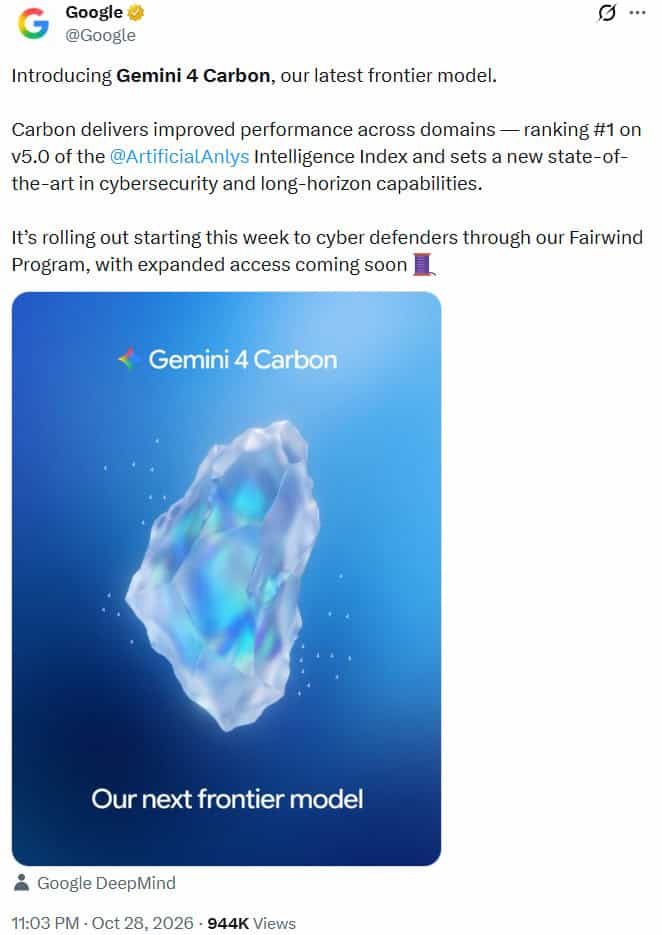
Gemini 4 Carbon delivers improved performance over its predecessor Argon, with advanced cybersecurity capabilities and enhanced support for long-running agentic tasks. Source: Google via X
According to the supplied benchmark results, Carbon ranks first on the Artificial Analysis Intelligence Index v5.0, scoring 59 points. The model also records strong results across several cybersecurity evaluations, including 88.2% on SEC-bench Pro for vulnerability detection, 54.8% on ExploitGym, and 71.0% on CWE-bench for software patching.
These benchmarks assess different capabilities, from identifying security weaknesses to evaluating how effectively a model can address vulnerabilities. Their results offer measurable indicators of performance, although scores across separate evaluations do not necessarily translate directly into better outcomes in every real-world environment.
Google also reports substantial improvements over Gemini 4 Argon in long-horizon tasks, agentic coding, and multimodal understanding. Secure code generation reportedly delivers a twofold improvement, while the model’s safeguards are designed to reduce susceptibility to indirect prompt injection attacks.
The supplied announcement describes Carbon as achieving perfect resistance to indirect prompt injection in the reported evaluation. This result should be understood within the scope of that test rather than as proof of immunity to every prompt injection technique or cybersecurity threat.
Gemini 4 Carbon Demonstrates Advanced 3D Modeling Capabilities
Gemini 4 Carbon has also attracted attention for its performance in computer-aided design (CAD) and complex 3D modeling. A side-by-side video shared by AI tracker @Mr_Salio compares the model with Opus 5.5 on a detailed airplane-design task.
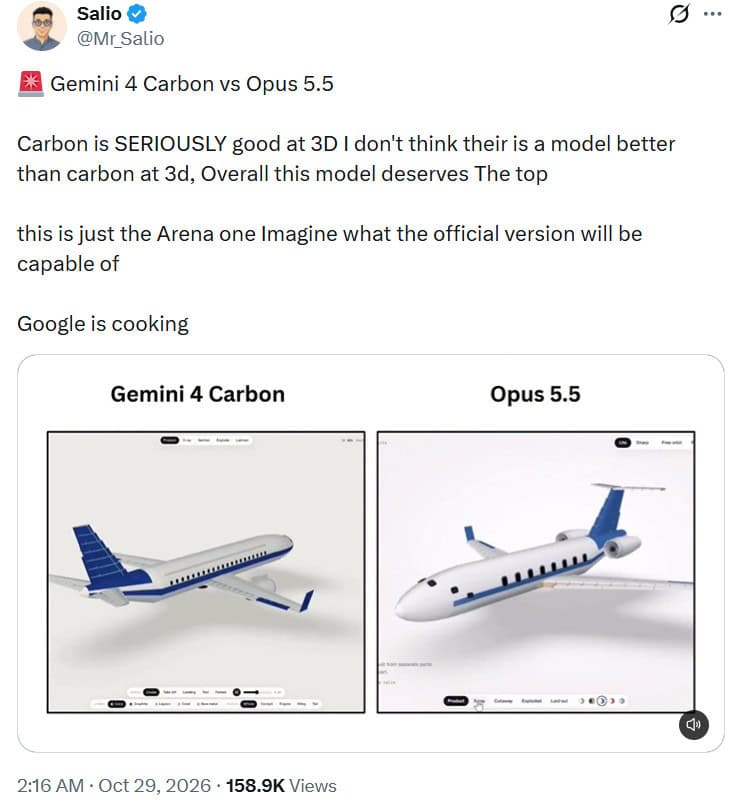
The post compares Google’s Gemini 4 Carbon with Opus 5.5 in a side-by-side video demonstration of complex 3D airplane modeling. Source: @Mr_Salio via X
The demonstration focuses on technically demanding features, including X-ray views, exploded assemblies, and intricate internal components. The aircraft models reportedly contain between 1,400 and more than 2,600 parts, requiring the system to maintain structural consistency across numerous connected elements.
In the comparison, Carbon appears to handle internal assemblies and complex views with greater coherence and detail. Such capabilities could be useful for engineering visualization, product design, and other workflows in which models must preserve relationships between components.
However, a demonstration video alone does not establish how consistently a model performs across professional CAD workloads. Independent testing would be needed to assess dimensional accuracy, editability, engineering constraints, and reliability in production environments.
Google Begins Gemini 4 Carbon Rollout Through Fairwind
Google is initially making Gemini 4 Carbon available to selected cybersecurity professionals through its Fairwind Program. The staged rollout is intended to gather feedback on the model’s capabilities, safety measures, and suitability for security-related tasks before wider access.
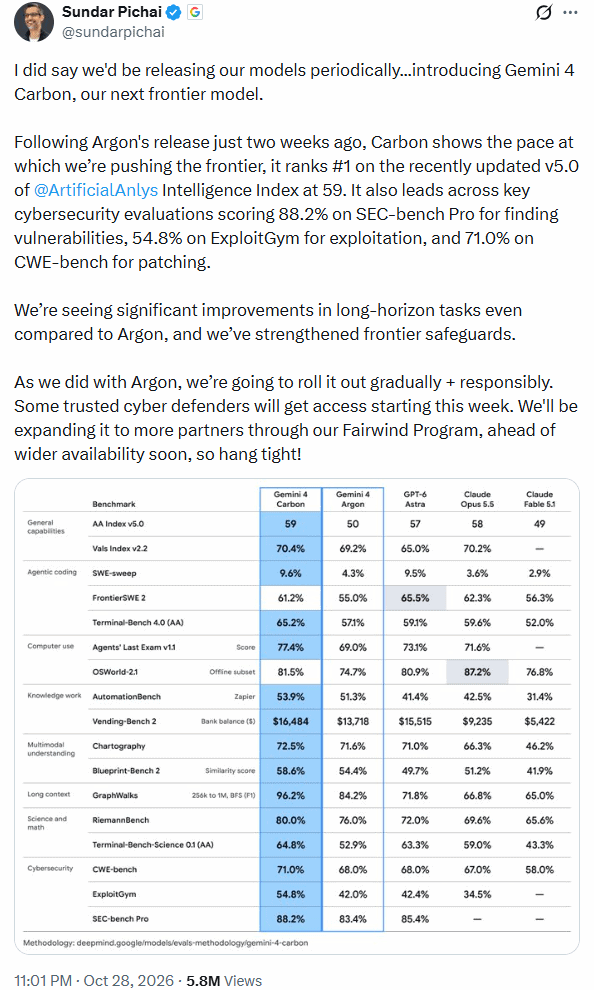
Google is gradually releasing Gemini 4 Carbon to trusted cyber defenders through its Fairwind Program, with enhanced safeguards against prompt injection and model misalignment ahead of wider access. Source: Sundar Pichai via X
The approach reflects the challenges of releasing powerful AI systems that can assist with vulnerability discovery and software security. These capabilities may help defenders identify weaknesses and develop fixes, but they also require safeguards against misuse.
Google plans to expand access to developers and other users in the near future. The supplied announcement lists introductory API pricing of $2 per million input tokens and $10 per million output tokens. These figures represent the stated initial rates, which may be subject to the terms of the eventual public release.
The company also highlights improvements in resistance to prompt injection and reductions in misalignment rates. The effectiveness of these protections will depend on how the model behaves across different applications, attack methods, and deployment conditions.
Genie 4 Generates Photorealistic Worlds With Native Audio
Alongside Carbon, Google DeepMind has introduced Genie 4, an interactive world model designed to generate dynamic environments with realistic visuals, physical movement, and synchronized audio.

Google DeepMind unveiled Genie 4, an interactive world model that generates photorealistic simulations with native audio and maintains consistency through Gemini integration. Source: Google via X
Unlike a conventional video generator that produces a fixed sequence of frames, an interactive world model allows users to influence what happens inside a generated environment. Genie 4 supports real-time text instructions that can change scenes, camera angles, and actions as a simulation unfolds.
Native audio is another central feature. Generated environments can include ambient sounds, music, engine noise, and character dialogue, adding an audio layer that responds to events within the simulated world.
Google’s demonstrations illustrate how these capabilities work together. In one 50-second example, a first-person motorcycle journey begins at a red traffic light on a sunlit coastal highway. A text instruction changes the light to green, after which the motorcycle accelerates along the road. Engine revs, ocean waves, and passing traffic accompany the movement.
Other demonstrations reportedly include dragon flights, crowded train stations, and robotic systems handling liquids. These examples showcase the model’s ability to combine visual detail, physical interactions, and changing scene conditions.
Gemini integration also helps Genie 4 track the state of its simulated environment and coordinate multi-step events. This is important for maintaining continuity as objects move, actions unfold, and users modify the scene.
Genie 4 Access Expands Through Project Genie and Gemini API
Genie 4 is currently available as a research preview for trusted testers. Google plans to extend access to Google AI Ultra subscribers through Project Genie, while selected partners are expected to receive early access through the Gemini API and Google AI Studio.
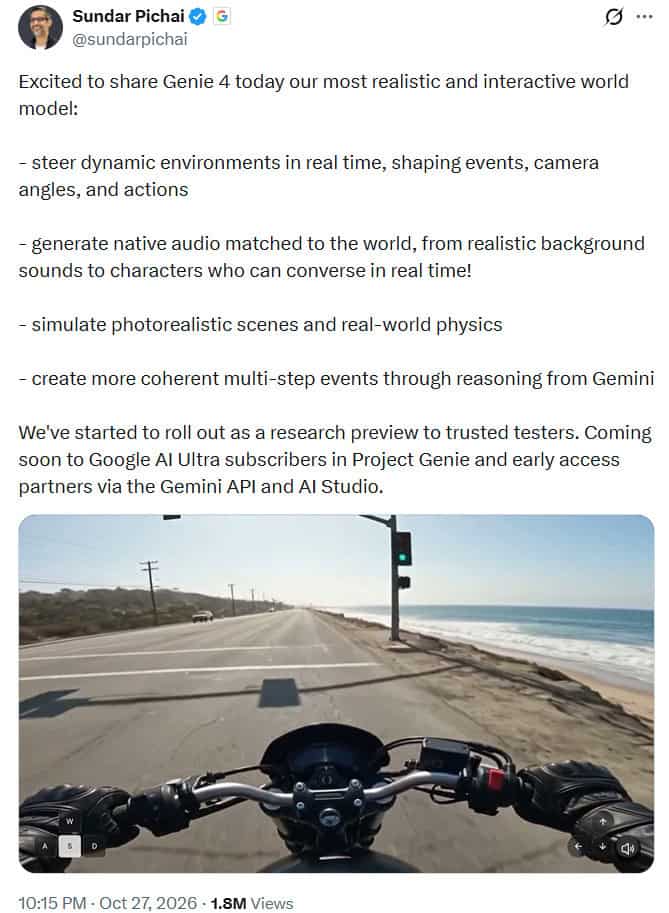
Sundar Pichai unveiled Genie 4, Google’s advanced world model featuring real-time environment control, dynamic actions, and native audio with realistic dialogue. Source: Sundar Pichai via X
The limited rollout gives Google an opportunity to evaluate the system before making it more widely available. As with other generative AI tools, practical performance will depend on the complexity of the requested environment, the consistency of interactions, and the model’s ability to preserve realistic behavior over time.
Interactive world models could support several applications beyond entertainment. In robotics, generated environments may help researchers test control systems and explore scenarios that would be expensive, difficult, or unsafe to reproduce physically. Developers could also use the technology for simulation, virtual prototyping, and interactive experiences.
Nevertheless, simulated environments do not automatically reproduce every constraint of the physical world. Robotics and engineering applications will require careful validation to determine whether generated scenarios provide sufficiently accurate conditions for training and testing.
Google Advances AI Across Coding and Interactive Simulation
Gemini 4 Carbon and Genie 4 address different but complementary areas of AI development. Carbon emphasizes reasoning, cybersecurity, and complex technical workflows, while Genie 4 focuses on generating interactive worlds with realistic visuals, physics, and sound.
Their initial releases remain limited, and broader availability will provide more opportunities to evaluate performance outside curated demonstrations and benchmark environments. For Carbon, key questions include how reliably it detects vulnerabilities and produces secure code. For Genie 4, the focus will be on consistency, real-time responsiveness, and the accuracy of simulated interactions.
Google’s announcements illustrate a wider effort to develop AI systems that can do more than generate text or images. By combining advanced reasoning with specialized capabilities, the company is targeting applications ranging from software security and engineering to simulation and robotics. The models’ practical value will ultimately depend on their reliability, safety, and performance in real-world use.




 Bengali (Bangladesh) ·
 English (United States) ·