

Sometimes science can seem really counter-intuitive. For example, occasionally in astronomy, you can see more with less light. Case in point: the emergence of a giant planet in observations made by the James Webb Space Telescope (JWST), when astronomers found a way to block out light from the planet's parent star.
The extrasolar planet, or exoplanet, in question is 51 Eridani b (51 ERI b), a gas giant with the same mass as around 11 Jupiters that orbits a star located around 97 light-years away. 51 ERI b was discovered back in 2015 by ground-based telescopes, but the planet was missing from observations of the system made by the JWST. That wasn't a failing of the JWST itself; no one is doubting the observing capabilities of the most powerful telescope humanity has ever hoisted into orbit around Earth. Instead, it was a result of starlight from the star 51 ERI A obscuring this intimidatingly massive world.
The brightest planets are 100,000 times fainter than their host stars, meaning spotting them is like observing a firefly hovering around a lighthouse. Even using a tool called a coronagraph to block the star isn't enough to reveal the planet, as that doesn't stop all the starlight.
The only solution to this glaring problem is a computer program to wipe out the starlight.
"For the past 20 years, astronomers have tackled this problem by observing a different star and using its image as a reference," Jason Wang of Northwestern University explained in a statement. "Then, they subtract that reference image from the original observation to remove the unwanted glare to reveal faint planets that otherwise might be hidden."
There is a problem with this process, however. Even the most stable telescopes "wobble." For instance, the JWST requires cryocoolers to keep its NIRCam instrument super cold, and those coolers have little motors that can cause the mirrors to vibrate. This movement, however slight, causes a scatter in starlight.
The result is enough glare remaining to obscure a planet, but Wang and colleagues developed a new approach to this problem.
Telescopes their more stable digital twins
The new approach taken by the team is dubbed Physics-based Learning for Imaging Planets (FLIP), and it involves creating a digital "twin" of a telescope. Essentially a virtual replica that simulates how starlight travels through the telescope's mirrors and reaches its detectors.
This twin is then fine-tuned to account for millions of tiny imperfections in the original telescope. The digital twin is then tweaked until it aligns with observations from the actual telescope. Astronomers can then remove the simulated glare from the original image.
To assess the validity of the technique, the researchers took a second look at JWST observations of two star systems with known exoplanets, HIP 65426 and 51 Eridani, and one system, TYC 5899, with no known planets.
The researchers found that, in terms of detecting faint exoplanets, FLIP outperformed conventional image-processing techniques two to 15 times. This led to ERI b emerging from data collected by the JWST two years ago.
"We showed that we can actually recover a planet that people previously couldn't see," Wang said. "This is real data in a real scenario. It was science left on the table because we didn’t have the right tools to analyze the data in the most optimal way."
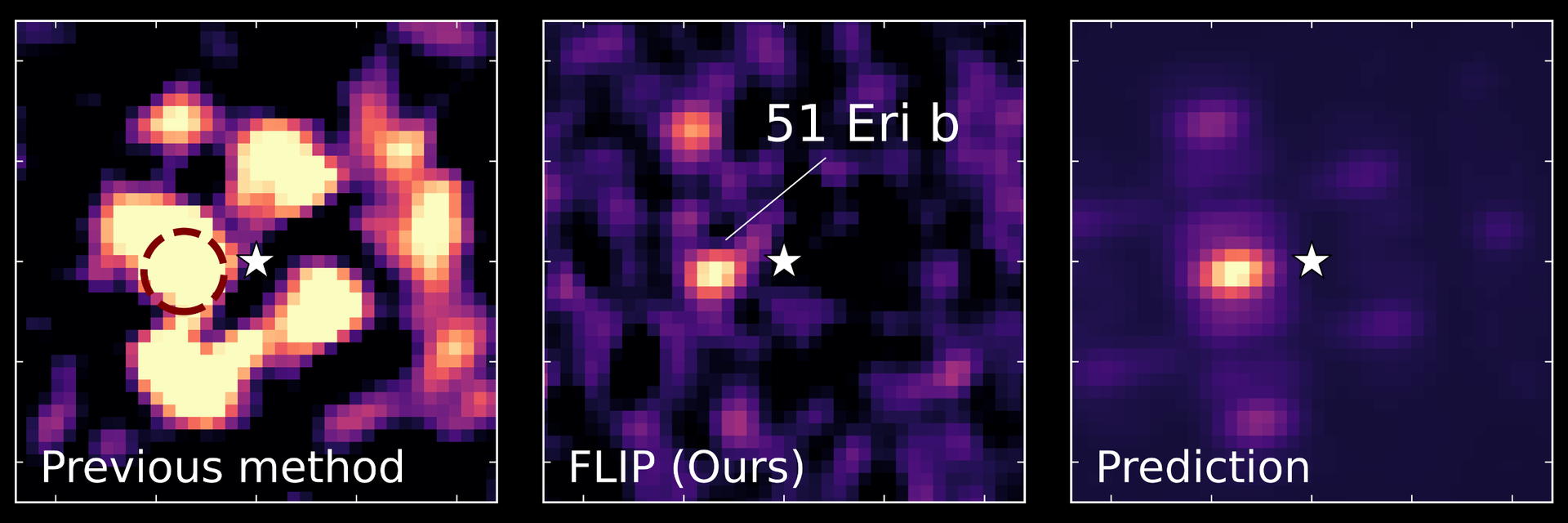
The team hopes that FLIP can now be adopted by other astronomers in a bid to recover hitherto undiscovered exoplanets that have been hidden by the glare of their stars.
This could be a major boon for NASA's proposed Habitable Worlds Observatory, which aims to directly photograph Earth-like planets orbiting distant sun-like stars.
"We know of no planets around other stars that are like those in our own solar system," team leader Rodrigo Ferrer-Chavez of Northwestern University said. "It's not that they don’t exist. It's that we cannot see them.
"Every time we improve our techniques, we discover new types of planets. By finding more planets, we can better understand how planetary systems form and evolve, and ultimately how typical our own solar system truly is."
The team's research was published on Wednesday (Nov. 4) in the journal Nature.



 Bengali (Bangladesh) ·
 English (United States) ·