

Martial artists spend years learning how to fall before they learn much of anything else. The rest of us just brace, then wonder why the landing does so much damage.
This is a best-of conversation, first aired in 2023, and it has only gotten more useful with time.
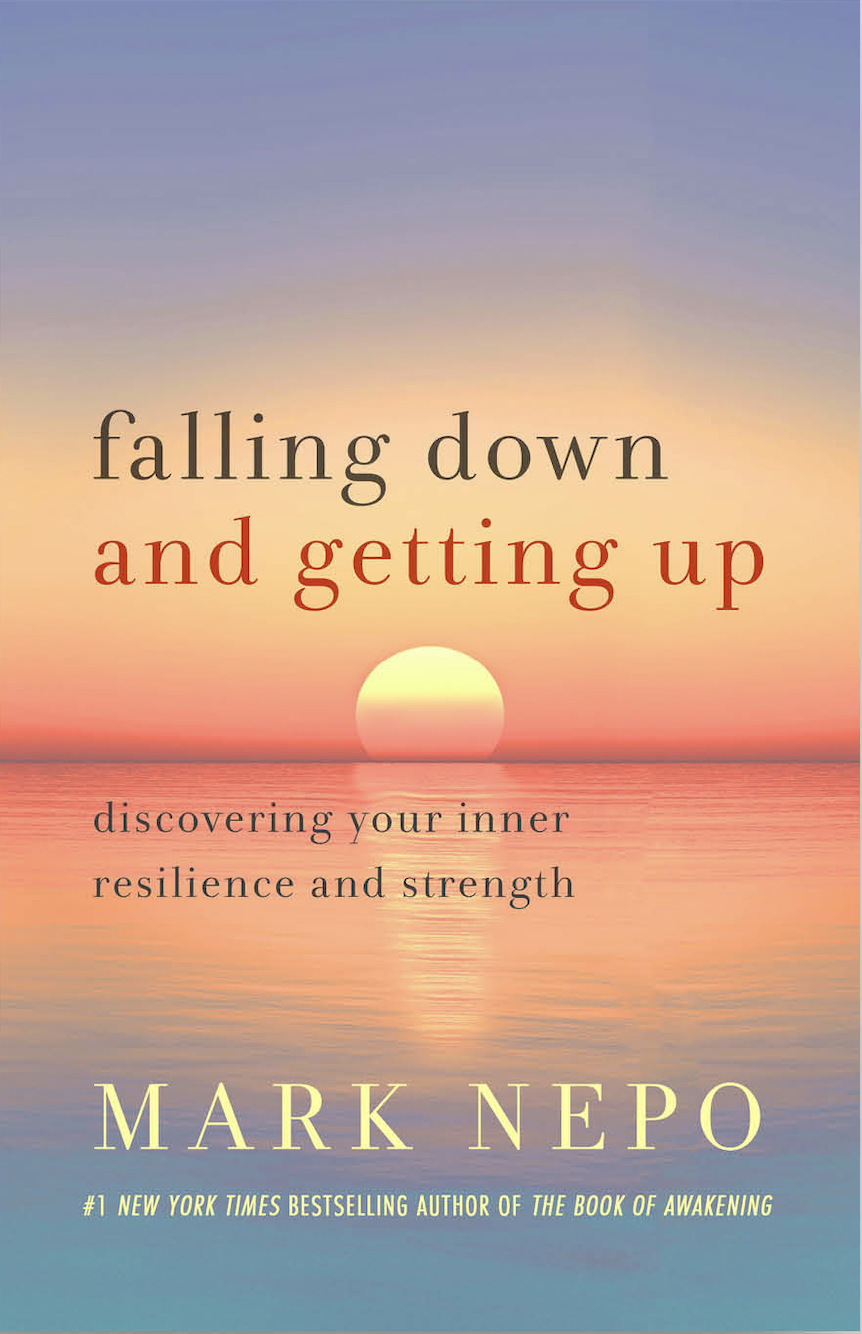
Mark Nepo is a poet and spiritual teacher who has been working in poetry and spirituality for more than fifty years. His book The Book of Awakening was a #1 New York Times bestseller, he has written twenty-six books translated into more than twenty languages, and he was named one of Oprah’s SuperSoul 100. In his thirties, he was diagnosed with a rare form of lymphoma, and that experience runs underneath everything he writes about adversity, grief, and what it costs to stay open. He wrote Falling Down and Getting Up when his cancer years came flooding back during the pandemic. Since this conversation first aired, Mark has published The Fifth Season: Creativity in the Second Half of Life.
What you’ll explore in this conversation:
Why aikido teaches students how to fall before anything else, and what that translates to when the fall is emotional rather than physical The journal question Mark asks people in circle that tends to surface, fast, whose voice you have actually been living under What a friend in the depths of grief told him about “the life after tears,” and the line that separates it from everything that came before The difference between grounding and chasing, and the small reorientation that changes where you go looking for a life What happened in a bar after the Iraq war that taught him how to feel for pain he had never lived throughIf you are somewhere in the middle of a fall, or still carrying one that never quite finished, this conversation offers you something steadier than advice: company, and a way to keep going that doesn’t ask you to pretend you’re fine.
You can find Mark at: Website | Instagram | Episode Transcript
Check out our sponsors and resources: Visit Our Sponsor Page
photo credit: Brian Bankston
_____________________________________________________________________________________________________
Episode Transcript:
Jonathan Fields: [00:00:00] We are all going to fall down at some point in our lives, sometimes in small ways, other times in unbearable, seemingly devastating ways. The real question is how do we get up without becoming smaller or making things harder, or getting more jaded and feeling alone? For that, we turn to acclaimed teacher, poet and New York Times best selling author of dozens of books, Mark Nepo. Drawing from his own cancer journey and study of spiritual traditions over many decades, Mark reframes the moments we try to avoid most. He explains why resistance often makes pain worse. Why no one is watching is more liberating than it actually sounds, and how the body, the heart, and the spirit all learn to move with what is. Instead of chasing what should be. You’ll discover why falling down and getting up is a universal practice, not a personal failure. We’ll talk about the powerful difference between grounding yourself and chasing approval or certainty, and how fear, pain, and grief can become sacred ground without romanticizing suffering. We talk about what it means to move through life with compassion, not just resilience. Why grief changes the map of your life, and why you never really go back to normal. How intimacy, friendship, and even a men’s group can become a net that distributes the weight. And along the way, Mark explores the hidden voices we inherit from parents, the social pressure to perform, and the modern habit of living vicariously instead of living directly. So excited to share this conversation with you. I’m Jonathan Fields and this is Good Life Project, and we’ll jump right in after this short break.
Jonathan Fields: [00:01:43] You and I have had have been in conversation a number of times over the years. Your new book is an interesting topic. Um, Falling Down and Getting Up is the title. And, you know, it’s fundamentally an exploration of adversity, which certainly over the last three years, if not, you know, many times over, you know, our lifetimes we deal with. But I feel like for so many people, the feeling that adversity has taken on a much more present role in their lives in the recent few years is just a much more common experience. And yet we often don’t talk about it in a meaningful way or really, um, resource ourselves with tools. So that was really interesting that you decided that this was a moment to write about this, especially considering your own personal, uh, journey where for sure. I mean, you have experienced adversity on the level of, you know, literally being life-threatening, um, in your past. So I’m curious what brings you to this topic at this moment in time?
Mark Nepo: [00:02:47] Yeah. So, you know, a couple of things constellated here. And so, you know, it goes back to my previous book just before Falling Down and Getting Up, which was surviving storms and, you know, right out of the pandemic. I mean, I think the the doorway to all of this, both books, um, was a moment that I think a lot of people who’ve been through things had, um, but all of a sudden, you know, in the pandemic, my own cancer journey was coming back vividly. And, and one of the one moment in particular was the moment I was diagnosed, you know, I, I had, as you might recall, you know, I had a tumor growing out of my skull bone, which was rather pronounced. And I went finally to a doctor, of course. And, um, and when I was told that I had cancer, you know, I was frightened and upended and, you know, everything. But then when I went to leave that appointment, the door I had come through to keep that appointment was gone. There was no way back to life before that appointment. And I think this came back so vividly because I think the pandemic was such a moment for humanity. The old world’s gone. There’s no way back. There’s only loving each other forward. And when you look at like, Kubler-Ross stages of grief, and we’ve had parts of our society in all of it. We’ve had parts of our society in denial. It was a hoax. You know, we had parts of our society and in anger, um, in, you know, resentment. And what were we protesting? Biology. Um, you know, so, um, and so that was the doorway in.
Mark Nepo: [00:04:40] And I think that, you know, in the, in the Jewish tradition, as you know, the word Sabbath literally means the one day we don’t turn one thing into another. Well, I think the pandemic was a global Sabbath. We were forced to stop. Now we’re not even dream or scheme or go from here to there. We were forced to revisit and accept the miracle of what is and which all the spiritual traditions point to through practice. Uh. But adversity brings us there abruptly, too. And so what? Moving forward, you know. Um, you know, central part of this book is about fear of pain and grief. And, and that came about because out of the pandemic, you know, I was having so many other folks ask me if I might open up a space around that and, and offer something around that. And then that dovetail with my publisher, Joel Fotinos, um, with Saint Martin’s Essentials. He was wonderfully, uh, saying, you know, you, you, you teach more than most of my other authors, you know. And he kept asking me about that space and. And then he finally had this wonderful invitation. He said, well, if someone couldn’t be in one of your circles, what book would be closest to that experience? So that was quite an invitation. And that, coupled with the things we’ve been talking about, gave me a way to really delve into into this archetypal journey. And, and, you know, the title comes because I discovered that medieval monks, when asked how to practice their faith, said, by falling down and getting up. And I, I know that I understand that. Um, and then as I learned, of course, every tradition has some version of that in the Japanese tradition, there’s a proverb that says, fall down seven, get up eight.
Mark Nepo: [00:06:48] And it made me remember to, you know, after one part of my journey, a cancer journey, I had a rib removed from my back surgically and, um, and I barely woke up in the hospital room. And this kind but gruff nurse was over me saying, we’re going to walk. I said, what we who’s we? And but then she said, two steps forward, one step back. Which again seems the rhythm of of really lit life on earth. And then in doing this book, I ran across another deep echo of this, this rhythm, um, which is in the Upanishads, those wonderful, amazing Hindu texts. There’s just metaphors galore throughout that. And there was one of a caterpillar and how a caterpillar bunches up and it moves back in order to move forward. So two steps forward, one step back. And the metaphor was that this is how spiritual growth takes place, like a caterpillar bunching up and moving forward, bunching up and moving. So it made me looking at my life and at others. No one signs up for falling down. We don’t say, oh yeah, sure. Sign me. No, no. But like gravity, it’s inevitable. And when we back up enough. Falling down and getting up becomes a dance. And so the question is what? We can’t avoid it or eliminate it. How do we learn the dance? And what does that look like for each of us? And what is our personal rhythm of falling down and getting up? And when do we need to ask for help in that process?
Jonathan Fields: [00:08:43] Yeah. I mean, it’s interesting, right? Because, um, when you use the, um, the term falling down to sort of describe a whole host of experiences that we all have. And I think everybody’s going to insert their own unique story or unique moment or series of experiences into that phrase. And this is something that you speak about and that you write about also is there’s also this notion that we spend an inordinate amount of time bracing ourselves to try and avoid the fall. And then once we realize that we are in the fall, that we are in this experience, that we’re tumbling, we’re stumbling, we are spiraling, whatever it may be. Um, the immediate impulse is, how do we break this? How do we break this? And you have an interesting reframe, which is what if we looked less at how do we break the fall and more? How do we receive them?
Mark Nepo: [00:09:35] Yeah. And you know, this was also a constellation of, of, uh, instructions, if you will, around this. I mean, I remember being a kid and my father, uh, saying in his own very simple way, if you find yourself falling, go with it. He said, if you resist, you’re just going to break something. And I remember that as a kid, as I stumbled on to that in the martial arts. And I don’t practice the martial arts, I’ve only read them and seen metaphors in it. Um, but in a kaiju, um, that art of using the energy of what whatever you meet, not resisting it or, but that they actually teach practitioners how to fall and how to get up. It’s known as ukemi is the skill. And, and that’s the first thing they say is tuck and roll, tuck and roll so that you’re right back up. And of course, you know, when we look at things like when we look at these different ways of falling. Well, a tuck and roll with grief could take a decade. Yeah, yeah. So you know these things again, how do we inhabit them and personalize them? Because that’s where the real meaning happens and how we can help each other.
Jonathan Fields: [00:10:57] Yeah. As you were describing that, um, the first 18, 19 years of my life, I was, I trained as a competitive gymnast. And so every day for hours a day, I was flying through the air and often out of control and falling. So one of the things that you learn very quickly is, and maybe that’s just because I really wasn’t all that talented at it, but that’s a whole nother conversation. But, uh, you learn quickly that you’re going to fall all the time. And it’s part of the process of growth. Um, and just like you described, you know, in martial arts, part of what you learn is how to fall. Um, how, because it’s going to happen over and over and over. Um, and you would eventually get to a point where if you hadn’t taken a fall, if you hadn’t flown off something for a long while. On the one hand you’re like, oh, this is great. I feel awesome. Like I’m not a little bit bruised or banged up. But on the other hand, there’s a little voice inside your head that says, um, but am I still growing towards, am I still becoming? Or have I just sort of like slid into a season of stasis? And I wouldn’t have used that language when I was 18, but the experience, the feeling was there. And you’re just wondering, you know, like, is this actually okay? It’s safe. But is that why I’m here?
Mark Nepo: [00:12:20] That’s a miseducation. Uh, that’s maybe even more acute in the modern world is that, you know, we want to eliminate turbulence and conflict and challenge, which are all part of the rhythm of growth. And, and we seem to think that, you know, if we hit stasis, that’s a good thing. And, you know, actually it’s not a good thing because too much stasis, the only time we’re really in stasis is in death. And we’re here. We’re alive. And that means we’re never free of struggle. You know, I often think of and I think in one of my books, I explored the imagined an alternative to the myth of Sisyphus, you know, and the myth of Sisyphus. He’s roll for, uh, for trespass against the gods. He’s punished Sisyphus to roll a rock up a hill. And when he gets to the top, it falls to the bottom. And he does that for eternity. But I imagined, you know, an alternate myth in which, for being kind and generous, he’s rewarded to roll a ball of light up a hill for eternity so he can give it away as he finds it. And, and happy to do it over and over again. And that the struggle, which, you know, Camus, of course, in his myth of Sisyphus, uh, ends up in that point of, uh, you know, we have to love the struggle and, and, and the struggle without end is really what makes the human journey noble. And, and even when we do, quote, accomplish things, it’s often not where we aimed, which is not a failure, but an awakening. You know, I think that I’ve been I’ve learned over my life so far that, uh, there’s nothing wrong with working for what we want, but often working for what I want has become an apprenticeship for working with what I’m given. Mm. And that’s, that’s where our real gifts show themselves.
Jonathan Fields: [00:14:34] And we’ll be right back after a word from our sponsors. As we talk about this, Just the notion of struggle, the notion of falling, the notion of, you know, the sometimes wide chasm between what we want it to happen and what is happening. Um, part of that is our own internal pain, our own internal you described, you know, fear, pain, suffering, grief. And these are very real, these are very physiological, somatic, experiential, emotional and sometimes intellectual things that we go through. Part of the experience is also we are such social creatures that we’ve all. There’s also this conditioning that exists where when we stumble, when we fall, and we see that in some way, it is an observable experience by others. You know, we freak out and we think the whole world is watching us. And again, this is something that you write and speak to. Um, and that alone, that social conditioning around the notion of falling and the shoulds that get wrapped around it. Um, that alone, it’s like it layers on this compound level of suffering that really needn’t be there.
Mark Nepo: [00:15:50] Yeah. I mean, you do, and thank you for bringing that up. You know, there’s the chapter in the new book called No One Is Watching. And and, you know, I think there’s this interesting thing from the beginning of time, but I think it’s more kind of a byproduct of community is that we’re taught at an early age that someone is always watching and judging us. And that becomes kind of a form of keeping everybody in bounds. It’s kind of a form of social control. But what happens through that is then we are conditioned very quickly that to feel some kind of we feel an anxiety that someone’s watching us and we feel that we need to please or get approval from whoever’s watching, whether that be a parent or uh, you know, social authorities or God or whatever form you want to talk about it. Um, and then we, we start to feel that the only release we get or peace is by pleasing or approving whoever we think is watching. And of course, that’s not where our peace comes from. Peace comes from our grounding in the direct experience of life. So we discover somewhere through great love and great suffering that no one’s watching. And that doesn’t mean we’re alone. That means the things that you’ve mentioned, all these tugs and pulls are out of the way for us to relate directly, um, to life and to each other.
Mark Nepo: [00:17:30] And again, you know, for me in my cancer journey, there was a moment when I realized this, you know, and it was after my rib surgery and I was not in a private room. I was in a four a quad room, you know, and and there I was. I woke up early five, five, 30 in the morning after the surgery, a few days after the surgery. And, and my other, uh, wounded angels were asleep and the light came through the window, hitting the chrome side of my bed. And I could see a distorted image of my face in the chrome. And I realized, no one’s watching. Like we’re we’re here together. This is all real. And, and a film or a grid or a screen was lifted, was lifted, which made life much more real and made the connections more real. So, so of course, as we, as we struggle with this. Um, you know, often our parents, uh, inadvertently become watchers in our mind. And then, you know, we and, you know, and I tell a story in the book that just happened, you know, I’m 72 and, um, you know, I left my home when I was 18. So who’s keeping those voices alive? You know, it’s up to us to put them down, to disengage them. But. So, you know, my father was a master woodworker, and, um, and he was a really good teacher.
Mark Nepo: [00:19:14] I think we may have touched on this in one of our conversations. He taught at Brooklyn Tech High School in New York City. And, and he was a really good teacher. But with my brother and I, I don’t know if because we were his sons, he wanted so much more from us. He was very perfectionistic and critical. And so, you know, I, I at an early age, I said, I’m, I’m out of here. I’m not, you know, I’m not. I got out of the tools in the basement. And, um, and so I always felt because of his voice that I was not handy, you know? And, uh, truth is, I am if I can disengage that voice. So. Okay, here we are. I mean, in the last year or year and a half in our foyer in our home here, we had coat hooks that were aging and pulling out of the wall. And so my wife, Susan, and I were going to replace them, and we had to take them out of the wall. And it got a little messy. And as we’re working on it, I started saying to her, you better be careful, don’t make a mess. You’re going to make it worse than when we started. And God bless her, she. Without missing a beat, she said, I don’t know who’s talking, but you go figure that out. I want to replace the coat hooks.
Jonathan Fields: [00:20:34] And Dad it has just entered the room. Yeah.
Mark Nepo: [00:20:36] And it just jarred me and I said, oh, so here I am. Well, last year, 7170 and, um, and without disengaging that watcher here, I am perpetuating it on Susan decades later. So we all struggle with this. And so one of the questions like to anyone who’s listening or a question I often ask when I, when I work with folks around this encircle a journal question is, who’s the largest voice in your head that’s not your own? And then the second part of this, which is just as important, is are you and me, are we watcher voices in someone else’s head? And how do we.
Jonathan Fields: [00:21:25] No doubt. Yeah.
Mark Nepo: [00:21:26] No doubt. So how do we encourage those, whether they’re friends or, or, or our children or students. How do we encourage people to be who they are, not who we are?
Jonathan Fields: [00:21:37] I mean, it’s interesting also because in that last question, you like as a parent, um, really gets me because I look at it on two levels. One is like, what have I said? But probably the more relevant one is what have I done? Because, you know, like kids model our behavior as much, if not more so than they model what we say. And in fact, if our behavior contradicts what we say, they’re going to look at our lived experience and they’re going to. That’s the truth to them. So it’s not just like, what are we saying in conversation to those whose voices we may become in their heads, but also, um, how are we living in a way that sends a message to them that then becomes like the unspoken but modeled voice in their head. Um, and it really makes you think about not just what you’re saying, but how am I moving through the world on a, just on a regular basis.
Mark Nepo: [00:22:32] Oh, and I think you’re absolutely right that, you know, children especially and all of us, we we pick we pick up the model of authenticity and that that stays with us more than any words.
Jonathan Fields: [00:22:47] You use the word grounding. Um, a little while back and, and um, you make an interesting distinction also between grounding and what you call chasing.
Mark Nepo: [00:22:57] So, you know, one of the other lessons so far in my life has been that we’re also taught while we’re taught that someone’s watching, that we need to get their approval. Uh, we’re also taught, and this is a menacing assumption. And again, it’s more acute in modern times, but it’s gone on forever. We’re taught that life is other than where we are. So we got to chase it. It’s over there. We got to go get it. It’s, you know, happiness is. Oh, if I’m alone. Happiness looks like what I imagine in the couple I see across the street. If I could just have that or happiness is in whatever it might be wealth, security, friendship. Oh, I wish I had more friends. Oh, I wish, I wish, I wish. And so we’re taught, miss taught that life is from here to there. When I’ve learned that life is from in to out. And so certainly in the outer world, we have to go from here to there, but not as a means to find meaning and worth as a means to live in the river of experience. That is life. So we do, in the surface world of circumstance, have to go from here to there. But meaning and beauty and truth and kindness all come from in, into, out. So how and how do we Ground ourselves. And this raises an interesting paradox in in between miracle and tragedy.
Mark Nepo: [00:24:41] So we all have both in our lives. So when we think of miracle, we think of the extraordinary, uh, you know, not just the, the special, extraordinary things that happen, but the extraordinary, uh, sanctity of life that’s released in the ordinary. When we’re present enough, everything’s miraculous. And, you know, so that’s uplifting. But if we’re not grounded, we can be barely tethered. And, you know, and we’ll just float up into the sky and we’ll have a, a 3500 zero foot view of everything or a panoramic view of everything. Oh, this is wonderful. Why bother yourself with this? And the other is the groundedness or the weight of falling down and getting up of struggle. And under that umbrella of tragedy or the tragic sense is that grounds us. And if but if we all we are is grounded, we are ground down. And so if we, if these things are, are allowed to separately dominate our lives, I found and I’ve been I’ve found myself in my life at different times, being swept up in one or the other. Um, well, this if you’re only grounded, you wind up in a nihilistic space. You wind up in a pessimistic space. You wind up where practical pragmatism is your God and fear is your prince. Now, if you wind up simply in the miracle of things and try to avoid the truth of being here, then you transcend out of here.
Mark Nepo: [00:26:29] And I think we’re asked as human beings to find our own balance and let those things to feel both to be, uh, uplifted enough that we’re not ground down and grounded enough that we don’t vanish. And that’s the amazing kind of, uh, I think, authentic journey. And this also speaks to my understanding of all art. Meaningful art, regardless of form, is to marry what is with what can be. Because again, if all we stay with is what is will just be ground down. And if all we stay is what can be, we won’t really touch down in real life. So this is a different kind of version of falling down and getting up. How do we, you know, live here fully, um, without being ground down. You know, I have a, a small poem of mine that goes like this. As a man can sit beneath a tree. And view all the trees from above. A heart encumbered by reality can know eternity. And that’s part of the rhythm of falling down. And getting up too, is how do we not run from our own experience, but allow other. Thank God there’s more than just my experience. And how can I be buoyed by other life?
Jonathan Fields: [00:28:13] And I mean, and this is something that you speak to also in various different ways, the notion of, of, um, you know, not moving through these experiences, not moving through life, but especially moments of falling down alone and and the experience of being in relationship with others. Um, there’s a part you describe this falling in and loving through where it’s really about relationships starting as for many, a source of refuge, um, from these experiences, but at some point they have to change, they have to open to seeing intimacy as a practice for something bigger and more universal.
Mark Nepo: [00:28:51] Yeah. And I, so I think we do tend to try to find another to kind of have safe harbor against the storm. But yes, um, sooner or later as our heart opens and this is the work and gift of true compassion. And compassion literally means being with. So when we open our heart to each other, we agree to feel each other’s pain and joy. And then humbly, I mean, I, I know from my own experience, by loving one person fully, I’ve learned how to love the world by feeling one person’s pain without avoiding it or running from it or reframing it. Um, I’ve learned to feel the pain of the world. And, and so yeah, intimacy is the practice ground for how to love each other everywhere. And we learn a feeling at a time, a step at a time, a falling down at a time and a, and a helping up, a getting up.
Jonathan Fields: [00:30:07] Yeah, I mean it. And at the same time, you know, it is on the one hand, it’s a it is a growth opportunity, a training experience to a certain extent. But as you described also like I feel like we can treat it sometimes also as a, an escape, um, from everything that’s happening outside of the container of that one relationship. Um, and so it’s interesting to me how your notion is. Well, yes. And like, what if, what if this is all true? And what if it is in fact a training ground for like this deep and intimacy and expansive love and compassion? Um, but that, that is not the thing that keeps you whole in the world that is suffering, that that is actually the thing that prepares you to expand that experience into a world that is suffering.
Mark Nepo: [00:31:03] Yeah, absolutely. And I think this is what I, I’ve come to understand as the maturing of compassion, you know, very naturally, our apprenticeship of compassion, which never ends is through commonality. You know, um, I had a broken heart. Where, friends, your heart gets broken. Oh, I’m drawing. I’m. There’s a magnetism. There’s a, there’s a pull of commonality. Oh, we share this. And then there’s compassion. But all of that is a practice ground for having compassion, for experience that I have nothing in common with my first true experience of compassion for something I had no experience of was, you know, back in the, uh, when the Iraq Iraqi war was happening after right after it, I was with friends in a restaurant bar, you know, and I went to the bar to get more drinks for our friends. And as I went by in the booth opposite the bar, there was a, a troubled guy who was kind of talking to himself. And, um, and I wound up in some conversation with him And I sat down and it turned out that he was a medic in the. In Iraq and had been through and seen horrible things and, you know. And I, you know, I couldn’t just get up. I was listening and. And there we were all of a sudden, a seam opened up and we were there.
Mark Nepo: [00:32:41] And I remember saying, you know, I can’t imagine what you’ve been through. And he slammed his fist on the table and said, no, you can’t. And I was taken aback, but then I put my hand on his fist and I said, But I’m here and I’m listening. And then he softened. And then he cried. And all of my work, unknowingly at having compassion through the doorway of things we have in common, was preparing me for that moment. There’s nothing we had in common. There was none other than that we were human, which is the big one that I would have any way, other than opening my heart, than to know or glimpse what he had been through. And so, in the same way, our intimacy, you know, we can be trapped and insular in a relationship, whether it’s a significant other or a friendship or something that insulates us from the world. And I think we’re suffering a lot of that right now in our society. But it’s it’s somehow the mystery of authentic compassion. Um, and through sharing of, of true pain and joy, that it doesn’t stay limited to us like X and Y chromosomes. All of life is encoded in it. And it takes our open, authentic heart to go from being insular to, feeling this strand that represents all of life.
Jonathan Fields: [00:34:22] And we’ll be right back after a word from our sponsors. Yeah, a lot of what you’re describing, a lot of what we’re talking about really, um, is this trifecta of fear, pain and grief. You know, um, when we fall down, there’s one, two or all three at play. Um, and maybe if not simultaneously, like one’s coming next. Um, and, and this is a lot of what you speak to also, um, and there’s a frame that you bring to those three experiences, which is there’s a sacredness that you say exists when within those experiences, um, and an opportunity to practice, to practice compassion, to practice, um, commiseration, to practice resilience, to practice. Like where do I go when I land in this place? Um, and yet most of us don’t when we’re in it, when we’re in the feeling of fear, when we’re in the experience of pain, when we’re mired in the chasm of grief, to say to somebody in that moment, oh, this is sacred ground, now you get to practice. It seems completely inaccessible, if not offensive.
Mark Nepo: [00:35:35] Um, yeah.
Jonathan Fields: [00:35:36] But I know that’s not how like for for. So expand the frame on this for me because I think it’s a really fascinating exploration.
Mark Nepo: [00:35:43] I think everyone who suffers has a wisdom the rest of us need. And since we all suffer, we take turns. So as a companion in compassion with you, if you’re suffering, if you’re feeling fear, pain, or grief, it’s not my place to tell you that sacred. It’s my place to love you and keep you company until you tell me what’s sacred about it. Yeah, because you’re the teacher when you’re in that place. And so this so one of the things that and this is our table, this goes back to this is really what the story of job is about. You know, we it’s told in the Old Testament about God. And, you know, as job’s faithfulness to God, no matter what happens to him. But I think we can understand it in a human context and a spiritual context as the faith in life, faith in no matter how we fall down, we will find our way into getting up and not knowing what that looks like. Um, that no matter when we’re in it, it’s hard to be grateful for pain and suffering when we’re in it. But faith in life, not in a principle or a, or a deity or a saint or a sage. Faith in life is that I will be faith. I will be grateful. And, uh, once I’m through. And, you know, there are two quotes that come to mind that are very helpful for me here.
Mark Nepo: [00:37:19] One is Vaclav Havel, who was the first president of the Czech Republic, uh, when the Communist rule fell. And he was a poet and a playwright. He was actually a poet president, a rare thing, but he defined optimism as not the belief that things will turn out well, but the belief that no matter how things turn out, they will have meaning. That’s very helpful in terms of what we’re talking about here. The other is Rilke, one of Rilke’s wonderful lines, which I only discovered this only in the last few years, was let everything happen, beauty and terror. No one feeling is final. Keep going. And the third helpful thing here is which, um, is Leonard Cohen’s Hallelujah when he talks about the broken hallelujah. I think this is what he’s, he’s talking about. You know, it’s, uh, the way I understand it, because I always think in terms of metaphor as a, as a poet, but, you know, he’s talking about that healing and strength and resilience come from not avoiding what we’re going through and not thinking that all of life is what we’re going through. And so that if you’re on a raft at sea and a wave crashes on you and smashes the raft and you’re clinging to one board, that’s terrible and not but and it does not diminish the majesty of the sea.
Mark Nepo: [00:39:07] And in, in there is a paradox of the broken hallelujah that we are. The truth of what we go through is real. That’s the groundedness, which can be tragic, can be difficult. And yet we are always held by something that is not tragic, that is larger than us, that is larger. And, you know, and, and I experienced this very deeply during my cancer journey, which in a moment, one of a constellation of moments that changed my life. And that was after a terribly, horribly botched first chemo treatment. And I was in a Holiday Inn outside of New York City, getting sick every 20 minutes, uh, because the only medicine they gave me when they sent me on my way was oral, which I couldn’t keep down. Afraid in pain. It was three weeks after I had my rib removed. So every time I got sick, you know, it was just terrible and thinking, well, this can’t go on. It can’t, you know. But eventually we did go to the emergency room, but just before that, it was really dawn. It was like five or so in the morning and the sun was coming up. And just not through any wisdom on my part, but because I was exhausted.
Mark Nepo: [00:40:26] Um, I realized that somewhere nearby, a baby was being born and somewhere nearby, a couple were making love for the first time and somewhere else not far away, an adult parent and child were, uh, resolving a breach between them that had lasted years. And so, thank God, what was happening to me on my small raft was true. That doesn’t, you know, and we tend to do this in, in, you know, we tend as human beings, if I realize that larger frame, well, I go, oh, gee, so what is happening to me is not so important or we go the other way more often, which is we don’t realize that larger frame, and we make all of life an extrapolation of what we’re going through. So if I’m broken, the world’s a broken place. If I’m afraid the world’s a fearful place. If I’ve been betrayed, you can’t trust anything. Life is not trustable. And of course, as I was mentioning earlier about miracle and tragedy, and the man under the tree can see the all the trees from above the tree at the same time, at the same time. Through our suffering and our understanding, we are challenged to be true to what we’re experiencing and, uh, to welcome all of life. That is not us. Because that’s where the healing and resilience comes from.
Jonathan Fields: [00:42:04] I mean, that all resonates deeply. And, you know, to a certain extent, I think we we’re we’re sort of we’re doing this dance between the experience of falling down, but also getting back up. And, and I wonder sometimes our, the popular overlay of, well, a successful quote, successful getting back up means that I get to return to quote, normal or we go back to the way things were. And that’s really not what we’re talking about. It’s not what you write or what you speak about. You know, and I certainly the experience of grief, um, is, is one where there’s not a thing where, oh, I’m finally past the grief so I can go back to the way things were like, as you describe, you know, you know, you’re forever changed, you know, like the landscape of your world has changed. And it’s not getting back up isn’t about going back to the way things were. It’s about moving forward differently.
Mark Nepo: [00:43:04] Yeah, absolutely. And I think grief is an entire, you know, fear and pain. We can learn to befriend, negotiate, work with, endure. But grief is a whole nother thing. And there are so many forms of grief, just as there are forms of falling down, certainly the most, you know, uh, acute form of grief is losing a loved one. But we can lose a marriage. We can lose a dream. We can lose our identity. We can lose our way. And all of these have their own form of grief. Um, and but grief. Yes. You know, I used the metaphor that, you know, when we, you know, we built with a, with, with someone in our life that’s close, whether that’s a friend, a family member, a significant other, a child, a parent, whatever. Um, we’ve, we’ve mapped our way through life with them and then we lose them and losing them to death when their never can return. It’s like the landscape is blown up, the geography. So the geography is never the same. And therefore all the maps, no matter how dear, are useless. And one of the paradoxes of grief is just when you don’t want to go out of the house and do anything in the world, you’re forced to remap the world. You’re you’re forced to go out there and, and because the old maps, uh, they’re useless. They’re inaccurate. They were dear. But now the land is blown up. And, and I think also the way that, you know, this is, uh, in the grief that I’ve experienced, they forever color your life.
Mark Nepo: [00:44:54] And then there’s this, just as there was an integration between my pain and that Holiday Inn room and the rest of life happening. There is an eventual integration between the loss, the emptiness that now is inside one, um, and merging with life going forward. And so the way that I understand that is another metaphor. You know, if you take, uh, a glass of water and you, I drop a drop of iodine in it or food coloring, one drop colors, the entire glass. And this is what grief does. It tints everything. And we will be different. And we have to discover and lean into what that what that new world is. And so I don’t think we ever get over it. We may get under it, but we never get over it. And often, and this is very common that, that people who, uh, are afraid to journey with another person’s grief will pathologize their grief or put a time limit on it and, you know. And then there were other people who said, wow, you know, this scares me. Your grief scares me, but I’m here. And then we say, yeah, well, it scares us too. And we can we’ll learn how to do this together. And then those people, we got closer. That’s the kind of intimacy through which you learn to love the world. And the other friendships didn’t endure because they refused to stay in the journey of life together. You know, one of the chapters in the book, the Art of netting, uh, there’s two chapters in the book that come out of my accompanying a dear friend who’s going through grief and, you know, he is friend of mine, dear friend of mine, Paul.
Mark Nepo: [00:46:49] We’ve been friends for 40 years and he helped save my life all those years ago. He was one of those, that group of people who helped save my life. And about a year and a half ago, he lost his wife very suddenly to a massive heart attack. And he’s just been devastated. And of course, I’m I want to be there and I am there for him. And so his grief is being our teacher. And one of the things are two things. One is that he sat right here visiting me in my study, and I have a rocking chair right next to here. And he said to me through tears, he said, you know, I’m now in the life after tears. Where everything is raw and everything is precious and everything is unrepeatable and. And everyone gets the chance to be dropped into the depth of life through great love or great suffering. It doesn’t. It isn’t always difficult things to drop us. There can be wonder, beauty, surprise, being loved unconditionally. But before that, we’re not in the we’re in the life before tiers, before we’re opened. You know, there was a line that has been my teacher, you know, these lines, this they’re all the things that, uh, you know, writing has become over the years, listening and taking notes and what comes becomes my teacher.
Mark Nepo: [00:48:16] And I know it’s true, but I have to be with it to understand it eventually. So a couplet that’s been with me recently is, you know, um, being hardened will help us get through life, but being softened will let us experience life. And before the life, the life before tears were getting through life. This goes back to getting from here to there. But in the life after tears, however, we are introduced to that. Now we’re softened and now we’re we’re dropped into the miracle, the miracle of life and how rare it is to be here. And so that the second part, the art of netting, to go back to that is. So I have this men’s group I mentioned. Now, they’ve never met Paul, but they know of him because he’s a dear friend and they’re dear friends. So, you know, as I’m there for Paul while he’s struggling with his grief, these guys are reaching out to me to make sure I’m okay. And that introduced me to the art of netting, taking the word net NET and making it a verb and that a net. When two people are holding something in a net, it distributes the weight. And we take turns, you know, next year I might be in the center and someone will be helping me. And someone who knows them but doesn’t know me will help them, help me. And we distribute the weight. And this is also the work of compassion.
Jonathan Fields: [00:49:55] Yeah. You, you describe um, in the book, this notion of us having this one shared assignment, which is sort of like what we’re starting to speak to now, like, which is to let, however you want to describe it, our light, our inner essence, like that which is vibrant and radiant about us, um, migrate through care out into the world. Um, and this is part of what you’re describing. Like the netting effect really relates to that context of like, well, there’s this bigger thing that we’re all here, um, for.
Mark Nepo: [00:50:33] Well, and I think, I think that our one assignment as I try to explore or offer that there is letting the light of the world manifest through our humanity, through our humanity. And that seems essential because through our authenticity and because we have this amazing thing, the mind. So I can intellectual, I can conceptualize things larger than me. I can abstract, but that’s not the same that that when we are authentic, it scours us out to be a hollow bone. And then spirit and light and all of the intangible resources of life can now come through us into the world. That’s the not the same thing as intellectualizing it. You know, these are traditional, you know, in the West, the Western traditions from the Greeks on down. Um, wisdom has always been thought of as the understanding of truth. But the Eastern and Indigenous traditions offer us that wisdom is the experience of truth. And it’s the experience of truth that can lead us to joy, you know? So there’s a there’s an old parable about, um, a master sends his apprentice to, he wants him to sit by the river and meditate until he’s learned all the river has to teach him. So he goes and he spends the whole first half day, uh, trying to figure out where’s the best place to sit.
Mark Nepo: [00:52:25] You know, and he’s too close. He’s too. Finally, he sits halfway under a willow tree, and he goes into serious meditation three days. And after three days, nothing. He just has a terrible headache. He’s wondering, why did my master send me here? And just as his head is pounding out of nowhere, across on the other side of the river, out of the brush, a monkey comes, jumps in the river and starts splashing and yapping. Wow. And it cracks the apprentice. He starts to weep. So he gathers his things. He goes back to his master. He tells him what happened. His master puts his arm around him and says, ah, the monkey heard you just listened. The monkey heard. You just listened. And so the intellectual, the conceptualizing root of our experience watching can only watching is wonderful because we can learn a lot from watching, but only if it leads us to getting wet. Getting in the river of life. Oh, curiosity is only helpful if it leads us to wonder. And so this is, I think, one of the things that’s actually adds to the insulation of our modern age, especially with the younger generation, is, you know, um, you know, my, in my father’s generation, we, He was, as I mentioned, the master woodworker school teacher.
Mark Nepo: [00:53:53] He never traveled that much in his life. So we subscribed to National Geographic because he loved to see the pictures from around the world. So now you know, here I am. I’ve been blessed to travel somewhat, but, you know, I can go on the internet on YouTube and I can watch a video over someone’s shoulder. Who climbed Mount Everest? I’m never going to climb Mount Everest. That’s great. Wonderful. But what’s happening in our insulation is so many of us are watching things and thinking we made the climb. It’s great if I watch that video because I’ll know I’ll never do it. But I didn’t climb Mount Everest. And so we have all of these vicarious experiences through social media, through the internet, and we’re losing our direct experience of life, which cannot be replaced. You have to go out of the house to have community. That hasn’t changed. So that’s why it’s so important that our one assignment is releasing the resources of life through our humanity.
Jonathan Fields: [00:55:10] Yeah. I mean, it’s so powerful. Um, it feels like that’s also a good place for us to, uh, come full circle in our conversation as we talk about that one, uh, sort of universal, um, mission or vision or shared assignment. Um, so in this container of Good Life Project, if I offer up the phrase to live a good life, what comes up?
Mark Nepo: [00:55:34] To hold nothing back and to give our heart, uh, and care to everything we meet until it becomes our teacher.
Jonathan Fields: [00:55:47] Hmm. Thank you.
Jonathan Fields: [00:55:49] So let’s talk about some of the big takeaways from this conversation. One thing Mark said, it kind of hasn’t left me since we stopped recording that the moment he stopped believing anyone was watching him alone in a hospital room at five in the morning, staring at his own distorted reflection in a piece of chrome. That was the moment that life actually got real. And three other things that have really stayed with me. First, the question he asked people he works with. Who is the largest voice in your head that isn’t your own, and where did it come from? I have been thinking about that a lot. Second, that grief that doesn’t have an ending. It has a whole new map because the old one stopped working the moment you lost what you lost. And third, what he calls the art of netting. This idea that when someone you love is struggling, you don’t have to carry the weight alone. You take turns holding it in a net. So here’s what I ask you to think about doing maybe this week. Think of the loudest critic living rent-free in your head right now. And just ask yourself honestly, whose voice is that, actually? You might be surprised how much lighter one honest answer can make you feel, especially when you realize it’s not yours. And hey, before you leave, do me a quick favor. Share this conversation. Share Mark’s thoughts and words and just his soul with just one other person who you know needs to hear what we talked about today. Or leave us a review wherever you get your podcast. Maybe do both. It helps us get discovered and it brings more people into the conversation. This episode of Good Life Project was produced by executive producers Lindsey Fox and me, Jonathan Fields. Editing help by Troy Young. Kris Carter crafted our theme music. And of course, if you haven’t already done so, go ahead and follow us wherever you get your podcasts so you never miss a conversation. Until next time. I’m Jonathan Fields signing off for Good Life Project.
The post Getting Back Up After You’ve Been Brought to Your Knees | Mark Nepo [Best of] appeared first on Good Life Project.



 Bengali (Bangladesh) ·
  English (United States) ·