
 3 hours ago
12
3 hours ago
12 
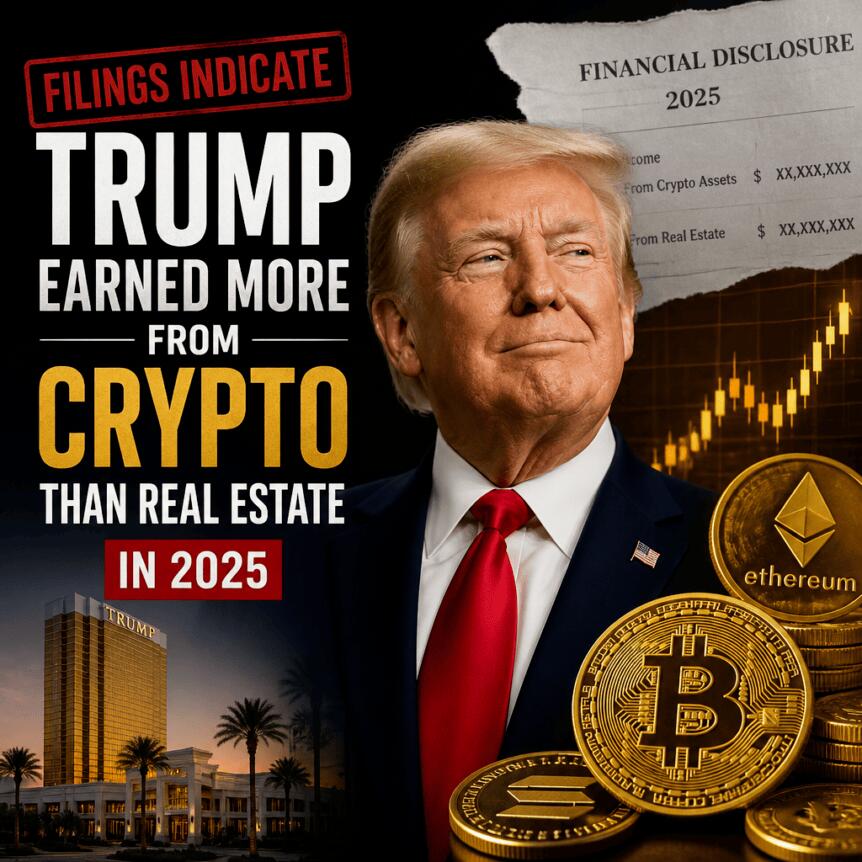
Donald Trump’s latest annual financial disclosure suggests his cryptocurrency-related ventures generated more income for him in 2025 than his real estate and resort businesses, reigniting scrutiny over potential conflicts of interest as his administration has promoted pro-crypto policies.
The U.S. Office of Government Ethics (OGE) released Trump’s 2025 annual financial disclosure on Tuesday in a report spanning 927 pages, showing that he earned more than $1.4 billion from crypto-linked activities last year. According to reporting by BBC, White House Deputy Press Secretary Anna Kelly said Trump has “proudly made the United States the crypto capital of the world,” adding that neither the president nor his family has “ever engaged — or will ever engage — in conflicts of interest.”
Key takeaways
Trump’s OGE financial disclosure reports over $1.4 billion in income tied to crypto ventures for 2025, surpassing income from his real estate and resorts. Memecoin licensing royalties were identified as the largest income source, followed by proceeds tied to World Liberty Financial token sales. The filing also indicates Trump holds cryptocurrency assets, including Bitcoin and Ether, as well as stablecoins such as USDC. Critics argue the structure of personal profit alongside government policy support raises conflict-of-interest concerns, while the White House rejects that claim.Crypto income dwarfs real estate and resorts
As detailed in the OGE filing released Tuesday, Trump reported more than $1.4 billion in income from crypto-related ventures in 2025. The scale of that figure stands out against his business income from traditional assets, including Mar-a-Lago and a portfolio of golf clubs and resorts.
In the same disclosure, Trump reported more than $290 million in income connected to revenue from his Mar-a-Lago Club in Palm Beach, Florida, along with other properties and resorts he owns. The contrast is central to the controversy surrounding the disclosures: critics point to the proximity between the administration’s stance on digital assets and the president’s family-linked financial activity.
Memecoins and World Liberty Financial lead the earnings
According to the disclosure, the biggest reported contributor to Trump’s crypto-related income came from the licensing and sale of memecoins, including “Trump Coin.” The filing attributes roughly $635 million in “royalties” to a “license agreement with Celebration Coins.”
The next-largest category cited in the report relates to World Liberty Financial, a DeFi platform associated with the Trump family. The disclosure states it generated about $588 million through “proceeds from token sales,” making it the second-largest income stream in the crypto portfolio described.
Trump’s reported crypto income also includes $197 million from selling equity in a stablecoin venture, the filing indicating a separate line item tied to that investment activity.
Digital assets listed in the filing
Beyond income, the disclosure also outlines certain crypto holdings. The filing states Trump owns more than $50 million in Bitcoin, with between $5 million and $25 million in Ether held in cold wallets.
In addition, the report references holdings that include USDC and USD Key (KEY). The presence of stablecoins and major cryptocurrencies among disclosed assets adds another dimension to questions about how personal exposure to the market intersects with government policy decisions affecting the sector.
White House response and renewed political pressure
Trump Organization communications emphasized what it characterized as transparency. Reuters reported that the Trump Organization said the filing’s “breadth and depth” underscores its commitment to transparency, describing the report as comprehensive.
Public Citizen, a nonprofit consumer advocacy group, took the opposite view. In a statement released Tuesday, the group called the reported crypto earnings an “obscene crypto grift,” arguing that the alignment between personal profit interests and government activity creates conditions for legislation that could put consumers at risk. Public Citizen co-president Robert Weissman was quoted urging Congress to act, warning that such conflicts could facilitate “mass rip-offs” and potentially threaten stability across the financial system.
In its broader critique, Public Citizen framed the disclosure as evidence that the president’s financial incentives are increasingly tied to the cryptocurrency industry itself. The White House, through Kelly’s statement to the media, denied any conflict concerns, asserting that the president and his family have not engaged—and will not engage—in conflicts of interest.
For investors and users watching the sector, the immediate follow-up is political rather than market-driven: the disclosures strengthen the case made by critics and may increase legislative and oversight focus on how digital-asset policy is crafted when the executive branch and private crypto interests appear intertwined. The key uncertainty remains how regulators and lawmakers will respond, and whether any specific conflict-of-interest questions translate into enforceable changes to rules or process.
This article was originally published as Filings Indicate Trump Earned More From Crypto Than Real Estate in 2025 on Crypto Breaking News – your trusted source for crypto news, Bitcoin news, and blockchain updates.





 Bengali (Bangladesh) ·
  English (United States) ·