


Hakushi Hasegawa had spent too much time alone.
The 27-year-old Tokyo artist has spent nearly a decade exploding familiar sounds into alien forms, slamming frantic keyboard melodies against pulverising percussion and their own digitally warped vocals to create works that hide pop hooks beneath the musical maelstrom. That vision earned them praise from listeners in Japan and beyond, leading to Hasegawa becoming the first Japanese musician to sign with American electronic label Brainfeeder, where they released the album ‘Mahogakko’ in 2024.
“But it was something I made entirely by myself, sitting in front of my computer the whole time,” Hasegawa tells NME about their prior release over a late-night video call from their home in early August. “It had become really difficult to step outside my own vocabulary, so to speak.”
So for the follow-up ‘Honest Feeling Album’, out this week, Hasegawa formed a band. They found players to form an outfit dubbed HaHa And The Hairpins, adding extra punch to their sketches. The resulting set features more force from guitars, percussion and horns, with songs such as ‘The Owner Of Sweetness’ bordering on a metal chug. Hasegawa’s wonkiness remains intact, but working in this setting led to surprises and challenges in equal measure.
“Since it’s actual people playing, and those people are…kind of eccentric people, all sorts of wonderfully strange sounds kept coming out of it, and that was really fun,” Hasegawa, who identifies as non-binary and uses they/them pronouns, says. “At the same time, there was also a real difficulty in making judgment calls. Like, is it OK to force this delightful, funny sound into my own texture or not?”
While considering others, ‘Honest Feeling Album’ still comes across as a fittingly pure expression of where Hasegawa is at as an artist. The rock and electronic whirlwinds are joined by dives into more vulnerable dance-pop, deceptively cheery bossa nova and more. It’s unpredictable, which Hasegawa revels in.
Hasegawa first came to music as an extracurricular activity, as their parents had them take piano lessons at a young age. That helped lead to a greater interest starting in junior high, including what Hasegawa laughs off as a very brief attempt at playing in a band for a school festival.
Their real gateway came online. Hasegawa connected with electronic creators via message boards, learning about a whole new world of music. They shared their first song in 2016, the jazz-tinged bounce of ‘Hadairo No Kawa’, and quickly gained attention from the Japanese internet music community. They built on that sound for their first release from influential netlabel Maltine Records a year later before expanding on and introducing more bombastic elements for a subsequent EP and debut album. Hasegawa offered a swerve in 2020 with the covers collection ‘Bones Of Dreams Attacked!’, featuring their takes on J-pop hits and a sweet rendition of the Disney classic ‘A Whole New World’.
“I consider myself the artist who most defies expectations”
This pinballing approach to style caught the attention of Western artists such as Porter Robinson, who featured Hasegawa on his 2020 online festival Secret Sky. Brainfeeder came a few years later (Hasegawa saying at the time that it was “an honour” to join the label), and seemed like a natural home for ‘Mahogakko’.
Yet Hasegawa was also being embraced by Japanese music even more – surprising for an industry that usually doesn’t spotlight jazz-damaged electronic works. But Hasegawa has produced songs for rappers, virtual artists and singer-songwriters while also remixing tunes by the likes of Tokyo Ska Paradise Orchestra (exactly what the name states).
Around the time of ‘Mahogakko’, Hasegawa made their most unlikely appearance to date on The First Take, a one-take YouTube music series usually hosting performances by the likes of Yoasobi, Hikaru Utada and Harry Styles. It was that experience that became the genesis of ‘Honest Feeling Album’.
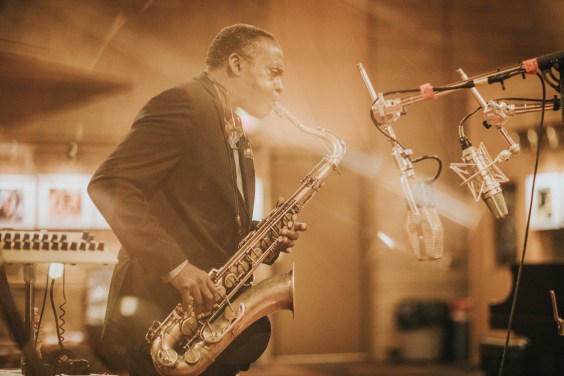
“At first I was only going to have the drummer Shu Akimoto join for The First Take. I asked him if he knew anyone else who could play this type of song,” Hasegawa says, noting how the performers gathered for the recording – Akimoto, percussionist Hitomi Aikawa, saxophonist Kei Matsumaru, and bassist Ryo Miyachi – served as a “prototype” for HaHa And The Hairpins, with guitarist Tokutaro Hosoi joining later.
 Hakushi Hasegawa credit: George Asakura
“Getting to meet those people who became band members, that might honestly have been the most valuable part of the whole experience,” they say.
Hasegawa finished the bulk of demos for ‘Honest Feeling…’ in early 2025. From there, they had to blend it with what the band could do. “I had to take their sound and somehow bring it into my own texture. My workload might have ended up being bigger than ever before, which was kind of unexpected.”
Bringing others in extended to guests who appear on ‘Honest Feeling…’, which Hasegawa picked based on a general feeling of who would work best where. It’s an eclectic bunch representing the diversity of modern Japanese music and beyond. Vocalist Accorinrin of in-your-face punk band Otoboke Beaver powers the bludgeoning ‘Why The Hell Do I Have To Say Everything From One To Ten Each Time Each Time Each Time Each Time’, while virtual YouTuber Tsukino Mito plays the role of sweet idol voice on the brighter ‘Gettinhereroute’. Inspired by frequently seeing their between-song banter at shows, Hasegawa recruited Japanese electronic artist Tofubeats to offer sports-like commentary on Matsumaru’s sax playing for the madcap ‘Boss-Moire-FS’.
“I think Hasegawa’s appeal lies in how the music coexists with – and blends – various facets of their personality,” Tofubeats says over email a few days later about what makes Hasegawa stand out. “The academic background of a music college graduate, a love for experimental music, and the sensibility of someone who frequents clubs.”
“On ‘Honest Feeling Album’, I’d wanted from the very start to pay tribute to non-binary people who are already gone”
The ‘Honest Feeling…’ here comes from Hasegawa themselves. Songs featuring some of the catchiest moments in their catalogue hide lyrics they describe as the most aggressive and, in the case of “The Owner Of Sweetness,” the creepiest they’ve ever written. They can draw from literature (‘Nausea’ taking its name and themes of disappointment from Jean-Paul Sartre’s novel of the same name) or just channel their own playfulness (“Ultimately, all I want to do is make people laugh,” they say).
Hasegawa, who once concealed their identity entirely, is now more open about sharing themselves, and then warping that image into something new. Their singing on ‘Honest Feeling…’ is frequently pitched up into a bright tone that often clashes with the noise around them. That was in service of just one goal.
“It’s really just about one thing…singing cute,” they say with a laugh, citing their own love of “cute songs” and a personal focus on keeping a high formant in their songs, referring to the peak frequency produced by the resonance of the human voice.
“As I’m talking about it right now, I’m realising that anime songs and [Vocaloid avatar] Hatsune Miku have probably had a big influence on me,” they say. Within the sonic context of ‘Honest Feeling…’, it’s another disorienting touch playing off of the more abrasive instrumentation around it. Yet it’s also a nod to Hasegawa’s own influences and likes, helping to make the album feel more personal.
 Hakushi Hasegawa credit: Courtesy of Hakushi Hasegawa
That extends to their identity, nodded to on closer ‘Never Lack Nothing’, which adopts the style of a traditional bon-odori song, played at festivals as a way to honour the dead.
“On ‘Honest Feeling Album’, I’d wanted from the very start to pay tribute to non-binary people who have died – or rather, non-binary people who existed in the past and are already gone,” they say. “Once I had that in mind, I thought about what musical form would suit that best, and the answer was bon-odori, because that kind of music was originally meant for everyone to dance together in mourning.”
For an artist so hard to pin down, it’s a surprisingly personal moment. Then again, that’s what Hasegawa does best. “I consider myself the artist who most defies expectations,” they say when asked where they fit into modern Japanese music. “I use my own ever-changing musical language to create a situation in which I draw attention while simultaneously avoiding it.”
Hakushi Hasegawa’s ‘Honest Feeling Album’ is out on August 28 via Brainfeeder.
The post Electronic wizard Hakushi Hasegawa’s next experiment? Forming a band appeared first on NME.




 Bengali (Bangladesh) ·
  English (United States) ·