
 10 hours ago
3
10 hours ago
3 
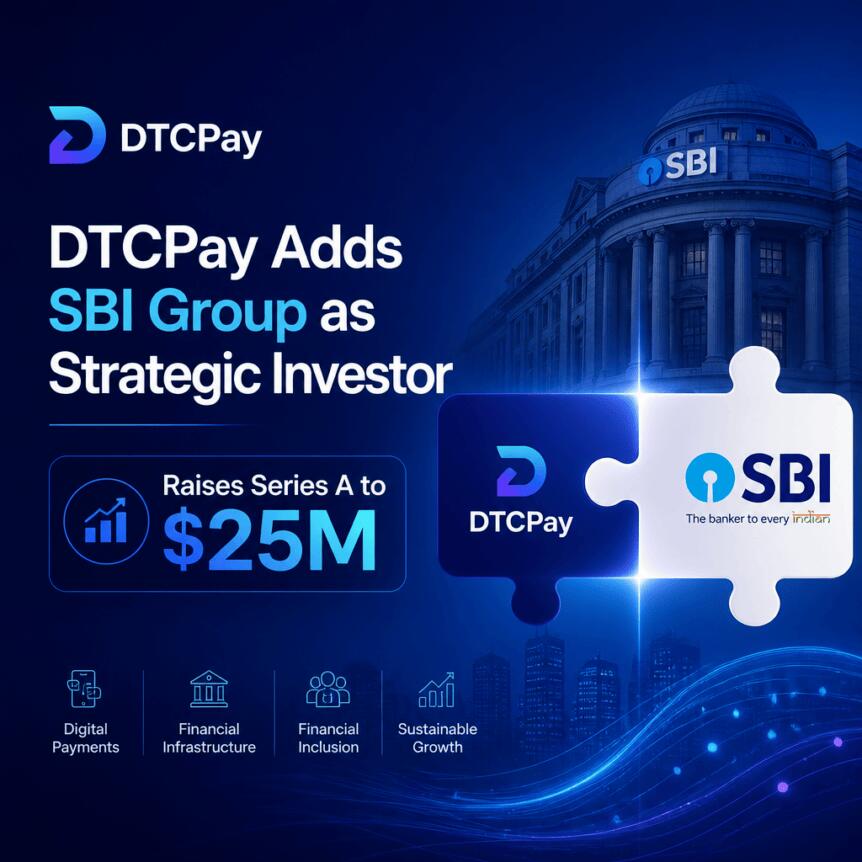
Singapore-based payment firm dtcpay has closed a $25 million Series A funding round, initially led by Vertex Ventures Southeast Asia & India and now bolstered by an additional anchor from Japan’s SBI Group. The company says the investment underscores growing institutional interest in stablecoin payments that aim to work with everyday finance instead of sitting on the margins of crypto.
dtcpay previously secured the Series A’s initial tranche in April, and the final round now includes participation from Genedant Capital and existing investor Kwee Liong Tek. In a company statement released Friday, dtcpay positioned the funding as a step toward making cross-border value transfers as frictionless as traditional payments.
Key takeaways
dtcpay has completed its $25 million Series A round, with SBI Group joining as a strategic anchor investor. Vertex Ventures Southeast Asia & India led the April portion of the raise, with additional participation from Genedant Capital and existing backer Kwee Liong Tek. The company markets its platform around “stablecoins as seamless and accessible” payments rather than a crypto-only experience. dtcpay’s Visa card reportedly enables spending using both fiat and stablecoins across 150 million+ merchant locations. Licensed operations span Singapore and the EEA, supporting the company’s focus on regulated payment services.SBI Group joins dtcpay’s Series A
dtcpay said the completed Series A was led by Vertex Ventures Southeast Asia & India, part of Vertex Holdings, which is wholly owned by Temasek Holdings. The company described the funding as coming at a time when stablecoins are increasingly being discussed by traditional finance players—particularly in contexts where settlement speed and cross-border transfer efficiency matter.
Japanese financial conglomerate SBI Group now adds further institutional weight to the round. The firm’s broader footprint across banking, securities, insurance, asset management, and digital assets gives dtcpay additional industry exposure as it scales its payment rails.
In its statement, dtcpay emphasized that the raise was not intended to simply extend existing operations. Founder and CEO Alice Liu said, “We did not raise this round to sustain what we have built. We raised it to fundamentally change how money moves across borders.”
From crypto payments to stablecoin-first transactions
dtcpay’s pitch centers on stablecoins as a payments layer that can integrate with consumer spending rather than requiring users to actively manage cryptocurrency portfolios. Cointelegraph previously reported that dtcpay launched a payment system for both in-store and online transactions using fiat and cryptocurrencies (coverage from 2023). In 2024, Cointelegraph reported dtcpay shifted toward stablecoin-only transactions, including support for stablecoins rather than assets such as Bitcoin.
This evolution matters for adoption because stablecoins align more closely with how most users experience pricing and budgeting—where volatility is a critical friction point. dtcpay’s current framing suggests the company is aligning product design with the needs of regular commerce: payments that behave more like digital cash and less like a speculative asset.
A Visa card built for fiat and stablecoin spending
A key element of dtcpay’s go-to-market strategy is its Visa card. The company says the card enables spending using both fiat and stablecoins across more than 150 million merchant locations worldwide. That distribution signal is part of why dtcpay describes stablecoin access as “seamless and accessible” in everyday settings, rather than limited to crypto-native venues.
For investors and market observers, this approach highlights the operational challenge behind many stablecoin payment narratives: the ability to move from a backend token settlement concept to a front-end experience that consumers can use without changing their payment habits. dtcpay’s mention of Visa merchant coverage suggests an emphasis on real-world usability and merchant acceptance at scale.
Regulated footprint across multiple jurisdictions
dtcpay also stresses its regulatory positioning. The company says it is licensed by the Monetary Authority of Singapore and holds an Electronic Money Institution license in Luxembourg. It also states it is authorized to deliver regulated payment services across the European Economic Area, while maintaining licenses and registrations in Hong Kong, Australia, the United States, and Canada.
It’s also worth noting that Genedant Capital—one of the participants in the round—is described by the company as a Singapore-based fund management firm licensed by the Monetary Authority of Singapore, with more than $2 billion in assets under management and advisory. Genedant’s involvement adds another layer of compliance-aware capital alongside the strategic capabilities dtcpay is seeking from its broader investor base.
In practical terms, the regulatory footprint is central to why institutional investors may be more willing to engage with stablecoin payment startups now than in earlier crypto cycles. While stablecoins themselves remain an area of ongoing policy debate globally, regulated payment licensing and cross-border authorization can reduce uncertainty around how value moves and how customer funds are handled.
As dtcpay takes this Series A forward with SBI Group and prior lead investor Vertex Ventures Southeast Asia & India, the next question for users and the market is how quickly the company can expand stablecoin-enabled payment features within its licensed framework—and whether more mainstream financial partners follow the same path.
This article was originally published as DTCPay Adds SBI Group as Strategic Investor, Raises Series A to $25M on Crypto Breaking News – your trusted source for crypto news, Bitcoin news, and blockchain updates.





 Bengali (Bangladesh) ·
  English (United States) ·