
 1 hour ago
6
1 hour ago
6 
Key Points
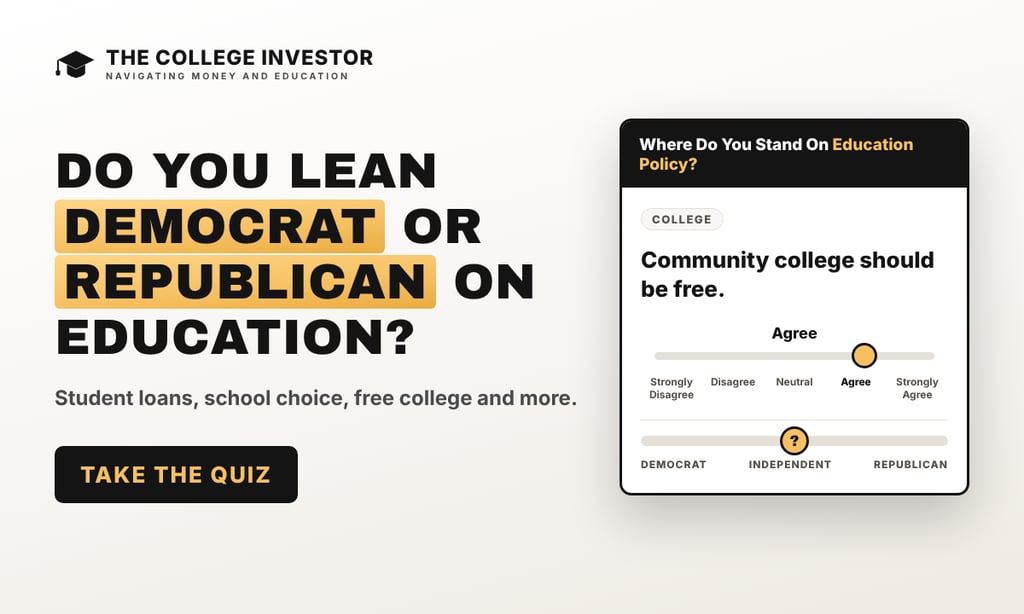
The quiz scores statements on a five-point scale and places you in one of five results, from Strong Democrat to Strong Republican. Each statement maps to a 2024 party platform, a federal law such as the One Big Beautiful Bill Act, a bill in Congress or a state policy.The College Investor’s education policy quiz shows whether your views on elementary education, college costs and student loans line up more with Democrat or Republican platforms.
Rate each statement and you’ll get an overall result, plus a separate lean for K-12 schools and for college.
Do your views on schools, college costs and student loans line up with Democrats or Republicans?
Rate each statement from Strongly Disagree to Strongly Agree. Your result compares your answers to recent party platforms, federal laws and state policies on education. It takes about two minutes.
Your answers stay in your browser. Nothing is saved or sent.
Start The QuizHow Does The Education Policy Quiz Work?
The quiz asks you to rate each statement from Strongly Disagree to Strongly Agree. Agreeing with half of the scored statements leans Democrat, and agreeing with the other half leans Republican, so someone who agrees with everything lands in the middle.
Many of the statements cover the biggest changes to student loans and federal aid in years, which Congress passed in 2025, along with other current policy debates such as test optional higher education.
A strong answer counts twice as much as a mild one, and Neutral doesn’t move you either way. Your answers place you on a scale between the two parties, and where you land sets your result. If the student loan statements hit close to home, our Student Loan Calculator estimates what you’d pay under the new repayment plans.
| Strong Democrat | Your answers match Democratic positions on nearly every statement |
| Lean Democrat | You side with Democrats on more statements than Republicans |
| Independent | Your answers split roughly evenly between the parties |
| Lean Republican | You side with Republicans on more statements than Democrats |
| Strong Republican | Your answers match Republican positions on nearly every statement |
Why Does The Quiz Split K-12 And College?
The results screen scores K-12 and college separately because plenty of people lean one way on K-12 education and the other way on student loans and higher ed policy.
The K-12 section covers preschool, school meals, teacher tenure and school choice, including the new federal school choice tax credit.
The college section covers admissions testing, free community college, student loan borrowing limits, accountability, endowment taxes and student loan forgiveness.
Why Each Statement Leans The Way It Does
Each statement ties to a party platform, a law, a bill introduced in Congress or a state policy. Open the drop-downs below after you take the quiz to see which party each statement lines up with, the sources behind it and where the parties overlap.
For the full sequence of federal changes, see our student loan timeline through 2028.
Spoiler alert: take the quiz first. Tap any statement to see which party it lines up with and the laws, bills and platforms behind it.
Why: The 2024 Democratic Party platform pledged free, universal preschool for every 4-year-old. In July 2025, congressional Democrats reintroduced the Child Care for Working Families Act, which would fund state preschool programs for 3- and 4-year-olds and push states toward universal access in high-need communities.
Where the parties overlap: Free pre-K isn’t only a blue-state policy. Republican-led Florida and Oklahoma both run universal pre-K programs, according to the Education Commission of the States.
Why: California, Colorado, Maine, Massachusetts, Michigan, Minnesota, New Mexico and Vermont serve free meals to all students, according to the Food Research & Action Center, and New York funded universal meals for the 2025-26 school year. All of those states have Democratic-controlled legislatures, though Colorado’s program came from a voter-approved ballot measure. In Congress, Sen. Bernie Sanders and Rep. Ilhan Omar introduced the Universal School Meals Program Act, which would make breakfast, lunch and dinner free for every student.
Where the parties overlap: High-poverty schools in every state can already serve free meals to all students through the federal Community Eligibility Provision. The partisan split is over covering every student, regardless of income.
Why: The 2024 Republican platform supports universal school choice in every state. The 2025 One Big Beautiful Bill Act created a federal school choice tax credit worth up to $1,700 for donations to K-12 scholarship groups, starting in 2027. The Democratic platform opposes private-school vouchers, and 30 Senate Democrats introduced a bill to repeal the credit.
Where the parties overlap: Some Democrats break with their party here. Democratic lawmakers in Louisiana, Nebraska and Pennsylvania have voted for expanded school choice, the Associated Press reported.
Why: The 2024 Republican platform supports ending teacher tenure and adopting merit pay. Republican-led Florida ended tenure for new K-12 teachers in 2011, and North Carolina and Kansas later rolled back their own tenure protections, according to Education Next. At the college level, Florida’s university system approved reviews of tenured professors every five years.
Where the parties overlap: The Democratic platform doesn’t address tenure directly. This statement leans Democrat because the push to end or limit tenure has come from Republicans.
Why: The Trump administration’s Compact for Academic Excellence in Higher Education, sent to universities in October 2025, asked schools to require a standardized test from undergraduate applicants. A 2022 Pew Research Center survey found 47% of Republicans said test scores should be a major factor in admissions, compared with 34% of Democrats.
Where the parties overlap: Testing’s comeback isn’t only political. Every Ivy League school now requires or strongly recommends scores, and dozens of colleges have brought back SAT and ACT requirements on their own.
Why: The 2024 Democratic platform pledged to make trade school and community college free for every American. Democrats have repeatedly introduced the America’s College Promise Act, which would give states $3 in federal money for every $1 they spend to waive community college tuition.
Where the parties overlap: Republican-led Tennessee launched the first statewide free community college program in 2015. A new study of Tennessee Promise found it raised earnings 6% to 8% for eligible students.
Why: The One Big Beautiful Bill Act ended Grad PLUS loans for new borrowers and set new federal borrowing caps on July 1, 2026: $100,000 for graduate students, $200,000 for professional students and $65,000 per child in Parent PLUS loans. The law passed without a single Democratic vote in the House or Senate.
Where the parties overlap: Undergraduate federal loans have had limits for decades under both parties. The fight is over graduate and parent borrowing, where caps now push more families toward private student loans.
Why: The One Big Beautiful Bill Act created an earnings test for every college, public or private. Under the Education Department’s final rule, programs whose graduates don’t out-earn high school graduates in two of three years lose federal loan access, starting as early as the 2028-29 school year.
Where the parties overlap: This is one of the closest calls in the quiz. The Biden administration’s 2023 gainful employment rule also cut aid to programs with poor earnings, but only certificate programs and for-profit colleges. Republicans applied the test to all colleges.
Why: Republicans created the first college endowment tax, a 1.4% tax on net investment income, in the 2017 Tax Cuts and Jobs Act. The One Big Beautiful Bill Act raised it to as much as 8% for the wealthiest schools and exempted colleges with fewer than 3,000 students.
Where the parties overlap: This lean is weaker than most. Democrats voted against the 2025 law as a whole, not against the endowment tax on its own.
Why: The Biden administration’s plan to cancel up to $20,000 per borrower, about $430 billion in total, was struck down 6-3 by the Supreme Court in Biden v. Nebraska in June 2023, after Nebraska and five other states sued. Under the current administration, Under Secretary of Education Nicholas Kent said student loan forgiveness is not happening.
Where the parties overlap: Even the 2024 Democratic platform stopped short of blanket cancellation. It pointed to $167 billion approved through targeted programs. A strong “agree” here puts you with the progressive wing more than the party line. Both parties still support targeted student loan forgiveness programs.
Why: Both parties support tying student loan payments to income. Republicans built the Repayment Assistance Plan into the One Big Beautiful Bill Act. It charges 1% to 10% of income, with a $10 monthly minimum and forgiveness after 30 years.
Where the parties split: The fight is over how generous payments should be. The Biden-era SAVE plan offered lower payments and faster forgiveness until seven Republican-led states sued, and a court order ended SAVE in March 2026.
Why Do So Many People Land In The Middle?
Education policy doesn’t split as cleanly along party lines as many voters assume. Republicans built income-based payments into the Repayment Assistance Plan, an idea Democrats also backed with the SAVE plan. A Republican president is who launched the Public Service Loan Forgiveness program.
Republican-led Tennessee launched the first statewide free community college program, and the Biden administration wrote a rule to cut federal aid to low-earning career programs before Republicans wrote an earnings test for every college into law.
Admissions testing shows the same overlap. Dozens of schools, including every Ivy League college, have brought back SAT and ACT requirements based on their own admissions data rather than pressure from either party. A result of Independent usually means your views cut across party lines, not that you lack them.
What The Quiz Doesn’t Measure
The quiz compares your views to party positions on education policy only, and it isn’t a recommendation for how to vote. Party positions also shift and individual candidates may not align with their overarching party. The statements reflect platforms, laws and bills as of October 2026, and we’ll update them as Congress and the states act on student loan debt and school policy.
Frequently Asked Questions
Is This Quiz Biased Toward One Party?
The quiz is built to be balanced. Five statements lean Democrat when you agree and five lean Republican, and every statement uses plain policy language instead of party names. The drop-downs cite the platform, law or bill behind each lean, including things like the Grad PLUS loan elimination.
Why Isn’t The Income-Based Repayment Statement Scored?
Both parties support tying student loan payments to income, so the statement doesn’t sort cleanly. Republicans created RAP in the One Big Beautiful Bill Act, and Democrats backed the SAVE plan until a court order ended SAVE in March 2026.
The parties disagree on how low payments should go and how long borrowers pay before forgiveness, which is harder to measure than overarching policy practices.
Does The Quiz Save My Answers?
No. Your answers stay in your browser and aren’t stored or sent anywhere, and retaking the quiz starts fresh. You can share your result with the share buttons on the results screen, which send only your result band and a link to this page, not your answers.
Which Laws And Policies Does The Quiz Reference?
The quiz draws on the 2024 Democratic and Republican platforms, the One Big Beautiful Bill Act, the Supreme Court’s 2023 ruling in Biden v. Nebraska and state policies on school meals, pre-K and tenure. Each dropdown links to its sources, along with our reporting on topics such as new federal loan limits.
Editor: Colin Graves
The post Do You Lean Democrat Or Republican On Education Policy? Take Our Quiz To Find Out appeared first on The College Investor.




 Bengali (Bangladesh) ·
  English (United States) ·