

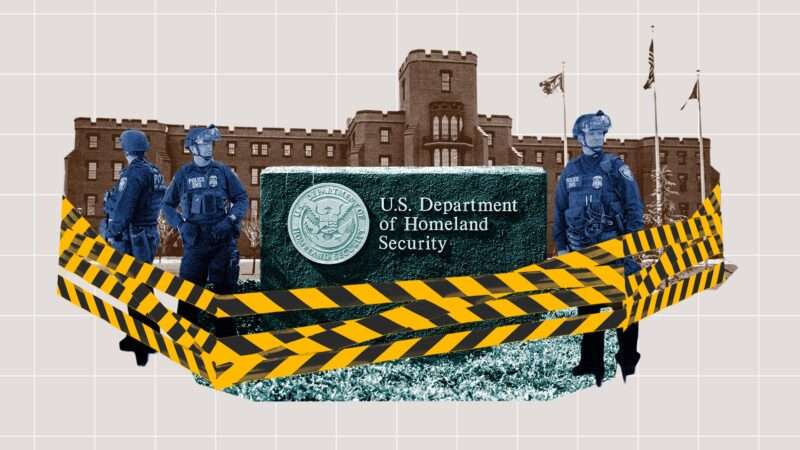
After officers of the Department of Homeland Security (DHS) shot and killed two American citizens in January, Democratic lawmakers threatened to let the department's funding lapse unless it changed its practices. As a result, the DHS shut down in February, and lawmakers have engaged with the Trump administration over what it would take to reopen.
This week, officials offered five concessions—two of which were just pledges to follow the law.
In February, Rep. Hakeem Jefferies (D–N.Y.) and Sen. Chuck Schumer (D–N.Y.)—each the Democratic leaders of their respective chambers—sent a list of demands to their Republican counterparts. Before Democrats would vote to fund the DHS, Republicans must agree to 10 "guardrails" against the department's overreach.
These included banning officers from wearing face masks, requiring that they display their name and agency on their uniforms, and ending racial profiling of suspects. It also asked the department to work more closely with local authorities, institute "a reasonable use of force policy," and "regulate and standardize the type of uniforms and equipment DHS officers carry during enforcement operations to bring them in line with civil enforcement."
In addition, Democrats called for an end to DHS officers "enter[ing] private property without a judicial warrant." The government currently claims that while conducting immigration raids, officers may enter homes without consent on the basis of an administrative warrant, which is signed by an immigration judge—an executive branch employee—rather than a magistrate judge, as the U.S. Constitution requires.
These were not radical proposals. "Some of these demands include rights that you'd think were already covered under the Constitution," Brandi M. Vail wrote at GovTrack. Further, as Reason's Christian Britschgi wrote at the time, "those are all incredibly popular positions," according to polls of Americans.
"Our DHS reform demands are exceedingly reasonable," Schumer wrote on X. "We're asking ICE to do nothing more than follow the standards that the vast majority of law enforcement agencies already follow. Republicans, the ball is in your court."
Border czar Tom Homan and White House Office of Legislative Affairs Director James Braid responded this week, offering five concessions in a letter to Sens. Katie Britt (R–Ala.) and Susan Collins (R–Maine).
"Throughout this process, the Administration has offered to codify improved operational guidelines to its immigration enforcement operations," the letter read. To that end, they pledged to "expand the use of body-worn cameras" for immigration officers, limit enforcement at "certain sensitive locations…like hospitals and schools," and "enforce the use of visible officer identification."
Homan and Braid further pledged, "the Administration will adhere to current law that affords Congress oversight of DHS detention facilities." Under a federal spending bill passed in 2024, members of Congress have the right to enter any federal immigration detention facility, but the DHS has routinely stonewalled their attempts.
Finally, Homan and Braid said, "the Administration will adhere to existing law and practice of not deporting any U.S. citizen and will codify current practice of not knowingly detaining a U.S. citizen."
"The White House…went above and beyond any initial offers," Senate Majority Leader John Thune (R–S.D.) said Tuesday. "There's a lot of stuff in there."
Democrats were unmoved. "We're trying to move a little bit, but they've got to get serious," Schumer said Tuesday. "They are not getting serious."
He has a point: Of the five "improvements" offered as concessions, two of them amount to simply agreeing to follow the law. Indeed, the administration offered "not deporting [or] knowingly detaining a U.S. citizen" as if it were a hard choice to give up, as opposed to the bare minimum we should expect from a law enforcement agency.
Limiting enforcement at churches and schools is welcome, as is requiring officers to be identified. But it offered no concessions on the use of face masks—which even the FBI admits is dangerous and makes it more difficult for Americans to tell the difference between cops and criminals.
It also declined to address the other demands on the original list, such as a "reasonable use of force policy," a moratorium on "paramilitary police," or an end to the blatantly unconstitutional practice of using administrative warrants—essentially, the executive branch giving itself permission to enter someone's home—instead of those signed by a member of the judicial branch.
And while the administration did pledge to expand body camera use by DHS officers—according to Thune, a fivefold increase in the amount of money set aside for cameras—its offer did not address Democrats' secondary request, that officials "mandate requirements for the storage and access of footage. Prohibit tracking, creating or maintaining databases of individuals participating in First Amendment activities."
Sadly, the DHS letter is an indication of how unserious the administration is about reforming its abusive practices.
"There are no concessions in here at all, and they are all merely promises, not an agreement to legislation that would be enforceable against its personnel," David J. Bier, director of immigration studies at the Cato Institute, wrote on X. "Absolutely zero reason at all for Congress to go along with this."
The post DHS Pledges Not To Deport Any U.S. Citizens if Congress Ends Shutdown appeared first on Reason.com.





 Bengali (Bangladesh) ·
  English (United States) ·