
 1 hour ago
9
1 hour ago
9 
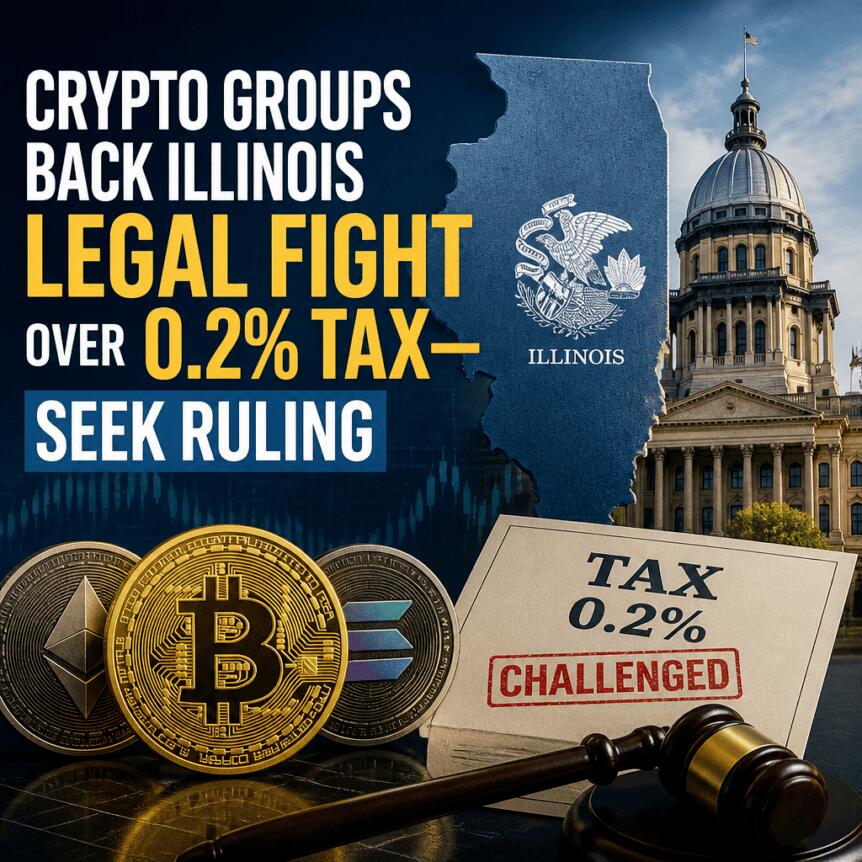
Two major US crypto advocacy groups, the Crypto Council for Innovation (CCI) and the Blockchain Association (BA), have asked an Illinois court to move quickly on a challenge to the state’s planned digital-asset tax. In a filing made in the Circuit Court of Sangamon County on Tuesday, the organizations requested an expedited timetable so the court can decide whether the Illinois Digital Asset Tax Act is lawful “as quickly as possible,” according to the motion.
The request builds on a broader legal effort that also includes claims filed by the Digital Chamber and the Illinois Blockchain Association. The outcome matters for market participants and businesses preparing for an upcoming tax regime that Illinois law currently aims to introduce in 2027.
Key takeaways
CCI and BA asked Illinois’ Sangamon County court for an expedited schedule to rule on the merits of the Digital Asset Tax Act. The motion seeks faster summary judgment consideration, potentially leading to a decision by March if the court agrees. Illinois officials previously delayed implementation of the 0.2% crypto tax by six months, moving the start date from Jan. 1 to July 1, 2027. The case is tied to objections that the tax was added without adequate debate or public input.Illinois’ digital-asset tax challenge heads for speed
The Tuesday court filing asked the Sangamon County Circuit Court to approve an expedited schedule for summary judgment, with the explicit goal of reaching a ruling on whether the law itself is valid. The filing references CCI’s and BA’s existing lawsuit against Illinois state officials, as well as parallel litigation brought by the Digital Chamber and the Illinois Blockchain Association.
CCI CEO Ji Kim said in connection with the filing that pausing enforcement protects Illinois consumers and businesses from what he described as an “onerous and legally flawed” tax until July 1. At the same time, he emphasized that the legal merits should be resolved without prolonged delay.
If granted, the expedited schedule could push the case toward a merits decision as early as March, though that timetable remains subject to court approval. For investors and industry operators, a faster resolution would reduce uncertainty around potential tax liabilities tied to digital-asset activity and planning assumptions for 2027.
Implementation delayed, but the dispute continues
Earlier this month, Illinois officials agreed to delay enforcement of the 0.2% digital asset tax for six months—from an original Jan. 1 start to July 1, 2027. Coverage of that development noted the agreement came in response to arguments that the tax had been inserted into the state budget without sufficient debate or public feedback.
As part of the same broader legal challenge, the Digital Chamber has maintained that it will keep litigating. Its CEO, Cody Carbone, said at the time that the organization would continue the case until the tax is “struck down for good.”
That context is important: even with enforcement paused, the core question is whether the tax can survive legal scrutiny. An expedited path toward a merits decision could determine whether businesses should prepare for compliance in 2027 or recalibrate expectations if the law is invalidated.
The filing’s emphasis on summary judgment suggests the plaintiffs are asking the court to decide the legality of the act without waiting for a full trial—an approach that, if accepted, can significantly accelerate final outcomes compared with slower litigation schedules.
What an expedited schedule could change for businesses
For firms that hold, transact, or otherwise support digital-asset activity, tax rules are not a purely academic issue—they affect cost structures, reporting, and operational planning. Illinois’ planned tax is scheduled to take effect in 2027 unless the court stops it. By pressing for faster adjudication, CCI and BA are effectively trying to shorten the period in which companies must plan under uncertain legal conditions.
Equally, an earlier merits ruling could reduce the risk that the dispute lingers through multiple compliance cycles. While Illinois already agreed to a partial delay, that postponement does not settle the larger legal questions. The plaintiffs’ request signals they believe those questions can be resolved promptly, without years of additional procedural steps.
Still, readers should note the key uncertainty: the court’s decision to grant expedited scheduling is not guaranteed. Even if expedited consideration is approved, the timing and scope of what the court decides may be shaped by procedural factors and judicial discretion.
Blockchain Association prepares leadership transition
Separately from the Illinois tax case, the Blockchain Association announced a leadership change this week. On Friday, Summer Mersinger is scheduled to step down as CEO as part of a transition plan.
According to the report, Mersinger joined the advocacy group last year after resigning from the US Commodity Futures Trading Commission. Kristin Smith, the organization’s former CEO, will serve as interim head. Mersinger is expected to remain involved until the end of 2026.
Leadership transitions can affect the pace and strategy of advocacy, especially when organizations are engaged in active litigation or policy campaigns. For observers tracking the Illinois dispute, it may be worth watching whether the new interim leadership keeps the same litigation posture and communications cadence during the period when the court is considering the accelerated schedule.
As Illinois’ court weighs whether to expedite summary judgment, the next development to watch is whether the judge agrees to the timetable—potentially bringing a merits decision sooner than the normal pace. Until then, the dispute over whether the 0.2% tax can legally stand remains the central driver of compliance uncertainty for Illinois-based and affected digital-asset businesses.
This article was originally published as Crypto Groups Back Illinois Legal Fight Over 0.2% Tax—Seek Ruling on Crypto Breaking News – your trusted source for crypto news, Bitcoin news, and blockchain updates.





 Bengali (Bangladesh) ·
  English (United States) ·