

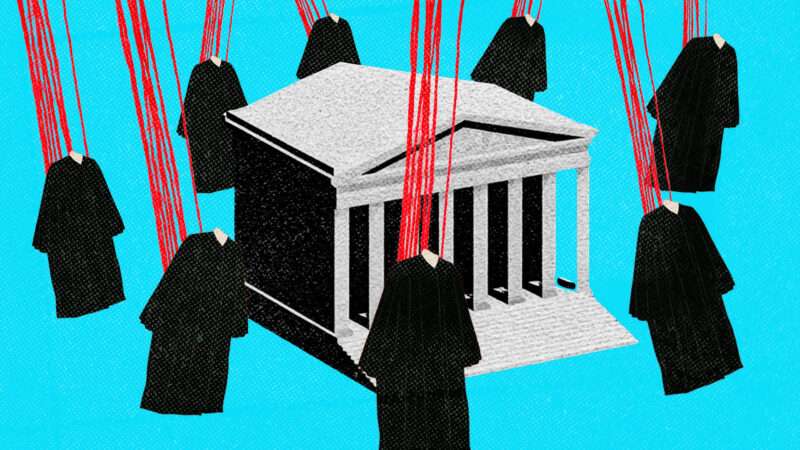
Article III, Section 1, of the U.S. Constitution says that "the judicial Power of the United States shall be vested in one supreme Court, and in such inferior courts as the Congress may from time to time ordain and establish." The document says nothing about how many justices should actually sit on the Supreme Court, leaving that rather important decision entirely in the hands of Congress.
For advocates of court packing, or court expansion, or whatever other label the idea of adding new justices to the Court might happen to be going by nowadays, this constitutional language is a very handy ally to call upon and legal authority to cite. Whether you are in favor of court packing, opposed to it, or simply agnostic about the concept, there is no doubt about its constitutionality.
Or is there? A recent Wall Street Journal op-ed tried to make the case that court packing is in fact unconstitutional because "it would undermine the separation of powers and the independence of the judiciary."
I agree that court packing is a bad idea. (My views are spelled out at length in this February 2021 Reason cover story.) But I don't find the legal argument on offer here to be persuasive. In fact, it seems to me that the op-ed undermined its own case at the outset by conceding the following: "Article III establishes 'one Supreme Court,' and Article I mentions 'the Chief Justice,' but otherwise the Constitution leaves to Congress the authority to establish the structure of the federal judiciary, including the number of justices."
It's worth remembering that not every unwise idea in American politics is also an unconstitutional idea. For example, Article I, Section 8, grants Congress the authority "To lay and collect Taxes, Duties, Imposts, and Excises." When President Donald Trump tried to usurp this power by unilaterally imposing tariffs on much of the world, that was unconstitutional because Trump sought to wield tariff-making powers that the Constitution did not assign to him. But if Congress had duly passed its own slate of economically harmful tariffs, there would be no comparable constitutional case against those tariffs because, for better or worse, Congress would have been acting within its lawful sphere.
Here's another example: Article III, Section 2, subjects the Supreme Court's appellate jurisdiction to "such Regulations as the Congress shall make." I happen to think that if Congress ever regulated the Supreme Court's appellate jurisdiction in an overly partisan manner, then such a regulation would harm the independence of the judiciary. And yet, such congressional power, as dangerous as it may be when used in such a fashion, is still present in the Constitution.
Like it or not, court packing, though unwise, is still constitutional.
The post Court Packing Is a Bad Idea. But It's Still Constitutional. appeared first on Reason Magazine.




 Bengali (Bangladesh) ·
  English (United States) ·