

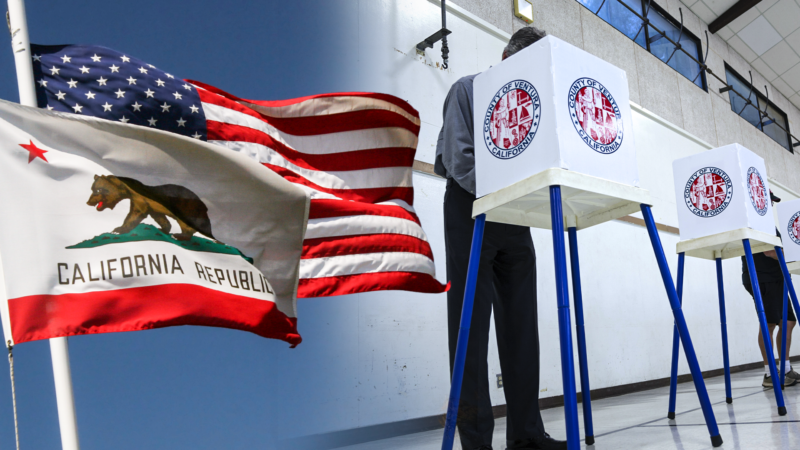
The November California elections are shaping up to be fairly wild. There's no clear frontrunner in the governor's race, and a non-zero possibility that two Republicans take the top two primary slots and head to the general election.
That's because multiple, second-tier Democrats are slicing up the Democratic vote into small portions, and Republicans are splitting theirs between only two choices. That would be something to see how any Republican would govern in a state with Democratic legislative supermajorities. Weird times.
If that happens, expect renewed vigor for revisiting the top-two primary, which was sold as a means to moderate the parties—not to create electoral flukes. And, of course, the November congressional midterms will be a referendum on Donald Trump's divisive second term. Based on the smattering of Democratic special-election victories in deep-red districts nationwide, Democrats expect an energized base that will express its displeasure at the administration. California voters will vote in hastily redrawn congressional districts designed to boost Democratic seats.
Lost in the partisan scuffles, however, are some serious nonpartisan—but ideological—initiative battles. The statewide initiatives likely to qualify for November are among the most substantive ones that we've seen in years. One initiative is grabbing the lion's share of media attention: a union effort to impose a one-time wealth tax on the state's billionaires.
California voters tend to be far more conservative in their initiative choices than they are in their candidate choices, but if Democrats turn out in droves, this one has a serious chance. Many prominent Democrats understand the dangers it poses to the state's business climate and capital-gains-dependent budget. Gov. Gavin Newsom, for instance, has publicly opposed it. The latest poll shows initial support at around 50 percent, with only 28 percent opposed.
Still, initiatives usually fail if they aren't well above 50 percent at the outset. And given that it targets the wealthiest Californians, it's likely these folks will spend extravagantly on the "no" campaign. The measure applies retroactively, but wealthy people are nevertheless moving out of state—and the retroactive language is a prime target for a lawsuit. A new tax is the last thing our overtaxed state needs, but there's no stopping unions, which always want more tax money to fund salaries and programs.
Two other initiatives, both likely to reach the ballot, are cause for optimism. The first, sponsored by the California Chamber of Commerce, would finally provide wide-scale reform of the California Environmental Quality Act. Even many Democrats have slammed CEQA, as it stops myriad projects—including environmentally friendly ones—or adds costs and delays. This "landmark" environmental law requires developers to provide voluminous environmental impact reports. It invites lawsuits—not just from environmental groups, but from unions that use it to secure wage concessions.
Admirably, the Legislature has chipped away at CEQA with exemptions and streamlining provisions for certain types of (mainly) housing projects. But this piecemeal approach is inadequate, with recent reports showing the most prominent new laws haven't resulted in significant new housing starts. Lawmakers have refused to adopt broader CEQA reforms, so it may be left to voters to decide.
The Chamber measure shouldn't suffer with a large Democratic turnout, as many Democrats have backed CEQA reform. One of the Legislature's most prominent progressives, Assembly member Buffy Wicks (D–Oakland) supports it. Per State Affairs, Wicks "mentioned a hearing in which she heard from one Southern California solar company that spent 12 years—preparing a 1,100-page environmental review and getting 72 permits from 28 different agencies—to build one transmission line." That's nuts, but consistent with other anecdotes.
The other encouraging measure comes from the Howard Jarvis Taxpayers Association. It would limit transfer fees on property sales and overturn Los Angeles' disastrous Measure ULA "mansion tax," which imposes 4 percent fees on sales of real estate between $5.3 million and $10.6 million and 5.5 percent fees on those above $10.6 million.
Because it applies to all commercial properties, Measure ULA has crushed apartment construction. It has raised only a portion of the promised proceeds, while undermining property tax revenues. The measure would also overturn a court decision that allowed local special taxes to be approved with a majority rather than a supermajority vote. This is the closest we've seen in years to a good, old-fashioned Prop. 13-style ballot-box tax battle. Local governments are freaking out, which actually is a good sign.
Voters likely will decide on a variety of complex initiatives that reflect some internecine interest-group squabble, but there's another one that will grab much media attention: an effort to approve a Voter ID law. It seems to have enough signatures to qualify. Such laws are fine enough if they create public confidence in elections, but there is so little identification-related voting fraud that it's clear this is mainly an effort to gin up Republican voter turnout.
For political nerds, November could be an election for the ages.
This column was first published in The Orange County Register.
The post California Democrats May Have To Choose Between 2 Republicans in November's Gubernatorial Race appeared first on Reason.com.





 Bengali (Bangladesh) ·
  English (United States) ·