

First things first, because this is the question that brought you here: you may buy Zcash (ZEC) today, and you may still own ZEC after July 10, 2027. What the European Union prohibits from that day is something else. What becomes forbidden is for an EU-licensed crypto exchange to keep an account for you through which transactions can be made anonymous or heavily obscured. The prohibition is addressed to the provider. Your ownership of the coin is untouched by it.
That distinction decides what you have to do over the coming twenty-two months and what you do not. It does not appear in the headlines that have been running through the crypto press since August 22, 2026, even though many readers are encountering Zcash for the first time right now: the ZEC price has jumped to its highest level in eight years, and since August 21 a fifth amended version of an application has been sitting in Washington that would turn a fund running since 2017 into the first US spot ETF on Zcash. Anyone buying in that situation should first know what legal position applies alongside it in Europe.
This article answers the three factual questions that follow: what EU law forbids in its actual wording, where you can buy and keep ZEC until then, and what happens to your holding if your exchange stops trading it. A price forecast is not what you will find here.
Does the EU Really Ban Buying Zcash From July 2027?
No. The legal basis is Regulation (EU) 2024/1624 of May 31, 2024, usually referred to in practice as the AMLR or the EU anti-money-laundering regulation. A regulation of this kind applies directly in every member state, without a national parliament having to cast it into domestic law first. Article 90 of the regulation sets the date of application at July 10, 2027, with a later deadline of July 10, 2029 for individual groups of obliged entities under Article 3, point 3.
The prohibition is expressly addressed to credit institutions, financial institutions and crypto-asset service providers. A crypto-asset service provider, CASP in supervisory language, is a company that provides crypto services commercially and is licensed for that purpose under EU Regulation 2023/1114. What is meant, then, are exchanges, brokers and custodians. Private individuals do not appear in the provision as addressees.
The practical effect is noticeable all the same, because once European trading venues may no longer carry a crypto-asset, it disappears from their trading pairs. That is exactly what a delisting is: the removal of a trading pair from an exchange's offering, usually with a limited window in which customers can still withdraw their holdings. As our existing article on the legal position on the privacy coin ban shows, that path has been legally mapped out ever since the regulation entered into force in the summer of 2024.
What Article 79 of the EU Anti-Money-Laundering Regulation Forbids in Its Actual Wording
The decisive passage sits in Chapter VIII, headed "Measures to mitigate risks deriving from anonymous instruments". Article 79(1) reads in the official English version:
"Credit institutions, financial institutions and crypto-asset service providers shall be prohibited from keeping anonymous bank and payment accounts, anonymous passbooks, anonymous safe-deposit boxes or anonymous crypto-asset accounts as well as any account otherwise allowing for the anonymisation of the customer account holder or the anonymisation or increased obfuscation of transactions, including through anonymity-enhancing coins."
Read that closing clause carefully. What is prohibited is the keeping of an account that allows obfuscation, and the anonymity-enhancing coin is one of the routes by which that can happen. The legislator has written no ban on ownership, ordered no confiscation and created no reporting duty for holders. It has forbidden regulated houses to keep an account.
What a Crypto-Asset Account Is Under the Regulation
The AMLR defines the term by referring to Article 3, point 19 of Regulation (EU) 2023/1113, the transfer of funds regulation. In practice what is meant is the account a service provider keeps for a customer and through which crypto-assets are held and transferred. A wallet whose keys are yours alone does not fall under it, because nobody keeps it for you.
Which Coins Count as Anonymity-Enhancing Crypto-Assets?
Here too only the text of the regulation helps. Article 2, point 25 defines anonymity-enhancing coins as "crypto-assets that have built-in features designed to make crypto-asset transfer information anonymous, either systematically or optionally".
The word optionally is the reason Zcash is a subject of this debate at all. Zcash has two address types. A transparent address, colloquially a t-address, records sender, recipient and amount openly in the chain, the way the large, non-anonymising networks do. A shielded address, the z-address, hides those details with a cryptographic zero-knowledge proof. A zero-knowledge proof is a procedure by which the validity of a transaction can be evidenced without revealing its content. Anyone using ZEC can switch between both worlds. That very freedom of choice satisfies the "optionally" criterion.
What is missing from the regulation is remarkable: the text names no individual cryptocurrency and carries no list. What it describes is a technical property. Whether a particular crypto-asset carries that property is judged first by the obliged companies themselves and after that by the competent supervisory authorities. For you that means: rely on your provider's notice, not on a list that officially does not exist at all.
 Twenty-two months remain: on July 10, 2027 the account-keeping prohibition of Article 79 takes effect for every crypto service provider licensed in the EU.
Why the ZEC Price Ran to an Eight-Year High in August 2026
On August 23, 2026 at 06:34 UTC, ZEC is quoted at around $790, measured at Coinpaprika. Over seven days that leaves a gain of a good 62 percent, and over the day a loss of just under 4 percent after the previous day's high. Market capitalisation stands at about $12.9 billion, trading volume over the past twenty-four hours at around $1.2 billion. That puts Zcash twelfth among the largest crypto-assets by market capitalisation. In circulation are around 16.33 million ZEC out of a cap of 21 million.
The industry outlet The Block reported a daily high near $857 on August 22, and thereby the first level above $800 since January 2018. Price and volume figures from different data providers diverge over the course of a day; the range between roughly $790 and roughly $857 between August 22 and August 23 is therefore the more honest statement than a single smoothed value.
What Grayscale's Fifth S-3/A for a Zcash Spot ETF Means
An S-3/A is the amended version of a registration form that an issuer files with the US Securities and Exchange Commission before it may offer shares publicly. The suffix A stands for amendment, that is, for a revision of the original application.
According to the SEC's public filing index for identification number CIK 0001720265, the Grayscale Zcash Trust filed an S-3/A on August 21, 2026 under accession number 0001193125-26-361067, three days after the fourth version of August 18. On the same August 21 there is additionally an 8-K on file, the reporting form for material events. The application provides for renaming the trust, which has been running since 2017, to The Zcash ETF, listing the shares on NYSE Arca under the ticker ZCH, charging an annual sponsor fee of 2.5 percent and leaving custody with Coinbase Custody.
A filing is not a decision. The SEC has not ruled on this application, and neither a date nor an outcome can be inferred from the number of revisions. What can be evidenced is the process itself: five versions within a few months show that the issuer is actively pursuing it.
Where to Buy ZEC Today Through a Regulated Crypto Exchange
Until July 10, 2027 nothing changes for buying within the EU. What matters is that your trading venue holds a licence under EU Regulation 2023/1114, known as MiCAR, which sets the single legal framework for crypto-asset services in the Union. Licensed providers are listed by the European Securities and Markets Authority, ESMA, in a public register under Article 110 of that regulation. If you want to compare which houses carry that licence and where their fees stand, our overview of the best regulated crypto exchanges helps with the sorting.
Two points are best checked by you before your first purchase, because they differ from provider to provider. First, whether ZEC is tradable there at all; some houses already do not carry shielded crypto-assets today. Second, whether withdrawals are possible and to which address type, because without a withdrawal function your holding is stuck until trading ends.
What Happens to Your ZEC Holding if Your Exchange Delists
The regulation does not govern the course of a delisting and says only what may no longer be the case from the effective date. The specific deadlines, the end of trading and the last chance to withdraw are therefore set out exclusively in the notice from your particular provider, and experience shows those notices come with lead time, but not years in advance.
What you do hold in your own hands are two things. You can move your holding to your own wallet at any point beforehand and are then independent of any provider decision. And you can set yourself a reminder for the spring of 2027 to review the situation once more then, rather than relying on an email that might land in the spam folder. Whoever leaves the holding at the exchange until the very end hands over the decision on timing.
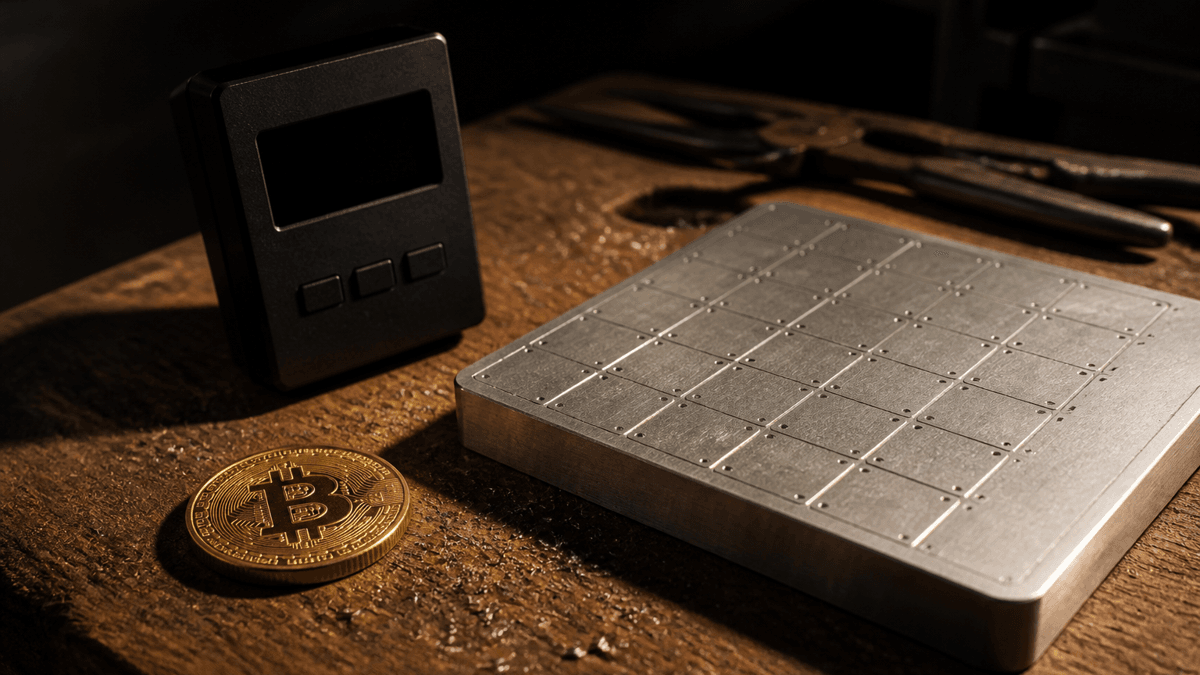 Self-custody is the only route that the AMLR's account-keeping prohibition does not reach in the first place.
Self-Custody: Why Recital 160 Exempts Your Own Wallet
The most important sentence for you is not in the enacting terms but in the recitals of the regulation. After describing the prohibition, recital 160 expressly records:
"That prohibition does not apply to providers of hardware and software or providers of self-hosted wallets insofar as they do not possess access to or control over those crypto-asset wallets."
A self-hosted wallet, usually called a self-custody wallet, is a wallet whose private keys lie exclusively with you and which no service provider can access. The European legislator saw that case and deliberately carved it out. That settles the opening question for good: a ZEC holding in your own wallet is not caught by Article 79, neither today nor after the effective date.
If you take that route, the quality of your custody decides everything else, because a lost key is lost for good. Our hardware wallet comparison ranks the common devices by usability, supported crypto-assets and backup design. Check expressly whether the device supports shielded Zcash addresses or only transparent ones, because devices differ here.
Shielded or Transparent: Which ZEC Address You Need for the Withdrawal
When withdrawing from the exchange you have to state a destination address, and with Zcash that is no formality. A transparent address behaves as on an open network: anyone can read the amount and the parties in the chain. A shielded address hides those details. Both are valid Zcash addresses, but not every service provider and not every wallet supports both.
In practice that means a short sequence that saves you trouble later. Set up the wallet first and check which address type it gives you. Then copy the address into your exchange's withdrawal form and see whether the form accepts it at all. After that send a small test amount and wait for confirmation before the rest follows. Those three steps cost you ten minutes and one network fee.
Tax: How a Forced Delisting Is Treated Under Section 23 of the German Income Tax Act
Here two processes part company that are often confused in everyday life. Transferring your ZEC from the exchange to your own wallet is not a sale. Only the place of custody changes, not the owner, and no proceeds flow. A sale, by contrast, is a private disposal transaction within the meaning of section 23(1) sentence 1 no. 2 of the German Income Tax Act if no more than a year lies between acquisition and disposal. That also holds when your provider's delisting forces you into that sale; tax law does not ask about the motive.
On the legal consequences side sits section 23(3) sentence 5 of the Income Tax Act. Gains remain tax free if total gains from all private disposal transactions in the calendar year came to less than 1,000 euros. That is an exemption threshold, not an allowance. The difference is expensive: at a gain of 999 euros everything stays tax free, at 1,001 euros the full amount becomes taxable, not just the excess.
The tax administration's position on crypto-assets was summarised by the German Federal Ministry of Finance in its circular of March 6, 2025 under file reference IV C 1 - S 2256/00042/064/043. It replaces the earlier circular of May 2022 and contains, for the first time, its own sections on cooperation and record-keeping duties. Anyone trading across several exchanges and wallets can therefore hardly avoid a clean transaction history; our overview of crypto tax tools and portfolio trackers shows which programs correctly recognise wallet transfers as a non-taxable event. This section does not replace tax advice.
Is the Planned US Spot ETF Reachable for You as a European Investor?
Even if the SEC one day waves the application through, that does not mean you can buy the shares at your European broker. The reason lies in the PRIIPs Regulation (EU) No 1286/2014. Its Article 13(1) obliges any person selling a packaged investment product to retail investors, or advising on it, to provide a key information document in good time beforehand. If no such document exists for a US product in the relevant national language, European brokers regularly cannot offer it to retail clients.
Whether and when an issuer produces such a document is its own decision. For planning your own holding, the US ETF is therefore for now a market signal and not a route to invest. The dependable statement is this: buying the crypto-asset directly through a MiCAR-licensed provider is the route open to you in the EU today.
What Separates Zcash, Monero and Dash in Legal Terms
The regulation turns on a technical feature, and that feature is present to differing degrees among the well-known shielded crypto-assets. Monero (XMR) anonymises transfers systematically, meaning in every case and with no option. Zcash anonymises optionally, depending on the address type chosen. Dash offers a mixing function that can be switched on and has for years been classified differently by its developers than the other two. With its wording "systematically or optionally", the definition in Article 2, point 25 covers both designs.
To place the orders of magnitude, all values retrieved on August 23, 2026 at around 06:35 UTC at Coinpaprika: ZEC is quoted at around $790 in twelfth place, XMR at around $431 in twenty-first, DASH at around $39 in one hundred and ninth. Over the week ZEC leads with a good 62 percent, DASH stands at around 33 percent, XMR at just under 5 percent.
Whether an individual crypto-asset ultimately falls under the definition is not decided by the regulation itself. That assessment is made by the obliged companies and the supervisory authorities, and it can differ between member states and between providers until a uniform practice has settled. For your planning, preparation therefore matters more than the fine legal delimitation.
What the Halving Dispute Has to Do With It
Alongside the price move, a vote of holders is running at Zcash on whether the regular halving of the block reward should be abolished. That question concerns the monetary policy of the network and has nothing to do with European anti-money-laundering law. The vote is, however, a second reason why ZEC is turning up in so many timelines right now, and anyone holding a position should keep the two apart.
Buying Zcash: What to Take Away
Sort out your trading venue first. Check whether your provider holds a MiCAR licence and whether it carries ZEC and pays it out. The comparison of regulated crypto exchanges takes the first round of sorting off your hands. Move the holding into your own custody in good time. Recital 160 expressly exempts self-hosted wallets from the prohibition. Which device suits you and whether it supports shielded addresses is settled by the hardware wallet comparison. Keep the history running before you need it. A forced sale within the one-year period is a private disposal transaction, and the 1,000 euro exemption threshold tips over at the first euro above it. The crypto tax tools compared separate wallet transfers cleanly from sales.And a fourth point that no tool handles for you: set yourself a reminder for the spring of 2027. There is enough time until then, but the deadline runs from July 10, 2027 with no injury time.
Primary sources to read up on: the official English full text of Regulation (EU) 2024/1624 at EUR-Lex and the filing index of the Grayscale Zcash Trust at the SEC.
(As of August 23, 2026. This article is not investment advice. Prices and fee structures change; check the terms with the provider before you buy.)




 Bengali (Bangladesh) ·
  English (United States) ·