
 1 hour ago
4
1 hour ago
4 
According to AlJazeera, Donald Trump pushed his self-imposed deadline for attacks on Iran’s power grid back to April 6, citing progress in negotiations and continuing to pressure Tehran to reopen the Strait of Hormuz. Bitcoin recovered to $66,400 on March 28 after hitting a low near $65,500 the previous day. The on-chain picture beneath that recovery shows institutions selling, short-term holders capitulating at a loss, and options traders pricing further weakness, while the one constructive signal in the data sits idle, waiting for the same date every large participant is watching.
What the Chart Shows
On the one-hour Binance chart, Bitcoin opened the week of March 22 around $70,500 and pushed to a high near $71,500 on March 23 before a sustained selloff began. Price declined through March 24, 25, and 26 without a single recovery candle gaining traction.
The 50-period simple moving average sat at $67,700.22 throughout, above price and sloping steeply downward, turning what should have been a dynamic support level into an overhead ceiling price never reached again after the March 23 high.
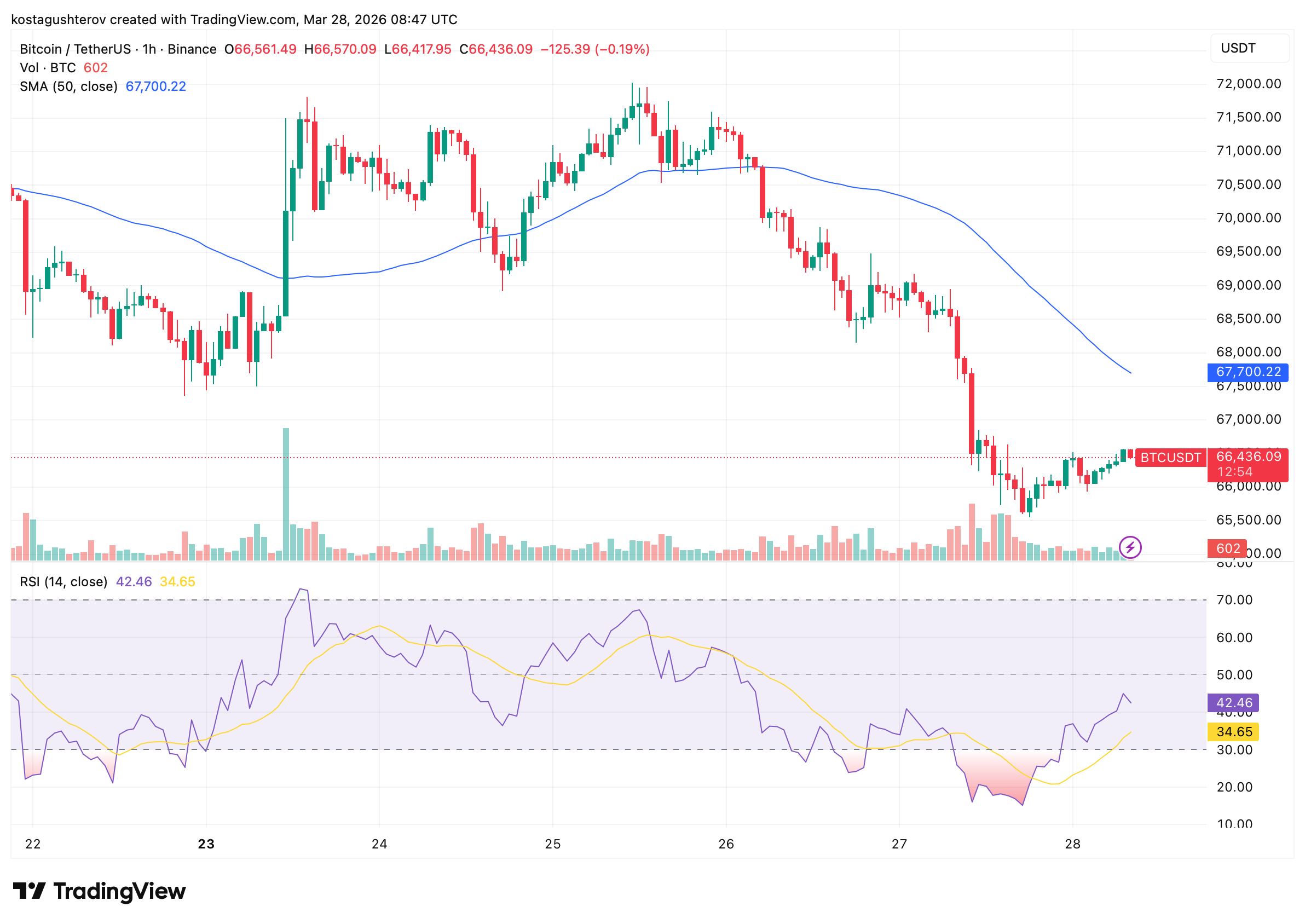
The sharpest move came on March 27, when a single candle dropped Bitcoin from below $68,500 to a low near $65,500 before a partial recovery brought price back to $66,436 by March 28. The 50 SMA remains $1,264 above current price and pointing lower.
The RSI reads 42.46 against a smoothed signal at 34.65. Buying conviction has crossed above its average and is building from a session low near 15 recorded on March 27. The recovery from extreme oversold conditions is real. The trend has not reversed.
Institutional behaviour through the same window explains why the recovery has found no follow-through.
Institutions Have Been Reducing Exposure
According to CryptoQuant data, the Coinbase Premium Index has returned to its most negative level since February. The driver is the Iran conflict, specifically its effect on oil prices through Strait of Hormuz disruptions and the resulting inflation and bond market implications. Institutional investors are acutely sensitive to those variables. As macro conditions deteriorated through late March, institutions reduced Bitcoin exposure and the index moved deeper into negative territory.
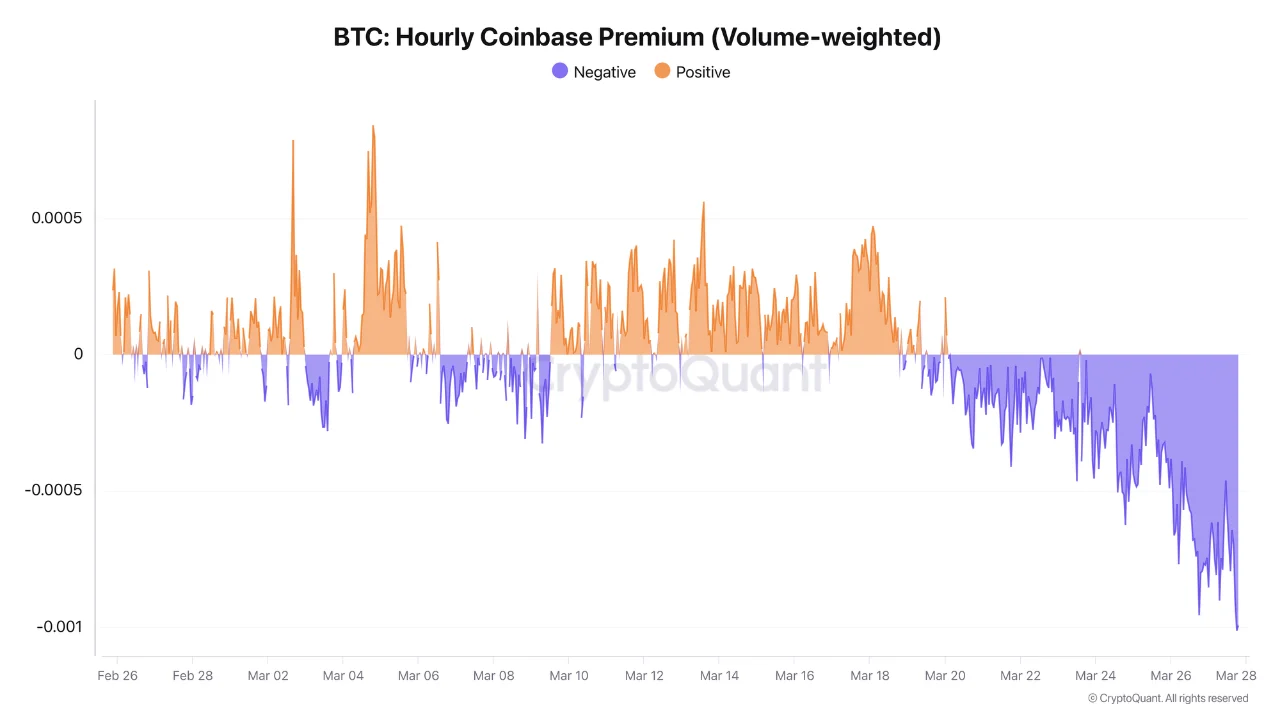
The Coinbase Premium Index measures the volume-weighted price difference between Coinbase Advanced and Binance. Professional and institutional investors predominantly trade on Coinbase Advanced. Retail investors predominantly use Binance. A negative reading means institutions are selling or withholding demand relative to retail activity. The wider the negative reading, the more pronounced the divergence.
The institutional exit has been compounded by forced selling from a different cohort entirely.
Short-Term Holders Sold 21,700 BTC at a Loss in 24 Hours
21,700 Bitcoin from short-term holders hit exchanges in the past 24 hours, all sold at a loss. Short-term holders, addresses that acquired Bitcoin within the last 155 days, are the cohort most likely to capitulate when price falls below their cost basis. At 21,700 BTC in a single day, the scale of that capitulation is significant.
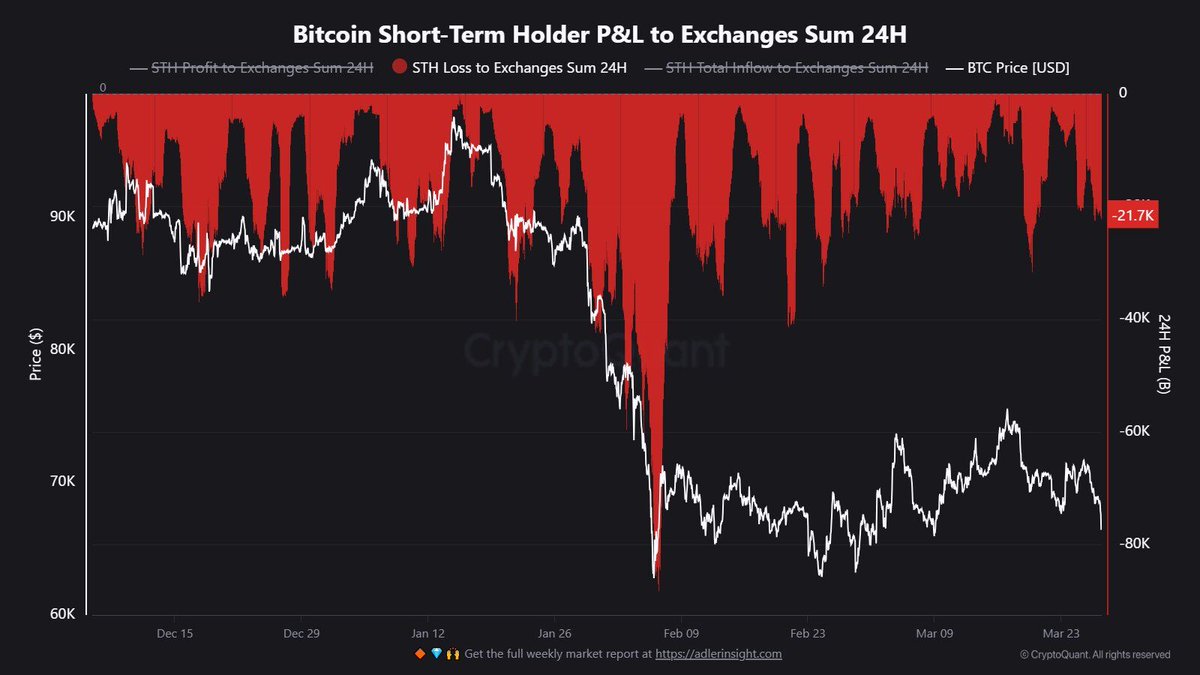
Every unit that moved to exchanges at a loss represents a holder whose conviction broke before the price recovered. That volume of realised loss thins the liquidity available to absorb further selling, making price more sensitive to even modest sell orders. It is the same dynamic that has characterised the broader market through March, and options traders are now pricing it forward.
The Market Sees 53% Odds Below $66,000 Through April 24
Cointelegraph reported that Bitcoin options traders currently assign a 53% probability to Bitcoin remaining below $66,000 by the April 24 monthly expiry. The underlying futures price at the time was $65,904. The $65,000 strike put carried 52.92% implied probability. The $66,000 strike read 52.22%.
🚨 ALERT: Bitcoin traders now see a 53% chance of $BTC staying below $66,000 by April 24 as macro uncertainty and geopolitical tensions drive bearish sentiment. pic.twitter.com/XyXLzx77kb
— Cointelegraph (@Cointelegraph) March 28, 2026
Options market probabilities reflect the weight of current positioning, not directional forecasts. The fact that both strikes cluster within a narrow band around current price signals that the market does not see a clear resolution in either direction before April expiry, and that the path of least resistance, as currently priced, runs sideways to lower rather than higher.
The stablecoin data sits on the opposite side of that positioning.
Whales Are Holding Dry Powder
The Exchange Stablecoins Ratio USD across all exchanges reads 1.51, according to CryptoQuant analysis. This metric compares stablecoin liquidity on exchanges relative to Bitcoin’s price. A higher ratio signals more capital available to absorb selling or buy dips. At 1.51, the ratio is at its strongest reading in the past 24 months. At the 2024 cycle top, the same ratio stood at 5.38, meaning the market now carries a fraction of the speculative excess present at that peak.
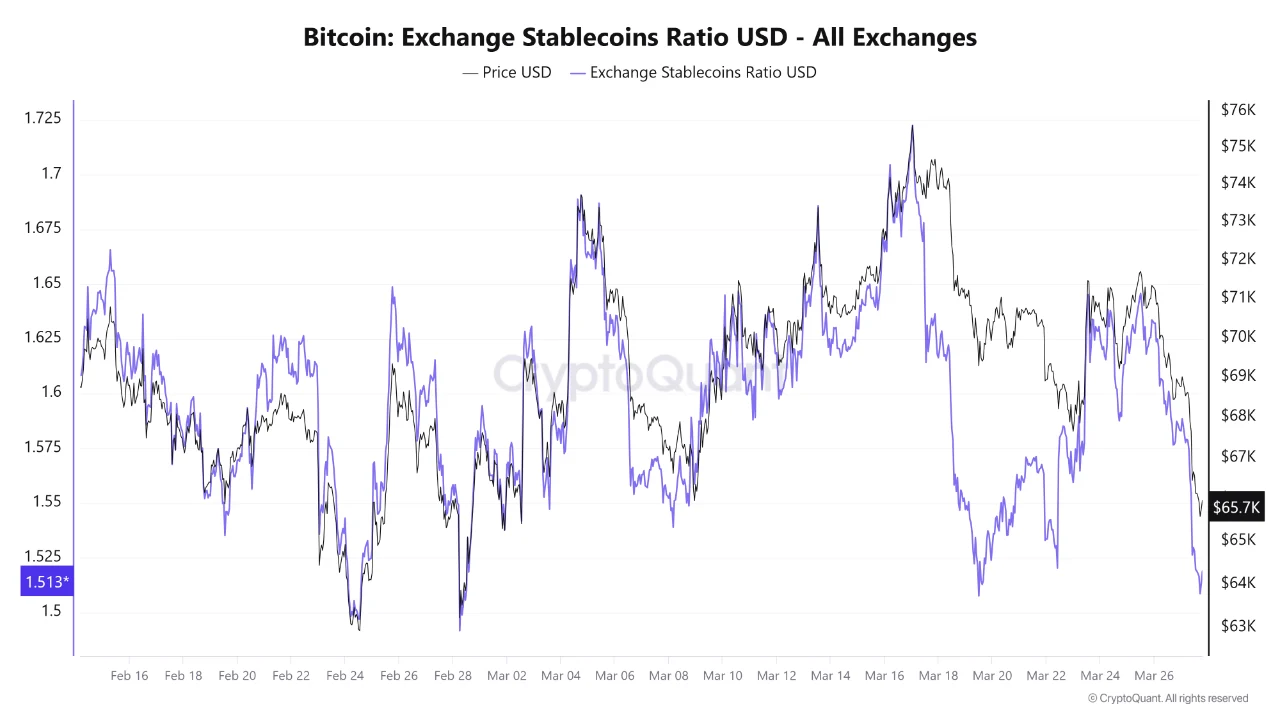
The CryptoQuant analysis is direct: while retail is responding to oil prices and geopolitical fear, large investors are holding stablecoins on exchanges. If the ratio stays at 1.51 or falls, capital is building on exchanges and investors remain positioned to absorb drops. If it rises toward 1.60 to 1.80, it signals flight to fiat or Bitcoin entering exchanges for sale at scale, the condition that removes near-term support entirely.
At 1.51, the dry powder exists. The trigger to deploy it has not arrived.
Michaël van de Poppe, market analyst posting as @CryptoMichNL, described the March 27 move as a sweep of the lows and said he would not be surprised to see Bitcoin test $58,000, the current location of the 200-week moving average. Van de Poppe noted that Bitcoin returns to the 200-week MA every cycle and has historically held it, with the exception of events causing systemic structural collapse. His current assessment is that the market is more or less at the end stage of the bear cycle.
A structurally cheap asset with 24-month high stablecoin liquidity and a prominent analyst calling end-stage bear conditions is the setup for a recovery. It is not a recovery. The difference between those two things is what April 6 resolves.
What April 6 Decides
Trump’s extension of the Iran deadline to April 6 has made that date the most specific geopolitical checkpoint currently affecting crypto markets. Brent crude above $103 and a constrained Strait of Hormuz keep inflation risk elevated and institutional selling pressure active.
If the deadline passes without escalation, the macro overhang that drove the Coinbase Premium to its most negative level since February loses its most immediate pressure point, and the stablecoin liquidity sitting at a 24-month high becomes deployable. If the conflict escalates, the CryptoQuant analysis identifies $65,000 as the next support level and the Realized Price of $54,000 as the cyclical floor below it.
Bitcoin is around $66,500 with nine days until that answer arrives.
The information provided in this article is for educational purposes only and does not constitute financial, investment, or trading advice. Coindoo.com does not endorse or recommend any specific investment strategy or cryptocurrency. Always conduct your own research and consult with a licensed financial advisor before making any investment decisions.
The post Bitcoin Recovers to $66,400: Institutions, Options Markets, and Whales All Watch April 6 appeared first on Coindoo.





 Bengali (Bangladesh) ·
  English (United States) ·