
 39 minutes ago
1

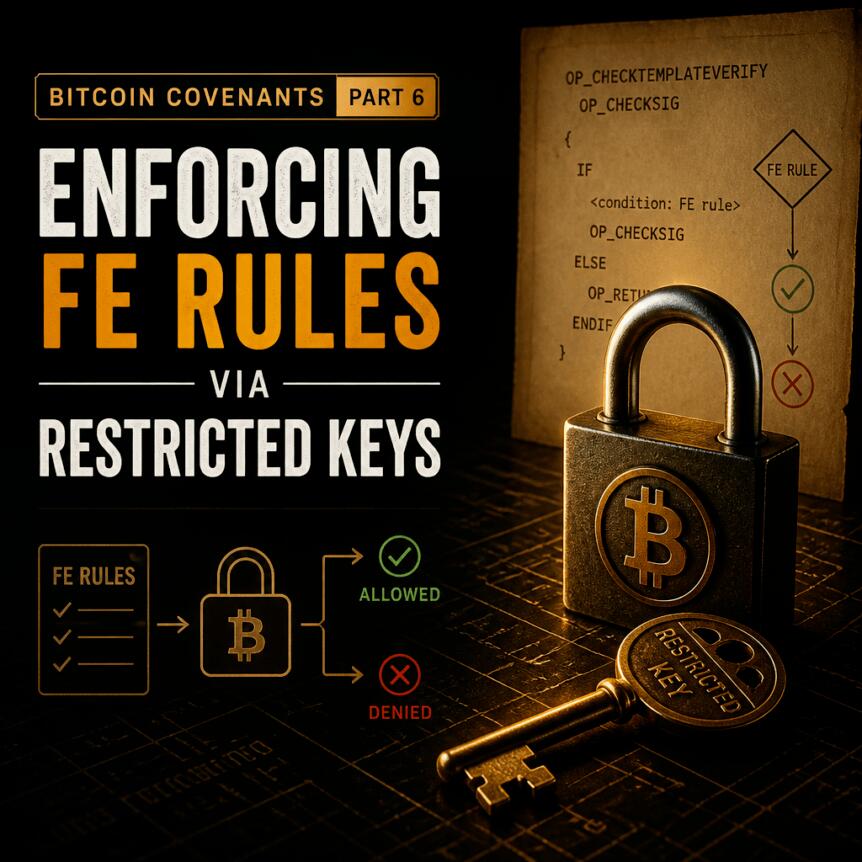
Bitcoin covenants have long promised more expressive “spend conditions” without requiring ongoing manual enforcement from users or custodians. But as Cointelegraph Research’s technical series on the topic continues, a central question keeps resurfacing: can covenant-like behavior be achieved without changing Bitcoin’s consensus rules? Part 6 examines a proposal by Jeremy Rubin—original author of the OP_CTV concept—that tries to move covenant restrictions out of Bitcoin Script and into the cryptographic structure of signing itself.
Rubin’s approach uses functional encryption (FE) to create signatures that only validate transactions matching a predefined spending policy. In theory, that would let Bitcoin verify covenant spends using today’s signature checks, avoiding a soft fork. In practice, the series argues the underlying cryptography is still far from the efficiency and maturity needed for Bitcoin-scale deployment.
Key takeaways
Rubin’s FE-based covenant design aims to restrict which transactions a key can sign—while keeping Bitcoin Script validation unchanged. Functional encryption would require an initial “setup authority” to generate keys and securely destroy sensitive material, otherwise the covenant could be bypassed. Although modern FE constructions are based on more grounded cryptographic assumptions than earlier work, practical implementations remain at toy scale. Earlier cryptography results tie the feasibility of compact FE schemes to primitives at least as hard as indistinguishability obfuscation. The series concludes FE-style covenants remain infeasible now, even if Rubin’s blueprint outlines how arbitrarily complex policies might be enforced in principle.From OP_CTV to “key-restricted” signing
The practical barrier to changing Bitcoin’s base-layer rules is coordination. Consensus rule upgrades require synchronization among node operators, miners, developers, and economic actors—making Bitcoin’s core layer increasingly resistant to frequent change. That’s why researchers have explored whether covenant behavior could be enforced without a consensus update.
In May 2024, Jeremy Rubin—author of the OP_CTV proposal reflected in BIP-119—addressed this problem in a paper titled FE’d Up Covenants. Rather than introducing new opcode logic in Bitcoin, Rubin proposes shifting covenant constraints into the signing key using functional encryption. Bitcoin would still verify a signature with OP_CHECKSIG as it does today, but the signing mechanism would only produce valid signatures for transactions that conform to an agreed policy.
The key idea is that, in standard public-key cryptography, a private key can sign any message. Rubin’s hypothetical FE construction restricts signing ability: the signing capability is constrained to a predefined set of transactions, determined by the covenant’s spending policy. If those constraints can be enforced cryptographically, then Bitcoin might not need any soft fork to recognize them.
Functional encryption in plain terms—what it would do for covenants
Functional encryption generalizes public-key encryption. Instead of enabling decryption to reveal the plaintext, FE allows the holder of a functional key to compute only a chosen function of the hidden value. The paper’s covenant framing uses FE where the function is effectively a signing function: given an FE ciphertext that encapsulates a transaction and a functional key tied to a policy, the signer can compute a signature for that transaction—without learning the underlying secret in a way that would expose unauthorized spending.
Technically, the series notes that early FE constructions were either impractical due to excessive overheads or relied on new untested primitives such as multilinear maps. More recent research has developed FE from well-founded cryptographic assumptions, which may open the door to future implementations.
For Bitcoin covenant behavior, Rubin’s design needs FE where the signing output depends on both the signing key material and the transaction being signed. That motivates the use of “multi-input” FE, because the function effectively takes multiple inputs (e.g., key material and transaction content). The series also describes how Rubin’s scheme tweaks keys based on a hash of the spending policy: signatures would validate under a tweaked public key rather than the base public key itself, meaning the covenant’s policy becomes cryptographically bound to the signer’s effective authority.
How an FE covenant spend would work (and the trust problem)
Rubin’s FE-based design introduces a setup authority. According to the series’ description of the paper, this authority generates both a Bitcoin key pair and an FE key pair (including a master secret). It then publishes public information and encrypted components needed for signing, while also deriving and publishing the functional key tied to the signing function. The authority must be trusted to destroy the private Bitcoin key and FE master secret after setup.
This trust assumption is not a minor footnote. If the setup authority retained enough secrets, it could sign spends that violate the covenant—undermining the purpose of using cryptography to enforce spend restrictions. In other words, the covenant becomes safe only if the initial key material is irreversibly eliminated.
Once setup is complete, each covenant would correspond to its own dedicated key pair, obtained by tweaking key material with the hash of the spending policy. The receiving party could generate covenant addresses based on the relevant policy hash. The series further explains that, to reduce the risk of unauthorized parties triggering permitted transactions in ways the receiver did not intend, practical covenant receiving constructs would typically involve an additional 2-of-2 script-style requirement combining user-controlled authorization with the FE-generated signature.
Why the approach still can’t scale with Bitcoin today
The series’ central criticism is feasibility. It points to deep links between compact functional encryption and other hard cryptographic primitives, implying that the heavy machinery needed for efficient FE may be at least as difficult as obtaining indistinguishability obfuscation in practice.
According to the cited literature discussed in the series, multi-input FE constructions can be connected to indistinguishability obfuscation. When researchers compress single-input FE for general circuits, similar implications appear: once the FE is made compact, it can imply obfuscation, making its implementation at scale unlikely in the near term.
The series also references empirical evidence about computational and storage costs from obfuscation experiments. For instance, it describes Carmer, Malozemoff and Raykova (2017) needing hours to obfuscate a small pseudorandom function circuit (a toy circuit by comparison to ECDSA signing), with a very large intermediate output size and long evaluation time. While these experiments are not Bitcoin itself, they support the broader claim that the kinds of transformations FE would require remain far from efficient enough for real-world covenant signing at Bitcoin throughput.
Even Rubin’s own paper, as summarized here, acknowledges limitations: the required cryptography is under-developed, and the design depends on the trusted setup assumption. The series contrasts this with CTV-style opcodes, which remain comparatively efficient in both bytes and verification—but require a base-layer change to become available.
What comes next in the covenant research roadmap
The series adds that Rubin’s follow-up work aims to approximate covenant behavior without relying on impractical FE. The next article highlighted in this sequence is Un-FE’d Covenants, which the series says replaces FE with oracle signers bonded through BitVM. It also notes that “Bitcoin PIPEs” originally began in 2024 as an FE design and later shifted toward witness encryption in 2026, suggesting a broader trend: moving away from fully expressive FE while still trying to achieve enforcement that doesn’t require consensus changes.
For readers watching Bitcoin covenants, the immediate uncertainty isn’t whether cryptography can describe these policies—it’s whether any approach can deliver the efficiency, scalability, and trust minimization needed for production deployment. The next milestones will likely hinge on whether oracle-and-encryption hybrids can replicate the guarantees investors care about without inheriting the biggest practical bottlenecks.
This article was originally published as Bitcoin Covenants Part 6: Enforcing FE Rules via Restricted Keys on Crypto Breaking News – your trusted source for crypto news, Bitcoin news, and blockchain updates.





 Bengali (Bangladesh) ·
 English (United States) ·