

Friday, November 13, 2026, 12:08 p.m. ET: Bitcoin trades at $68,760, 44.9 percent below its highest daily close on October 6, 2025. Is this a buying opportunity or a falling knife you should not try to catch? CoinMarketCap's daily prices since April 2013 give an uncomfortable answer and an encouraging one. The uncomfortable one: in six of seven earlier cases where Bitcoin first closed 45 percent below its record in a cycle, the price was lower one year later. The encouraging one: a $100 weekly savings plan started at the record high is down only 11.6 percent today, while a lump sum invested on the record day is down 44.9 percent.
Why Bitcoin is falling today and what the weekend could bring is covered in our report Bitcoin on Friday the 13th: weekend panic builds as traders eye $60,000. This piece tackles the question many investors are asking tonight: buy Bitcoin now or wait?
Catching a falling knife: what the old market rule means for Bitcoin
"Never catch a falling knife" is an old market rule. If you buy into a sharply falling price, it may keep dropping before a bottom forms. For Bitcoin, that rule has been especially costly. In the three major bear markets since 2013, the price fell by more than three quarters each time, and it took 10 to 13 months from the first 45 percent drawdown to the bottom.
| Bear market 2014/15 | $1,151, Dec 4, 2013 | $178, Jan 14, 2015 | 84.5% |
| Bear market 2018 | $19,497, Dec 16, 2017 | $3,237, Dec 15, 2018 | 83.4% |
| Correction 2021 | $63,503, Apr 13, 2021 | $29,807, Jul 20, 2021 | 53.1% |
| Bear market 2022 | $67,567, Nov 8, 2021 | $15,787, Nov 21, 2022 | 76.6% |
| Since October 2025 | $124,753, Oct 6, 2025 | so far $58,559, Jun 30, 2026 | so far 53.1% |
The table also shows why the outcome is open. The low of this cycle so far, minus 53.1 percent, matches the summer 2021 correction exactly. Back then, no bear market followed, but a new all-time high in November 2021. A drop like 2018 or 2022, by 77 to 85 percent, would put a bottom at roughly $19,300 to $29,200. That is arithmetic, not a forecast: since 2024, exchange-traded funds and companies have been buying Bitcoin on a scale earlier cycles never saw.
 Symbolic image, created with AI
Buying Bitcoin after a 45 percent drop: what earlier cycles show
Since 2013, there were seven days on which Bitcoin first closed 45 percent below its record during a downturn. One year later, the price was higher only once: in July 2013, when one Bitcoin cost about $78. In every other case it kept falling, by 16 to 66 percent. Anyone who bought at $10,106 on January 30, 2018, was down 65.5 percent a year later. Anyone who bought at $36,457 on January 21, 2022, was down 37.5 percent twelve months later.
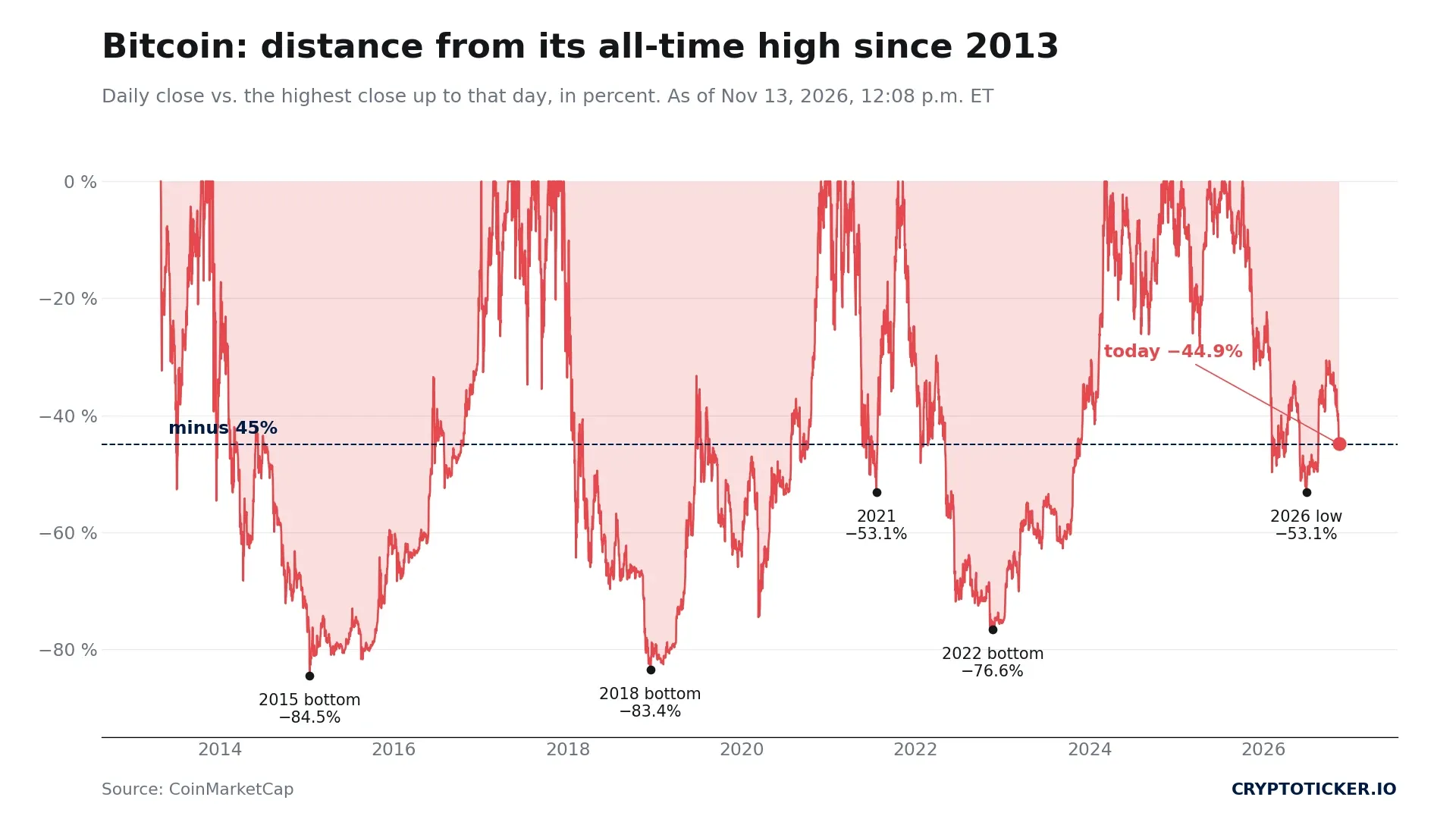 Bitcoin: distance from its all-time high since 2013, in percent. Source: CoinMarketCap
Over a longer view, the picture changes. Looking at every single day since 2013 on which Bitcoin was at least 45 percent below its record, the price was higher one year later in 80 percent of cases, with a median gain of 88.5 percent. The reason: most of those days were deep inside bear markets, shortly before the recovery. Early buyers had to sit through the valley, later buyers were rewarded. Nobody knew the right day in advance.
In this cycle, Bitcoin first fell more than 45 percent below its record on February 5, 2026, to $62,702. Today, a little over nine months later, it trades 9.7 percent higher. Whether this cycle plays out differently will be clearer by February 2027.
Bitcoin dollar-cost averaging in a crash: saving since the record high cuts the loss
If you do not want to guess the bottom, spread your entry. The table shows a plan buying $100 of Bitcoin every Monday at the daily close, valued at tonight's price.
| Oct 6, 2025 (record high) | $5,800 | $5,127 | minus 11.6% |
| Nov 11, 2024 | $10,500 | $8,369 | minus 20.3% |
| Nov 14, 2022 (just before the 2022 bottom) | $20,900 | $29,458 | plus 40.9% |
| Nov 8, 2021 (2021 record high) | $26,200 | $41,875 | plus 59.8% |
For comparison: anyone who bought everything at once on October 6, 2025, is down 44.9 percent today. The savings plan started the same day loses only a quarter of that. And even someone who started saving at the 2021 record high, the worst possible moment, is up almost 60 percent today.
 Symbolic image, created with AI
Should you buy Bitcoin now? Three ways to avoid catching the falling knife
A savings plan instead of a lump sum: a fixed amount every week or month removes the need to pick the right day and automatically buys more Bitcoin when prices are low. Staggered buy orders: if you want to invest once, split the amount and place limit orders at levels where buyers stepped in recently, such as the 200-week average at $67,752, the August low at $64,111 and the February low at $60,074. Only money that can wait: earlier bear markets took 10 to 13 months from the first 45 percent drawdown to the bottom, and the recovery often took longer. If you need the money sooner, stay out.Traders who want to play short-term moves can profit from falling prices with short positions, but leverage carries a high risk of loss. What long, short and leverage returned on Friday the 13th is shown in our report on the Friday Bitcoin crash. Which platforms offer recurring buys and what they charge is listed in our crypto exchange comparison, licensed providers in our comparison of regulated crypto exchanges.
Advertisement: Crypto futures trading: Bitget offers leverage of up to 100x. Leverage can lead to high losses. Our exchange comparison shows more platforms.
Bitcoin crash: what investors should keep in mind now
After every major bear market so far, Bitcoin has gone on to new records, but never in a straight line. Anyone buying now should be able to sit through another 20 to 30 percent drop without selling. Taxes depend on where you live: in the US, Bitcoin held for more than one year qualifies for long-term capital gains rates, which are lower than short-term rates.
Not investment advice: cryptocurrencies are highly volatile, so only invest money you can afford to lose.




 Bengali (Bangladesh) ·
 English (United States) ·