

Based on everything documented so far, the Binance account closure hits customers in France, Spain, Italy and Poland: the exchange is closing their accounts on December 31, 2026, and from November 29 it will deduct a monthly fee of 0.025 percent of holdings, with a minimum of 10 USDC. There is no evidence so far that accounts in Germany are among those affected. According to the customer emails, anyone who withdraws their full balance before November 29 pays nothing at all.
A Binance spokesperson confirmed the closure date to CoinDesk: the affected accounts would be closed with effect from December 31, 2026, in what the company called a carefully managed process. The fee rules, by contrast, come from emails to customers that several trade publications have reviewed. As of Sunday, November 8, Binance had made no public announcement containing these figures. The distinction matters, because it determines how far you can rely on the details.
For crypto investors in Germany the story is still more than foreign news. Binance holds no licence under the MiCA regulation anywhere in the EU and has only been winding down its business with customers in the bloc since July. Anyone in Germany who still keeps coins on Binance faces the same basic question as customers in Paris or Madrid: where should the balance go, and by when? An overview of regulated crypto exchanges with a MiCA licence helps you pick a new provider.
Binance account closure: the countries named in the customer emails
French media were the first to report on the letters from Binance France on November 6. According to Bitcoin.com News, the exchange told its customers that deposits were no longer possible and that every account held with the French entity would be closed on December 31, 2026. Accounts whose owners have not withdrawn their crypto assets by then would be treated as inactive. CoinDesk also names customers in Spain and Poland as recipients of identical emails, and users in Italy report the same letters on social media.
The four countries have one thing in common: before the MiCA deadline, Binance held its own national registrations there. In France, Binance France was registered with the financial regulator, the Autorité des marchés financiers (AMF), as a digital asset service provider. National registrations of this kind lost their effect when the transition period ended. The account closures therefore affect precisely the entities through which Binance served customers in these countries.
As early as July 1, Binance had shut down spot trading, margin and futures for EU customers in these markets and allowed only withdrawals. In France alone, around two million customers were affected, according to an estimate cited by Bitcoin.com News. What that meant for your balance at the time is summarised in our June article on Binance's withdrawal from the EU. What is new now is the fixed end date, together with the fee.
Monthly fee from November 29: 0.025 percent or at least 10 USDC
The fee is an administrative charge on whatever is still held in the account. According to the customer emails, from the cut-off date of November 29 Binance will charge 0.025 percent of the total crypto holdings once a month, but at least 10 USDC. Whichever amount is higher applies. USDC is a stablecoin pegged to the US dollar, a token whose value is meant to track the dollar one to one; 10 USDC is therefore roughly $10.
Two deductions before the end of the year
The first deduction is due within three days of November 29, the second after December 24. Fees are taken from existing USDC holdings first and then from other cryptocurrencies in the account. If the account holds less than the fee, Binance takes the entire remainder. Someone still holding coins worth $15, for example, would by this logic lose 10 USDC in the first deduction and whatever is left in the second.
The percentage only applies above $40,000
For almost every account, the minimum fee determines the bill. A rate of 0.025 percent only produces exactly $10 on holdings of $40,000, because 10 divided by 0.00025 equals 40,000. Below that threshold you pay a flat 10 USDC per month; above it, the percentage applies. Holdings of $100,000 accordingly cost 25 USDC per deduction. Over two deductions, the fee on small accounts adds up to 20 USDC.
| $15 | 10 USDC, then the remainder | the entire balance |
| $1,000 | 10 USDC | 20 USDC |
| $40,000 | 10 USDC | 20 USDC |
| $100,000 | 25 USDC | 50 USDC |
In percentage terms, the rule hits small leftover balances hardest. Experience shows these are exactly the accounts most often left untouched, because moving them hardly seems worth the effort. The fee turns that around: a forgotten remainder of a few dollars is gone after two deductions.
 A good three weeks separate the customer email from the first deduction on November 29.
Are Binance accounts in Germany affected by the account closure?
What is known so far: none of the sources reviewed mentions Germany. The reports from CoinDesk, Bitcoin.com News and FinanceFeeds refer to France, Spain, Italy and Poland, or more generally to some European countries. Whether Binance will also close the accounts of German customers therefore remains open, neither confirmed nor ruled out.
The background explains why Germany may be in a different position. Binance never held its own licence in the country and withdrew its application with BaFin in 2023. According to the available reports, there is no German national entity comparable to Binance France that is now being wound up. German customers were served through other Binance entities. Since the end of the MiCA transition period, the same wind-down applies to them as to the rest of the EU: no new purchases, no deposits, while withdrawals remain possible.
You can check whether the closure on December 31 affects you in three places. Start with your inbox: affected customers have received an email stating the closure date and the fee rules. Next, look at the notifications inside the Binance app, where the exchange usually mirrors such notices. Finally, the terms of use you accepted when opening the account name the entity your contract is with. If one of the four national entities is listed there, the deadline applies to you.
If you have received no such notice, there is no November 29 deadline for you. That changes little in practice: even without a fee, your balance sits with a provider that has no EU licence and where you can no longer buy anything. Many investors are therefore using the occasion to complete the move anyway.
MiCA transition period: why Binance is only winding down in the EU
MiCA stands for the Markets in Crypto-Assets Regulation, the EU rulebook for crypto-asset markets. It requires every crypto service provider serving customers in the EU to hold a licence as a crypto-asset service provider, or CASP for short. A licence from one member state is valid across the whole union through so-called passporting. The transitional arrangements for older national registrations ended on June 30, 2026 at the latest, and in Germany as early as the turn of 2025/2026. More on the obligations for providers can be found on our overview page on the MiCA licence.
Binance had bet on Greece as its entry point and withdrew its application there in June. Since then the exchange has not named another member state, and it does not appear in the register of the European Securities and Markets Authority (ESMA). That removes the basis for regular operations, and Binance may only accompany EU customers through an orderly exit. The account closures at year-end are the final step of this wind-down in the four countries with their own national entity.
Which restrictions have applied since July and how to look up a provider's licence yourself is explained in our guide to switching from Binance to a MiCA-regulated exchange. For the fee question, one point matters above all: according to the reports, withdrawals in crypto and fiat continue to work; only deposits are blocked.
Leftover balances after December 31: inactive accounts and conversion
Binance intends to treat anything still held in an affected account after the cut-off date as the balance of an inactive account. The email to French customers explicitly mentions the possibility that assets may be converted, transferred or otherwise handled under the terms of use. How exactly is left open. Neither a conversion rate, a destination account nor a date is given.
For you, such a conversion means two things. You lose control over when and at what price your coins are sold. And a forced swap can count as a sale for tax purposes, with all the consequences for the holding period (more on this below). You avoid both by deciding yourself while the account is still fully accessible.
A third point concerns access itself. The block on new deposits is already in place. The emails do not say whether login will still work after December 31. Anyone who needs account statements, trading history and tax data should therefore export them now and save them locally.
Binance withdrawals after the hack: networks and phases
The deadline falls at a time when withdrawals at Binance are not running quite normally. After the hack of October 29, the exchange is reopening withdrawals in phases. Not every coin is immediately available on every network, and some could initially only be withdrawn via BNB Smart Chain (BEP20). We described the status of the third phase, covering HYPE, Aptos and Litecoin, in our article on withdrawal phase 3.
That suggests a simple order. Withdraw whatever can be withdrawn today first, ideally USDC and large coins such as bitcoin and ether. Coins whose network is still blocked you track in the exchange's status updates and withdraw as soon as the network opens. With every withdrawal, make sure the destination address supports the same network. A token sent on the wrong network can be lost.
Also plan for a buffer. Withdrawal fees per network come on top of the monthly fee, and when demand is high, withdrawals can sit in review for longer. If you only start on November 28, you risk part of your balance still being in the account on the cut-off date.
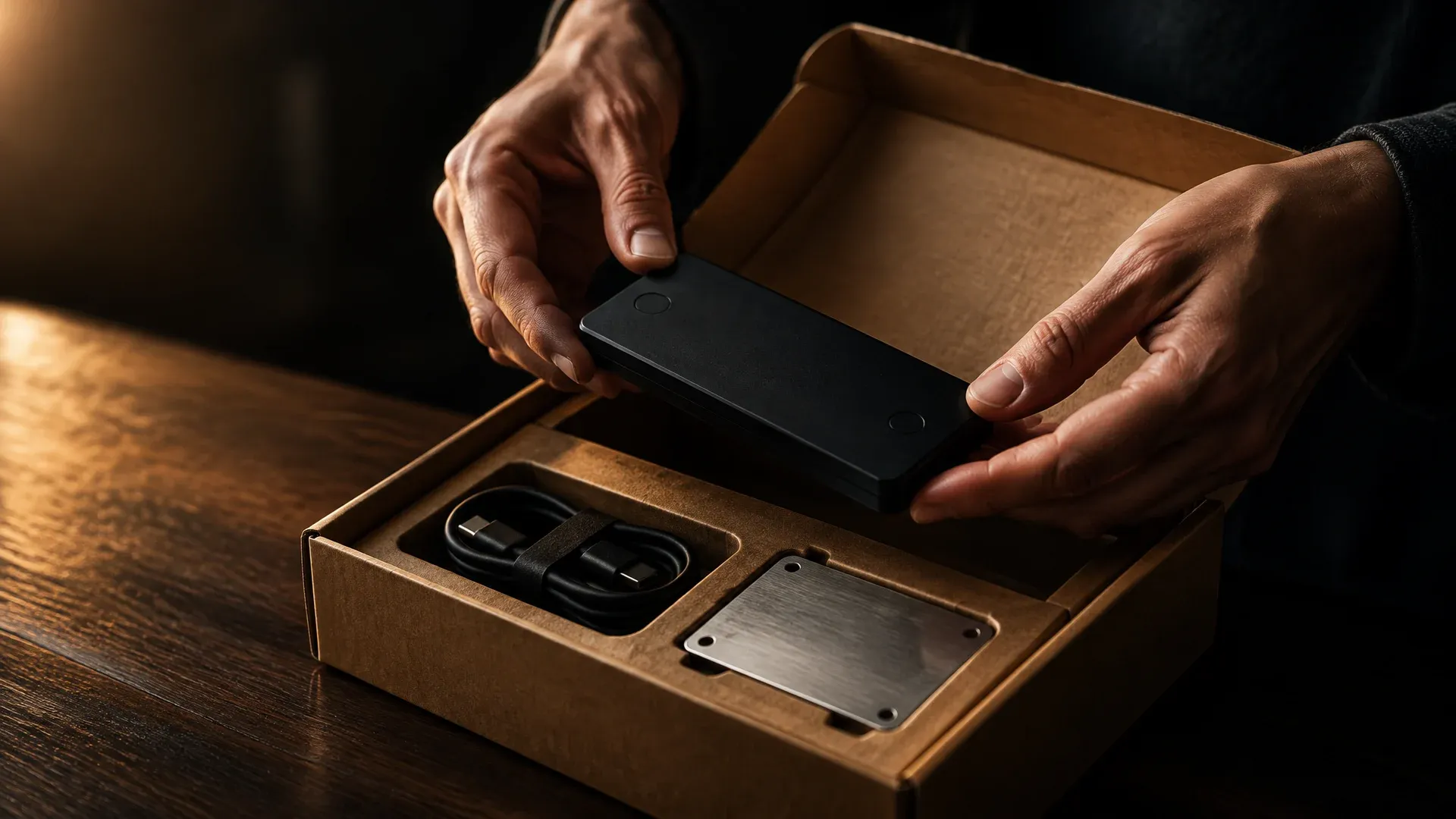 Self-custody on a hardware wallet is one of two ways to move your Binance balance out before the fee applies.
MiCA exchange or hardware wallet: two destinations for your Binance balance
There are two routes for the move. The first leads to a crypto exchange with a MiCA licence. There you can keep trading, use savings plans and withdraw euros, and the exchange is supervised by an EU authority. We compared four such providers in our comparison of Binance alternatives.
The second route is self-custody. A hardware wallet is a small device that stores the private keys to your coins offline, so no exchange has access any longer. The device suits holdings you intend to keep for longer. In return, you bear full responsibility for the recovery phrase; lose it and you lose the coins. Which devices are worth considering is shown in the hardware wallet comparison.
The two routes can be combined: whatever you want to trade goes to the regulated exchange, the rest to your own wallet. Whichever destination you choose, send a test amount first. Once it arrives, move the rest.
Crypto tax when switching exchanges: transfers, fees and forced conversion
In Germany, moving your coins is usually unproblematic for tax purposes. Transferring coins between your own accounts and wallets is not a sale and does not trigger any tax. Gains from private disposals under Section 23 of the German Income Tax Act only arise if you sell or swap crypto assets within one year of buying them. The holding period continues to run during a transfer.
Things can look different if Binance itself sells coins. If the exchange takes the monthly fee from cryptocurrencies other than USDC, the tax authorities regard this as an exchange for a service, in other words a disposal. The same applies to a forced conversion after December 31. If less than a year lies between purchase and disposal, a gain becomes taxable once the total of all private disposal gains in the year reaches the exemption limit of 1,000 euros.
For your tax return you need the complete trading history from Binance. Export it before you empty the account and import it into a tax tool so that the purchase dates of the coins you moved are preserved. Without this data, the holding period will be hard to prove later.
Account closure phishing: how to spot genuine Binance emails
Deadlines with fees are a popular pretext for fake emails. Fraudsters copy the exchange's layout, set a tight deadline and link to a cloned login page. Anyone who enters their credentials or a two-factor code there opens their account to strangers.
So do not click links in any email about the account closure. Instead, open the app or type the exchange's address yourself and check the notifications there. Binance offers an anti-phishing code that appears in every genuine email once you have set it in your account settings. If the code is missing, or a message asks for your recovery phrase, it is fake. No exchange will ever ask for this phrase.
Binance leftover balance: withdrawing before November 29 costs nothing
The situation is clearer than the many open questions suggest. For customers in France, Spain, Italy and Poland the deadline is running; for Germany there is no evidence. Either way the goal is the same, and three steps are enough:
Choose a new home. Open an account with an exchange holding a MiCA licence and complete identity verification before the move. You will find a selection in the comparison of regulated crypto exchanges. Keep long-term holdings in self-custody. Whatever you do not want to trade goes to your own wallet, starting with a test amount. Suitable devices are listed in the hardware wallet comparison. Save your history, plan for tax. Export your Binance trading history and import it into a tax tool so that purchase dates and holding periods are preserved. Suitable programs are listed in the comparison of crypto tax tools.(As of November 8, 2026. This article is not investment advice. Prices and fee structures change; check the terms with the provider before you buy.)




 Bengali (Bangladesh) ·
 English (United States) ·