

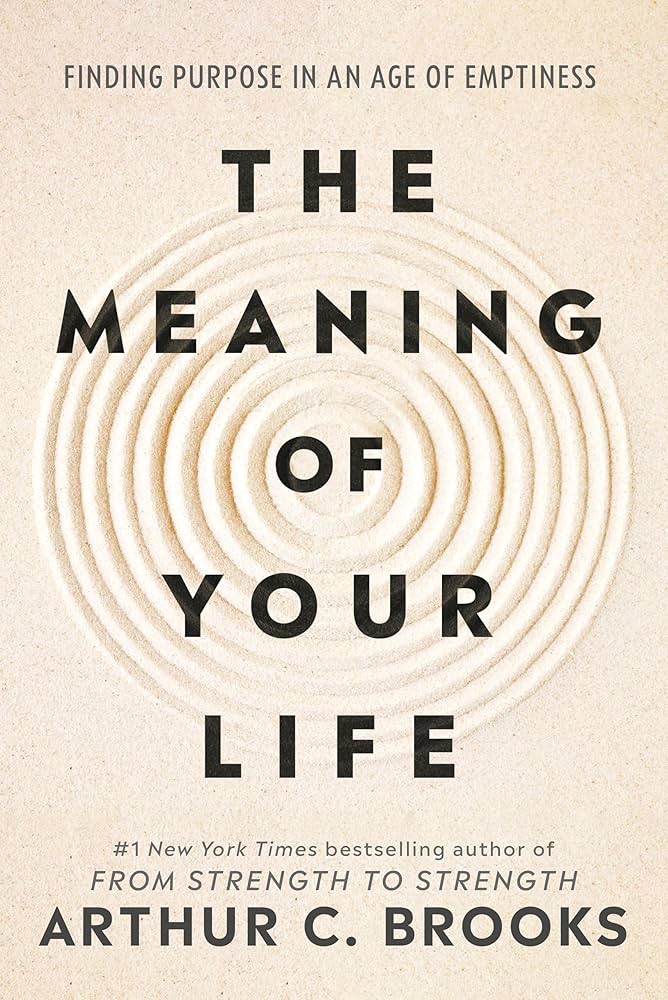
 You’ve reached a point in life where you thought you’d feel different. You’ve checked a lot of the boxes of achievement, happiness, even success. And, still, something is missing. It is a quiet restlessness that age or achievement cannot seem to quiet. What you’re missing is meaning.
Our guest today is Arthur Brooks. He is a Harvard professor and #1 New York Times bestselling author of The Meaning of Your Life: Finding Purpose in an Age of Emptiness. In this conversation, we explore:
The myths we tell about how to find meaning, and how they delude us. The neurological reason why your phone is blocking purpose The 3 real keys to meaning and mattering, and finally feeling alive The arrival fallacy that explains why winning is not the same the meaning How to use a specific morning protocol to program your brain for mystery and wonder The counterintuitive reason you actually want suffering in your lifeIf you are tired of the hustle and still feeling empty, it is time to look at the science of the soul, and learn how to bring more meaning into your life, starting with practical tools today.
You can find Arthur at: Website | Instagram | Episode Transcript
Next week, we’re sharing a really meaningful conversation with Jenny Lawson. She’s a #1 New York Times bestselling author who has made millions of people laugh with her writing, and she also lives with treatment-resistant depression and anxiety. This conversation is one of the most honest, funny, and unexpectedly hopeful we’ve ever had on the show.
Check out our offerings & partners:
Join My New Writing Project: Awake at the Wheel Visit Our Sponsor Page For Great Resources & Discount Codesphoto credit: Jake Rosenberg
_____________________________________________________________________________________________________
Episode Transcript:
[00:00:00] So you reached a point in life where you just thought you’d feel different. You checked all the boxes of, you know, achievement and happiness, and even quote, success and still. Something is missing. It’s a quiet restlessness, that age or achievement, they just can’t seem to quiet. And what you’re missing may well be meaning.
My guest today is Arthur Brooks. He’s a Harvard professor, number one New York Times bestselling author. His new book, the Meaning of Your Life, finding Purpose in An Age of Emptiness.
Today we’re exploring the myth that we tell about how we find meaning and how they dilute us into doing things that actually keep meaning out of our lives.
We talk about the neurological reason why your phone is actually blocking your ability to feel a sense of purpose and joy. We explore the three real keys to meaning and mattering. And finally feeling alive that nobody ever really talks about or tells you about. We talk about something called the arrival fallacy that explains why [00:01:00] all the success in the world won’t make you feel like you want to feel.
And we explore how to use a specific morning protocol to just kind of reprogram your brain for mystery and wonder, and finally. We drop into the counterintuitive reason you actually want suffering or pain in your life. It’s a deep research-backed look at how to move from not just getting by to truly flourishing.
So excited to share this conversation with you. I’m Jonathan Fields, and this is Good Life Project
Jonathan Fields: Excited to jump in with you. You spent years studying happiness, and flourishing all different aspects of flourishing and. What you’re now really focusing in on is this notion that something deeper has been missing in the conversation. It’s not necessarily about success, not even about joy, not even about happiness, but something more fundamental. The real crisis is what you are describing as a crisis of meaning. Take me into [00:02:00] this.
Arthur C. Brooks: Yeah. You know, when I, I left academia for a little while in 2008. I’m a lifelong academic. My father was an academic, his father was an academic, and, and one of the things you find about college life is it generally has traditionally been happier than the rest of life. It’s when people make their closest friends, it’s when they fall in love.
It’s fun actually. I left in 2008 to go run a company, and I came back 11 years later and it was completely different than when I had left.
Something happened between 2008 and 2019 that changed university life now. That’s what I saw. It turns out it was all over society, but the mood had really darkened.
And what I found, you know, as a behavioral scientist is what everybody saw, which is that clinical depression had tripled, um, anxiety, generalized anxiety had doubled. People were lonely. People were angry. I mean, all the things that we talked about, the trouble that we talked about on campuses, it came down to this epidemic. And I’m not talking about COVID. This was before COVID actually. And then COVID, of course, made it much, much worse. [00:03:00] And so I thought to myself, okay, okay, I’m a behavioral scientist. Let’s figure this thing out. So I started talking to people on campuses, and one of the words that kept coming up again and again and again and again was the word meaning, saying, I don’t know what I’m meant to do.
I don’t know what I’m supposed to be doing. I feel empty. My life feels meaningless. And it turns out that the number one predictor of this depression is feeling like your life is meaningless. Now, that’s weird for a guy my age because nobody asked about that when I was 20 years old. You know, it was the meaning of my life.
I mean, we would ask it in a late night dorm room conversation perhaps, but it wasn’t the thing that we went around worrying about. Something actually changed in the way that we live after 2008. And here’s the punchline, because. You know, the, the solution is not that interesting. It’s actually what do we live, how do we live differently that makes this, that, that we need to pay attention to?
We solved an actual problem, which is the problem of boredom, and we created a major crisis, which was we stopped [00:04:00] being able to sense the meaning of life because we solved the boredom problem
Jonathan Fields: Why is boredom a problem in the first place? Well,
I mean, did, was this a problem that needed solving?
Arthur C. Brooks: Well, it’s an annoyance is what it comes down to. You know, nobody likes to be bored actually. But we finally got to the technological place where, you know, where, where this comes along, where we’re actually able to eradicate the boredom from our lives. And it fundamentally changed the way that we used our brains when technology took over our lives After 2008, the first iPhone was delivered in 2007.
Everybody had one by about 2008, 2009. Apps were on all the phones. By 2010, 2011, by 2012, the dating apps were on the phones. People started to spend a lot of time on it, and today the average American adult checks the phone 205 times a day. And the times that you check the phones are the moment that you feel the slightest amount of boredom.
But when you do that, you immediately use your brain differently. You stop using the hemisphere of your brain that you naturally use when your mind is wandering, when you’re thinking about meaning, when you’re thinking about. [00:05:00] The bigger why questions of life and you shove yourself into the part of your brain that’s all about technology and how to, and what questions.
So the problem is that we, we have changed brain activity to the point where meaning has become inaccessible.
Jonathan Fields: know, in doing that, it’s sort of like we’ve moved ourselves away from spending time, um, in the questions and the activities that really make us flourish in a completely different,
Arthur C. Brooks: You know, my great-grandfather, Leroy Brooks, probably never went home to Mary Ellen, his wife, and said, honey, I had a panic attack behind the mule today because his brain was working the way his brain was supposed to work.
His brain wasn’t malfunctioning in the way that a lot of people’s brains are actually malfunctioning. It’s not their fault. The problem is that actually they’re just going along and getting along in a world that’s eradicated boredom and, and in the process has eradicated the pathways that we can actually find to the meaning of our lives.
Jonathan Fields: Draw for me the most linear line that you can between then us effectively annihilating the possibility for boredom from our lives and [00:06:00] also this pervasive feeling of meaninglessness.
Arthur C. Brooks: the way that it works is that, that we are designed to be creatures of meaning. And meaning is a very abstract concept, but we have two hemispheres for our brain. One for the complicated stuff of, you know, technology and analysis and efficiency and how to and all the little ordinary problems that we face every day.
How to drive a car, how to push a plow, whatever it happens to be. But then we have another hemisphere of our brain, the right hemisphere for our brain that is all the mystery and meaning and love and happiness. All the things you can’t quite articulate, but that you care about the most. On the left side of your brain is the complicated parts.
On the right side of your brain is the complex thing. You understand the essence of them really well, but you’ll never solve these problems. So, you know, my marriage is very, very complex. Meaning I get it what it means to have a happy marriage, but I’ll never solve it once and for all. I’m gonna have an argument today with my wife.
I guarantee you, we’ve been married 35 years. We argue every day. If I’d solved my marriage, that wouldn’t happen. But the reason I love my marriage is because it’s a complex [00:07:00] thing. My cat is a complex thing. You can’t predict actually what it’s gonna be. When you’re online all day, when you’re working with technology all day, when you’re in the hustle and grind culture of solving complicated problems all day, you’re sitting in the wrong hemisphere of your brain, is what it comes down to, and you simply aren’t in the space that you actually need to even ask the questions of mystery and meaning and love and happiness and fulfill.
Jonathan Fields: Yeah, it’s like you’re crowding out the part of your brain that would really allow you the opportunity to dive into that. As you’re describing that, I’m thinking of reflecting on a conversation I had. This is years back now with Jill Bolty Taylor, um, who, if you know her name, you probably know it because she had this huge Ted talk many years ago.
She had a stroke, um, and she describes it basically as she was forced into. The right hemisphere of her brain, um, to, to effectively just spend, to dwell there. And she said, well, this was a, like a brutal experience for her. It was also stunning and profound and deep, and she’s been trying to find ways to get back to the [00:08:00] place of access that she had
and live from that place of just almost an abject wonder
for the rest of her life.
Arthur C. Brooks: that’s right. We need that. We absolutely need that, which is why, and you know, when you’re in that space, you hear a, a song that you haven’t heard in a long time and it makes you feel
emotional. There’s a memory of something you can’t quite articulate. There’s a feeling of love that you have for somebody that actually eludes words that means, but you’re having a right hemispheric experience and the more you’re spending time with brutal technology, you know, you’re not seeing beauty, you’re looking at a screen.
Whatever happens to be, the less you’re actually doing that you brain’s not working. Right? We have two hemispheres for a reason, but we’ve. We’ve reduced ourselves in modern life, is what this comes down to. So you know what this book talks about is like, here’s a problem. Then I talk about what is the thing you’re actually looking for?
What does meaning mean? And then where do you find it in your brain? And then most importantly, two thirds of this book is what do you need to do? This is
basically a six part plan to to reorganize your [00:09:00] brain again, to find your meaning in six months.
Jonathan Fields: Yeah. So I wanna drop into what meaning is with you, but before we get there, let’s do a little bit of myth busting actually,
um, meaning and achievement.
Arthur C. Brooks: Right. So achievement is actually what we’re seeking for satisfaction. So let’s back up a little bit to happiness, which is what
I teach. So I’m a behavioral scientist dedicated to the study of human happiness, and, and the me the, the definition of happiness is it’s not a feeling. Feelings are evidence of happiness.
Like the smell of your Turkey is evidence of your Thanksgiving dinner. When people seek happy feelings, it’s like seeking a vapor, and they’re, they’re consigning themselves to hoping things are better the next day. Happiness is a real thing. I mean, your Turkey dinner, by the way, is a combination of three macronutrients, protein, carbohydrates, and fat.
And your happiness has three, carbo has three, has three macronutrients as well. They are enjoyment, satisfaction, and meaning. Those are the three things that we actually seek, that we need, we need to get better at. And those are the things that we actually need to pursue, and [00:10:00] that’s what I teach is how to enjoy your life more, how to take more satisfaction with your achievements and accomplishments, and how to find the meaning of your life.
So the second one is satisfaction. And that’s all about achievement. It’s about, it’s actually not just about that. It’s achievement with struggle.
Humans want a struggle, and if it you don’t have any struggle, the achievement won’t be sweet. So there’s no satisfaction, and that’s the important thing. It’s what we try to teach our kids the good things to come to those who wait.
And you need to struggle for good things. You need to pass up on your, on the on, on the, you know, the, the, the ways that you can shortcut, et cetera. You wanna work hard is what we tell ’em because we want the struggle and, and the sweetness of the achievement. Meaning is in another channel, meaning is this idea of the, the concept of, of the why of your life, the big why questions of your life.
And that’s a, that’s an entirely different discipline. It’s a complimentary one, but it’s a different kind of pursuit.
Jonathan Fields: When we think about the pursuit of meaning then, ’cause a lot of us think, okay, so when I reach x, when I, like, when [00:11:00] I succeed at this particular level, when I go and pursue something that, you know, is I’ve been striving for or I’ve been told is the thing that will gimme the feeling that I wanna feel, um,
Arthur C. Brooks: Right.
Jonathan Fields: So many of us actually get there. And, and you hear this variation of, of a theme, which is, you know, like, look, I was told from the, the youngest years that, you know, when I, I should work really hard to, to go do this thing. I’m willing to suffer in the name of doing it. I’m willing to shrug and I’m doing it. I’ve done it. It was really hard.
I got knocked down and stood back up and knocked down a thousand times, and 20 years later I’m here. I did the thing and the feeling that I was promised. I don’t feel,
Arthur C. Brooks: I know, I know Mother Nature is such a tyrant, and, and the reason that we feel that is because Mother Nature promises you that the, that the little satisfactions that you get from progress toward your goal will be massive when you actually hit your goal.
And that’s wrong. that’s called the arrival fallacy.[00:12:00]
We are built for progress, not for arrival at the goals. This is why the Buddhists, they talk about intention without attachment. You want intention toward goals. You wanna make progress every day, but you have to have detachment from the actual, the object of your goals. And that’s a really, really super hard thing to do.
I’ve worked with Olympic athletes who almost always suffer a clinical depression in the months after they win their gold. And the reason is because they just assumed, you know, the good feelings that I’m gonna have when I have this great accomplishment, they’re gonna last forever. Then they don’t, you know, people get very depressed often right after they get married because they got to their wedding day and they thought that this great, you know, thing is gonna give me this permanent sense of bulence, of elation.
And, and it doesn’t either. That’s not how emotions are supposed to work. Emotions are signals of, of, of threats and opportunities. You’re not, you know, mother nature isn’t there to give you a permanently fun day. Mother nature wants you to be ready for whatever’s gonna come your way. And you’ve just misunderstood emotions if that’s actually the case.
So I have to work with my students about this all the time. What you want is really, really good goals and you have to [00:13:00] recognize that, you know, achieving a particular worldly achievement is not gonna bring you the be all and end all. I’ve
worked with billionaires. They the fir, after their first billion, they say, I didn’t feel it.
I guess I need another billion. And they, they stay on the treadmill for the rest of their lives.
Jonathan Fields: Yeah, it, and it makes no sense. And yet that is how so many of us live our lives. I remember a conversation with Matthew Grossman who teaches this class of life worth living at Yale, actually, and he said, you know, it’s the most frustrating class that all these kids will take because they have worked so hard to get to the place where they can actually sit in this classroom, in this esteemed university.
And the entire class is questions and no answers.
And he said one of the single biggest questions that he asks, um, is what’s worth wanting? Not, not what do you want, but what’s worth wanting? And it is a
brutally hard question to
Arthur C. Brooks: Yeah. Yeah. That’s the notion. That’s a Budd, another Buddhist notion of right desire,
which is behind all major religions. It’s not a question of what you want. The question is what you wanna want or what you should want is what it comes down to and achieving right [00:14:00] desire is one of the greatest ways to understand this concept of meaning that we’re talking about.
Meaning the meaning of your life, which is why things happen the way they do. A sense of coherence, why you’re doing what you’re doing, which is your goals and purpose, right? And of course, why your, why, why your life is significant. You know, why does your life matter and to whom is what it comes down to.
Um, and you have to do a lot of work to actually find the answers to these questions. But you have to be fully alive and you can’t get the answers online.
Jonathan Fields: You’re not gonna AI your way into
them, so.
Arthur C. Brooks: You know the, all they answer. All AI does, by the way, is answer questions in the left hemisphere of your brain.
How to and what questions if you ask. For example, here’s a big, big, big meaning question. For what would I give my life? If you know what you die for happily, then you know what you’re living for.
And that’s a, that’s a meaning question. So if you put into ai, I challenge everybody watching us to put into ai, what would I die for? The first thing it’ll do is you’ll kiss your butt for a little while. It’ll say, that’s a really profound question, Arthur. Well, some of the smartest people in the [00:15:00] world have asked that question.
I compliment you on this question now. Let me tell you how five different people have answered this question. They’re
giving you nothing. They’re giving you nothing. And the reason is because these ais have been trained on what people have said in the past. They have nothing having to do with the meaning and the mystery and the creativity that’s going on in your brain.
If you can ask Google or chat GPTA question, it’s not a meaning question.
Jonathan Fields: I mean that’s all speaks to this one other sort of like myth that you explore, which is this notion that we can solve for meaning, um, or we can optimize our lives for. Meaning, and you’re really just saying, it, it, it doesn’t work that way.
Arthur C. Brooks: It doesn’t. And, and the reason is because complicated questions have solutions. Complex questions don’t. And all the things we care about the most are the complex questions. Love is complex. It is meaning is complex. These are things that we, we know what they mean, but you’ll never solve them definitively.
You have to. You have to live them. My [00:16:00] marriage is something I have to live and I come to understand. Not that I’m gonna solve like a math problem. Can’t be done.
Jonathan Fields: So if these are the questions that we care or should care about the most yet, um, invest the least amount of energy and time in. I guess
my curiosity is why. I mean, it seems like life is so much centered around let’s, let’s, let’s identify all the other questions on the other side of the spectrum, um, and spend the vast majority of our waking hours.
Really trying to delve into them.
And you’re saying, well, sure, but that’s actually not gonna give you any of the feelings that your Aspire have. So why do we spend the vast majority of our waking hours there instead of the deeper questions?
Arthur C. Brooks: So that’s a keys under the lamppost question.
You know, the drunk whose friend comes along and finds him on his hands and knees under a lamppost at night and he says, what are you doing? He’s a drink, he’s drunk, he’s been drinking. He says, well, I’ve been drinking here, but, and I lost my keys. And he says, right under the lamppost, he says, no, I over there in that dark alley, but the light’s better here.
So I’m looking here. [00:17:00] So that’s why people are actually looking in the complicated things. ’cause they’re just hoping, hoping, hoping that maybe the keys are there, even though they know they’re kind of not. That’s why they keep looking for the perfect algorithm. They look for the perfect internet influencer.
They’re looking for the perfect body. They’re looking for the right supplement routine. They’re looking for the perfect app, the perfect dating app. That’s what they’re looking for, even though they know deep down that that’s not where the truth is gonna be found.
Jonathan Fields: I mean, do you feel like a part of this also is, um. A desire to avoid having to live in the domain of the unknown because we are just brutal at handling that in, in a, in with any level of equanimity.
Arthur C. Brooks: We don’t, we don’t like it. We certainly don’t like it. We, what we like is not neatly tied up things and we’re being promised neatly tied up answers. Look,
you’re not gonna make very much money with complexity. You’re gonna make a lot of money with complication. And so what’s offered to you, you’re offered an education that’s gonna solve, you know, the problems that you face and [00:18:00] make you a whole bunch of money.
And that bunch of money’s gonna make you successful and that success is gonna make you happy. That’s what you’re being sold, the bill of goods, or your parents are being sold if you’re going into college. If you’re going on the internet, they’re not talking about, you know, being, you know, the idea of being in communion with the divine and with your friends.
They’re talking about buying a product and that product will solve a particular problem, will solve a problem, is what it comes down to. And so the truth is that we want the easy answers and we’re being sold, the easy answers and they don’t exist. It’s a bill of good. It’s a ripoff is what it’s coming down to.
We don’t need to buy a particular thing. We need to live in a different way.
Jonathan Fields: So let’s talk about what meaning is then. If all these things that we’re talking about is not it, you have a, a, a framework for this, um, with effectively three, three, discrete elements. Take me into
this,
Arthur C. Brooks: Three why questions. So what and how to Questions are not [00:19:00] meaning questions
deep. Why Questions are what you get at meaning and, and this actually comes from the work of Mike Steger, who’s a social psychologist near you and yours in North Colorado.
Jonathan Fields: Yep.
Arthur C. Brooks: And, and, and the first question is, is, is coherence.
Why do things happen the way they do? Like things are happening all the time. A lot of ’em I don’t like much of it is outta my control. Why? And you have to have an explanation for this. Why do things happen the way that they do? Some people say as the mind of God. Some people say it’s the force of nature.
Some people who don’t trust science or religion, they talk about conspiracy theory. Shadowy forces and a cabal of powerful people. That’s just a cry for coherence, which is a cry for meaning, which is a cry for happiness. That’s all that is. If you have a relative who’s going down the rabbit hole on, on conspiracy theories, that’s what’s going on and confronting them with facts and saying, you’re a moron, will not get the job done.
The second is purpose, the second part, and that’s a why question. Why, why am I doing what I’m doing? The answer is, I don’t [00:20:00] know, or for no reason. Then that’s a big meaning Problem. Purpose means goals and direction. With students, when I can give them just a minor goal in their life, they start getting immediately happier because this pur purpose thing starts to come into, go into view, and they start to feel like their life is purposeful as a matter of fact.
And last but not least is, is, is the significance question. Why does my life matter? And to whom? That’s the love question. Which is why when people cultivate relationships or get to know God or, or build friendships or, or get closer to their families, that life starts to feel more meaningful as well.
Those are the three parts of meaning is why do things happen? Why am I doing things and why does my life matter
Jonathan Fields: So if we’re gonna go into, so, and, and those distill down to coherence, purpose and significance,
Arthur C. Brooks: right.
Jonathan Fields: significance. I mean, there’s a, I don’t wanna skip over something that you added in there, which is why do I matter? And to whom? That last part I think is really important, that even if we consider the question, like [00:21:00] we often leave off that last part.
Arthur C. Brooks: Oh yeah, totally. I mean, it’s like why does my life matter? And so you look for, by the way, people look all online all the time for the significance question. So why does my life matter? Because I have a million Instagram followers. Are you. Kidding me, are you kidding me? People will look for the left brain complicated solution to the right brain.
Complex problem. If you find a comp, a complicated solution to a right brain, problem’s gonna make it worse. You know, remember, let’s go back in time. Facebook, which was invented in my university. The promise was it was gonna solve loneliness, which is a complex problem with a complicated computer algorithm.
And guess what happened, man? It got worse. I mean, every hour you spend on social media beyond the first hour, you will get lonelier. Sure. As you and I are sitting here, that’s the truth. I’ve seen the data and everybody knows it’s true. You’ll get lonelier because you’re, you wanted a cat and people kept giving you a mechanical cat and it just made you feel emptier.
And lonelier is the way that this whole thing works. And so [00:22:00] the, the, the whole problem with significance is that you’re saying, I want to be significant. I want to mean something. But the only tool at my disposal is a simulation of love. simulation of real life, you can’t simulate meaning, and so when you’re looking for your significance online, it’s gonna make you feel worse.
Jonathan Fields: So we think about coherence, purpose, and significance in the context of everyday life.
Arthur C. Brooks: Right.
Jonathan Fields: and asking this question in the context of everyday life, I think what a lot of people look to, um, to try and again, solve for this. And I know we already know that there’s an issue for that,
but I think a lot, one of the, the prime domains of life that we look at when we’re looking for the feeling of meaningfulness and also when we’re trying to, even if we know the questions, we’re looking for coherence, we’re looking for purpose, we’re looking for significance from the domain of work in our lives.
Um. Take me into how you feel about that
Arthur C. Brooks: About finding, finding those things in the, in the, in the realm of your job
Yeah.
[00:23:00] Well, I’ve studied work a lot. And, and, and as a, as a, as a behavioral scientist, it’s a really important thing because you’re gonna spend a lot of time at work. Most people do. And by the way, we’re not just talking about paid work.
I mean, if you’re staying home and taking care of your children, that’s
work. If you’re retired and you’re doing something productive, that’s work too, is what it comes down to. So I’m not just talking about working for money, I’m talking about doing something absolutely productive. It’s incredibly important.
But the whole idea behind is the concept of work as a calling. That’s what it comes down to. And I’ve studied calling a lot the sense that your work is kind of a holy vocation. And, and, and there’s two things to look for in your work. You won’t find significance, purpose, and coherence through position or prestige or pay.
You won’t. What you’ll find them through is two things, and this is what to look for in a calling. Number one is the fact that you’re earning your success. I’m creating value with my life and I’m creating value in the lives of other [00:24:00] people, and I’m rewarded and, and, and acknowledged for that. That’s why merit based systems in the workplace are so critically important and that like tenure based systems and loyalty based systems are just terrible for people.
They’re awful because you don’t know if you’re actually creating value or not. I’ve worked a lot with people who inherited a lot of money, for example, and a lot of ’em won’t admit it. And the reason is because they never know. You know, if that person likes me romantically for me or for my money, if that person is laughing at my jokes for me or for my, because they’re funny or because I got money, I’m not trying to make rhymes, but you get the point that I’m actually trying to make earned.
Success is everything, and more important even than earned success is, is serving other people. The belief that you’re lifting people up. That you have the dignity of being needed. Those are the two things to look at as you raise your children, as you volunteer, as you work for pay. Am I earning my success authentically and am I serving other people? This is kind of like the [00:25:00] whole IY guy framework. What does the world need? What will they pay me to do? What am I good at and what do I love? And the center of that is earned success in serving other people. Those are the priorities in finding your career.
Jonathan Fields: I mean, it’s really interesting the, the earned success side of that. Also, you brought up the, the, the notion of the concept of tenure.
You know, sort of like in the world of academia, if you’re
Arthur C. Brooks: It’s terrible.
Jonathan Fields: it, it like, but this is the golden ring that
you’re taught to aspire to, like publish your parish. You do all these things in the name of getting this like anointing of tenure
and then all of a sudden.
Yes. This is like
now I can breathe. Now
life is good.
Arthur C. Brooks: it. I remember when I got it and I’m like, and it was the arrival fallacies
exactly what we talked about 15 minutes ago, which is that, oh man, I’m making progress. I’m making progress. I’m publishing my papers, I’m getting good teaching evaluations, dude, I’m gonna get this.
I’m gonna get the permanent contract and it’s gonna be so sweet. And I got my, I got my tenure and I, I nailed it, baby. I nailed it. I got our unanimous vote is sailed through the provost [00:26:00] office. And that night my wife and I went out to celebrate and we spent the whole night threading about the fact that our.
Three-year-old son had bitten three kids at the preschool that day.
Jonathan Fields: It doesn’t change that. Um.
Arthur C. Brooks: Tell me about it. Fortunately, he’s now a, you know, he turned into a U US Marine, and so his bellaco has been turned
outward on America’s enemies.
Jonathan Fields: Um, yeah, it takes me back in, in a very, very, very past life. I was a lawyer and, and I spent a hot minute at a large firm in midtown Manhattan. And, um, and I walked away from both the firm and the career. And, um, one of the reasons that I did, ’cause people were kinda like, wait, what? Like, this is the thing that
everyone in the field, like you worked so hard, you went to school, you like, and, um.
And part of the reason that I did it was that I basically was looking at the lives that I saw the senior partners living. Um, and I was kind of like asking myself the question. Do they [00:27:00] seem to feel the way that I wanna feel when I am at that point in my life and career. And do they have a lot more money?
Did they have financial security? They have prestige and status. Sure. Check, check, check, check, check. Something. Me looked at that and said, I, I will work really hard. I’m, I’m okay. Suffering. I’m okay. Like, pouring myself into something. Um, making hard choices for a long time. But in the name of something I don’t feel like A is actually being delivered at the end of the day.
And also, I wanna feel like you’re describing, I kind of wanna feel pieces of that along the way because who knows what’s gonna happen at the end of the
Arthur C. Brooks: Well
Jonathan Fields: I wasn’t seeing it.
Arthur C. Brooks: on, on the equanimity and the wisdom of that. But you know, a lot of people didn’t make that choice and a lot of people listening to us right now didn’t make that choice. And so
let’s talk directly to them
about this. There is, I’ve studied strive my whole career, and I’m guilty, dude.[00:28:00]
I mean, I’m guilty. Um, and, and what workaholics and success addicts they all have in common. Almost all have in common is the following. So right now, when I say, congratulations on making these wise choices, let me compliment your mom
for the following reason. Kids who are super, super, super strivers, what they find often is that they only get attention and affection from grownups when they do something really unusual, really extraordinary, like straight A’s on the report card first here in the orchestra.
Starting pitcher of the baseball team and their little synaptically plastic brains come to the following conclusion. And a lot of people are tracking with me right now who are watching, who are listening to this podcast. Love is earned. Love is earned. You learn the lesson that love is earned. Now, that’s wrong, by the way, because true love is a free gift, freely given.
It’s a grace if it’s earned. It’s not love. I’m not making it some weird philosophical argument. This is as old as the hills and we all know it’s true. If somebody [00:29:00] makes you earn their love, they don’t love you. That’s what it comes down to. If you have a good marriage, your spouse loves you on your worst day because love is a free gift freely given.
That’s it. That’s what it comes down to. Withheld love is not love at all, so, but you don’t realize that. And so the result is that you’re going to trying to earn love and you work on that for the rest of your life and you wind up at age 50 years old. Saying, am I lovable yet? Okay, I’ll go work a little harder.
I’ll make partner. I’ll get a big bonus. Am I lovable yet? You’ll go to the grave doing that. Man, you, you will never be able to get up off the bicycle. You’ll never be able to relax. And so I wind up counseling people all the time on that particular pathology. It leads to self-objectification. It leads to an addiction to success.
That’s literally recognizable in brain activity. It leads to workaholism that ruins relationships. It’s the kind of thing where, you know, husbands who are the partner will [00:30:00] never be home and have constant fights with their wife and and under and don’t figure, can’t figure out whether their wives don’t understand them.
I have all these obligations. It’s like, yeah, but I never see you. Well, I noticed that you sure? Like the money I bring home. And she’s like. I’ll spend the money, but what I really want is you and he doesn’t believe her or, or, or she’s trying to earn his love all the time. By being more beautiful, by being more youthful, by being something more, you can’t earn his love.
It can’t be done, and that’s a pathology we have to get over.
Jonathan Fields: Yeah. As you’re describing that, it’s interesting because, uh, I’m nodding along thinking there, there has never been a time in my life where I felt I needed to earn my parents’ love. Um, it was just all there for me. And one of the things that I’ve come to learn, you know, like now that I’m 60 years into this life, is how unusual that is and how unfortunate it is that
Arthur C. Brooks: Oh man, it’s really great. It’s great. Is it kudos to your mom? Is she still alive?
Jonathan Fields: Yeah.[00:31:00]
Arthur C. Brooks: Call her for me and tell her that she did a great job.
Jonathan Fields: Will do.
Arthur C. Brooks: Great job.
Jonathan Fields: Um, let’s wrap up on work. Um, does work have to be meaningful? And part of the reason I ask this is actually it’s triggered by curiosity. There’s this fabulous book that I revisit so many times called Daily Rituals and kind of looks at 24 hour cycles of many of the world’s greatest X, Y, and Z.
And, um, and what you see is this interesting pattern recurring in a number of them, which is the work that they became known for to others, the, their stunning work in the world, whether it’s writing or art or whatever it may be, or music. Um. That was actually the work that they did, you know, at the five to nine at night or on the weekends.
They worked in the post office. They had kind of like a mundane, everyday job. Wasn’t awful, wasn’t great. It was just there, it provided for them, it took care of the family, took care of their, you know, their needs, met, their values for, you know, security and providing, um, and they never had any desire. To stop doing that and just do the [00:32:00] thing that eventually became their great work, their like their calling.
They were actually good with that balance. Yet it seems like the common lore is that’s not okay.
Arthur C. Brooks: Yeah, I know. And that’s a workaholic culture. You know anybody who says that you actually can’t, that you have to live to work as opposed to working to live doesn’t actually understand the. The integration of how life and work are supposed to work together. I mean, this leads to all sorts of dumb ideas like work life balance, which says that your work isn’t part of your life.
That’s such a dumb idea. Your work is part of
Jonathan Fields: I always struggle with that. It’s like, yeah, it’s not an opposition.
Arthur C. Brooks: No, no. It’s an integration that your work and your non-work should actually, it should be iron sharpening iron, as they say in the proverbs. That’s a critical thing that, that we need to be thinking about. And that means that you have to be excellent at leisure and excellent at things that the world doesn’t actually reward you for and excellent at your relationships.
And, you know, that’s really critically what it’s all about.
Jonathan Fields: . You brought up the, the notion of suffering earlier in a conversation. Um, and [00:33:00] I wanna revisit that, and that is something that you actually dip into a bit more in, uh, in the new book as well. The relationship between suffering and meaning is complicated because here, here’s the thing that most people think, okay, so I’m gonna pretty much live my life to try and minimize or avoid as much of this capital s suffering type of thing possible.
And I’ve been told that that is part of the goal of life. Um, you don’t really agree with that,
Arthur C. Brooks: Yeah, it’s wrong. It’s wrong and, and, and know. First let me give you the science,
just a little tiny bit of science and it won’t hurt, right? So there’s a guy named Richard Davidson at
University of Wisconsin in Madison, and you know Richie Davidson,
right? And his work is completely, is completely visionary.
And one of the things he looks at is where suffering, how the brain reacts when we’re unhappy. What he finds is, is largely a right hemispheric experience. The right hemisphere, that’s the complex hemisphere. That’s the hemisphere that we need actually to process. Meaning, as we’ve talked about already in this conversation, it’s not a coincidence.
When you’re trying to eliminate suffering from your life, [00:34:00] you’re gonna eliminate meaning from your life. Now, I’m not saying, and my students will be like, professor, are you saying I should go looking for suffering and say, don’t worry, it will find you.
Jonathan Fields: It’s coming.
Arthur C. Brooks: The question is, what do you do when it visits you?
You know,
pain, for example, and I, I don’t mean just physical pain. I mean, I mean, uh, affective pain. There’s two kinds of pains, sensory and affective. One involves nerve endings and inflammation, and the other involves this little thing in your brain called the dorsal anterior cingulate cortex that throbs when you’re feeling rejected and when you’re feeling sad.
It exists for a reason. So that you can understand actually what’s happening, so you can understand what’s happening in your life. That’s affective pain. When you actually try to eliminate that pain, when pain is the enemy, you’re probably gonna fail because that happens to you on purpose. If you didn’t have any pain, I mean, man, if I weren’t afraid of of rejection, I would be divorced in a week.
I would be friendless and fired. Are you kidding me? I need, I need aversion to this. And if I weren’t afraid of physical [00:35:00] pain, I would just like leave my hand on a hot stove and, and, and, and, and there would be big consequences to that. The truth is, I need that particular pain. And pain is gonna find me because it’s a natural part of life.
However, suffering is different. Suffering equals pain multiplied by the resistance to pain. That’s the
important thing to keep in mind. And if you try to avoid your pain, if you’re assiduously, medicating yourself against all pain.
And, and by medicating, I mean passing the time, scrolling social media to distract yourself. You’re not in a state of non-resistance. You’re not going to be able to get into the zone of meaning. Here’s how you know, here’s how you know, and I learned this from the Dalai Lama himself, with whom I’ve been working for the past 12 years.
If your pain is high and your suffering is low, then you’re finding the meaning of your life because that means that you’re facing your pain without resistance.
Jonathan Fields: The way that most of us [00:36:00] explore pain, which is by trying to reduce it, what you’re effectively saying, and again, we’re not talking about physical pain.
Arthur C. Brooks: We could be. There are kinds of cases, and I’ve studied back pain, for example,
and back pain specialists say that if you try to eliminate your back pain, your back pain’s gonna get worse.
The reason is ’cause you’re gonna baby it,
Jonathan Fields: Yeah. And some of the, some research actually has come out of, uh, uc, like Right, right over here. And I’m a big believer in that research,
so, but I wanna make sure I’m getting this right. What you’re inviting us to do then is to focus less on ameliorating suffering and focus more on reducing resistance.
Arthur C. Brooks: That’s right. And then the suffering will take care of itself and the suffering that remains will be generative. It will be. It will. It will lead to growth. So, you know, there are a lot of people listening to us right now who are probably. Dealing with relationship problems. There are probably people who’ve had a bad breakup recently, maybe who’ve gone through divorce.
There’s no way around that. There’s only through that I’ve studied relationship issues and [00:37:00] I’ve counseled people for many, many years. You only go through that and the way that you do that is by saying, okay, okay, bring it on. Okay, bring it on. You don’t do that. You don’t drink away your pain, the suffering, the rejection.
The anger, the betrayal, you can’t drink that away. You can’t scroll that away. You can’t, because if you do, you’re trying to reduce the pain as opposed to reducing your resistance to the pain through which the resulting suffering will make you a stronger person and a better person, and a happier person, and a person who’s ready to love again.
Jonathan Fields: Where does Faith come into this conversation? If, if at all, and, and, and what of those who don’t have any particular spiritual orientation?
Arthur C. Brooks: So faith is falls into a category that’s called transcendence, which is all about not focusing on yourself.
Jonathan Fields: Hmm.
Arthur C. Brooks: Transcendence is critically important because we’re made. [00:38:00] To be the star of our psychodrama. You know, my job, my car, my food, my television programs, my kids, my preoccupations, me, me, me. It’s just, man, it’s just so boring.
We’re just looking in the mirror all day long. And, and, and by the way, it is not our fault. Mother Nature makes us that way, but mother Nature, she doesn’t care if we find meetings. She doesn’t care if we’re happy. She wants us to pass on our genes and find mates miserably, if that’s what it comes to. So what we need to do is what William James calls to get into the eye self.
William James, the father of modern psychology, iself, not the me self. The me self is the mirror and, and there’s nothing wrong with the mirror, but if we do it too much, the eye self is to observe the outside world and to stand in awe. There’s two ways to do this by looking up to the divine and looking outward to serve.
That’s what it comes down to. Those are the two ways. So, you know, to stand in awe. This is not necessarily religious. This is, this might be through the stoic philosophers. This [00:39:00] might be by studying the works of Johann Sebastian Bach and, and standing in awe of the greatest composer ever lived, or walking for an hour before dawn, every day before devices as the sun comes up, which is just this transcendent experience or, or of a possum meditation practice, which I’ve studied and strongly recommend, or, or is the faith of your youth.
I’m a, I’m a Catholic. I go to mass every day, right? That’s not everybody’s path. But it’s my path because I transcend and then serving other people and then actually loving other people without compensation. That kind of, that’s the, this kind of transcendence that really, really changes the life. And when you do that, that focus that’s no longer on yourself, it’s just, it’s just peace.
It’s so funny because, you know, at my university, the most popular class is astronomy 1 0 1. And, and, and it’s like, I always wonder because they’re not astronomers. I mean, they’re not physicists, they’re just like English majors or something. And, and, and, and I asked a student one time, it’s like, why do you all love the [00:40:00] astronomy class so much?
Why are you lined about the door for the astronomy class? And this girl, she says, you know, I don’t know, professor, but you know, on Thursday morning, you know, I go into my astronomy class at. And I just had a big argument with my mom and, and I think my boyfriend is gonna break up with me, and I just got a b in a class, which is like a big crisis at Harvard.
And, and then an hour and a half later after my class, I come out and I say, I’m just a speck on a speck. On
a speck. And that’s paradoxical, right? Because you think, especially when you’re, you’re buried in your phone and you’re looking at your follower account and you’re looking at your notifications and you’re waiting for a text.
That you’re the center of everything. And then when somebody satisfies that desire to be center of everything, then, then, then you’ll feel what you want. And that’s exactly wrong,
paradoxically. That’s exactly wrong. You need to transcend yourself.
Jonathan Fields: I mean that also speaks to, and, and I like that the way that you tee this up also, because we’re not attaching it to any [00:41:00] one particular tradition or even to a belief in God. You know, but it, it is really about how can I transcend just the internal focus on just constantly, me,
me, me, me, sell, sell, sell, sell, sell, sell.
What will break me out of that pattern? Like one of the other things, and, and this relates to one of the other things I’ve heard you talk about and you write about, it’s this nature of aesthetic experience, or you call it beauty for shorthand.
Arthur C. Brooks: yeah.
Jonathan Fields: Um, you used the word awe before. You know, Dr. Kelton, there’s great research on this.
Um. I, I, I’m blessed to live where I am and to, you know, like seven minutes out my front door. I’m hiking in the most stunning, majestic mountains. I often do the same trails on a regular basis, and every time it’s different and
gorgeous, and no matter what’s going on in my head, no matter how stressed out I am about what was going on, two hours later I come back and I’m like, it’s still going on, but
I’m different.
Arthur C. Brooks: Well, what’s happened is that you were stuck in the left When you went out on the hike. out on the hike.
you moved to the right hemisphere of your brain. So you were starting to contemplate the [00:42:00] big questions of meaning and mystery and beauty and love and happiness, and that’s what you needed, and that’s what beauty does.
Beauty moves you. I mean, beauty is assessed now. There’s three kinds of beauty.
What I’m not talking about is, you know, a beautiful member of the opposite sex that’s attractive to you. That’s a different part. There’s different parts of the brain.
There’s three kinds of beauty that actually matter as there, there, there is natural beauty, which you’re getting in Boulder, Colorado, where you’re privileged to live and many other places.
By the way, there’s Beau. There’s natural beauty every place,
but it’s not on your screen.
Jonathan Fields: Yep.
Arthur C. Brooks: It’s, you know, and the average 12-year-old kid spends between four and seven minutes outside a day, and between four and seven hours behind the screen. That’s a, that’s a complete inversion of what their brains need.
Second kind of beauty is artistic beauty. So for me, that’s music. I was a
professional musician for many years and, and for me, you know, beauty, I mean natural, I mean, uh, artistic beauty in the form of music is highly, highly synesthetic experience, which is to say that I have a big blending of. Patterns and senses.
So I see a lot of color when I [00:43:00] hear
sound and, and many professional musicians have actually this synesthesia experience. And so, and that’s a very right brain phenomenon. And many people, some people was poetry or literature or painting. My mother’s a painter and she suffered all her adult life with, with a, with psychotic depression, which was
completely debilitating and, and misery provoking.
What saved her life was that she was a painter of some. Actual renowned in the Pacific Northwest. And you know, she would wake up in the morning with the demons and the demons and the demons and she would go up to her studio and then she’d find relief because that’s what she needed. And last but not least, is moral beauty.
When you, when you witness acts of moral beauty, it’s, it’s completely transformative. It’s funny because in the, in the 1960s and seventies, there. There was a, a, a journalist in, in England named Malcolm Ridge, that many people will remember that name. The reason he’s famous today as a journalist, because he sort of discovered Mother Theresa for the world, who was this completely unknown, [00:44:00] four foot 10 Albanian nun living in the streets of Calcutta, lifting up the poorest of the poor lepers.
Homeless people, people who were dying in the street, she would bring them into her convent where she would nurse them and hold them, love them, and pray for them as they die, as they died. And, and he, he was completely inspired by this. And so he wrote a series of articles and then a book about Mother Teresa.
And then he did a, a, a documentary for the bbc and she became this huge rock star. And then people all over the world were inspired by Mother Teresa. Why? Because of moral beauty. So I have this great, great friend of mine, uh, is Rainn Wilson, the actor. We grew
up in sort of the same part of the world. We both grew up, we’re the same age.
We grew up in Seattle, and, um, his uncle is one of the most distinguished psychologists in the world on moral beauty. Is this a Harvard psychologist by the name of Rhett Diener. Stuff’s really great. I I ci his stuff all the time. And he shows that physiologically you react to witnessing acts of moral beauty,
and that’s what we should look for every [00:45:00] day. When you have those emotional experiences that you can’t explain, that’s your right hemisphere. That’s what’s happening. That’s how you know. So for example, certain, there’s a certain number of topics. Everybody has a certain number of topics that they have to be very careful when they discuss. ’cause they’ll, they’ll start crying.
Men, women, everybody. Right? There’s certain things for me, it’s when I talk about my kids,
it’s my love relationships. When I talk about, when I listen to music and when I talk about my faith. Those are the big three I can talk about. Anything else. Anything else. I’m not gonna get emotional, but those three, careful
Jonathan Fields: Yeah, I hear
Arthur C. Brooks: because I move over to the right hemisphere of my brain and I can’t stay away from that, which means by the way, that when I’m looking for the meaning of my life, those are the three places I go.
Jonathan Fields: I love that. Let’s get really practical as we wrap this up. Um, somebody’s joining us for this conversation. They’re kind of nodding along, saying, yeah, this all makes sense to me. Um, how do I wake up tomorrow? And like, wh. What are some practical things that I should think about? Questions that I should ask?
Like what, what can I do tomorrow morning when I get up, when I [00:46:00] think about how to live this day?
That would help invite me more, more of the experience of meaning into, into my life.
Arthur C. Brooks: So I’m a practical guy because I’m trained as a scientist. One of the things that I do with my students is to give them actual protocols that will take willpower out of their life so that they can live in such a way that meaning can find them. Because this is the funny thing, you don’t find the meaning of your life. You put yourself in a position where meaning finds you. You open the aperture, you have openness, and then meaning actually finds you. And I realize that’s super mysterious sounding, but it’s not because you need to live in a particular different way. So here’s what I recommend to my students. I recommend to everybody. Tomorrow morning when you get up, don’t look at your phone for the first hour. That’s the, when you neurocognitive program yourself, that’s when your brain is getting programmed and, and what should you do instead? I would recommend you go for a walk and you watch the sun come up without devices. That’s an Indian philosophy called the [00:47:00] bra mato, which in Sanskrit means the creator’s time, and there’s a ton of research that shows that this really works.
It’s really, really good for you Then. Then what I would recommend is that you do a couple of other things with your phone as well. I would recommend that you put it away, you eat with somebody and you put it away, and that you don’t eat with your device and then you stash it an hour before you go to bed.
Just those three things. Why? Because you will turn on the default mode network in your brain. You’ll start asking the big questions, your mind at the most critical moments, which is the first hour that you’re awake and the last hour as you’re spending, ideally with somebody that you love. That your brain will be thinking about mystery and meaning in a particular way.
You don’t have to worry about the right question to ask. You don’t have to worry about it. What you need to do is to put yourself in the position where the right questions will enter your brain, and in so doing meaning will find you.
Jonathan Fields: Love that feels like a good place for us to come. So full circle as well. So I always wrap with the same question in this [00:48:00] container of Good Life Project, if I offer up the phrase to live a good life, what comes up?
Arthur C. Brooks: To live a good life is to love and be loved. To live a good life is to live in the space where happiness and meaning, which are contained in love, can actually be a constant part of your life, and most importantly, never to chase it away.
Jonathan Fields: Thank you,
Jonathan: Hey, before you leave, be sure to tune in next week for our conversation with Jenny Lawson. She’s a number one New York Times bestselling author who has made millions of people laugh with her writing, and she also lives with treatment-resistant depression and anxiety. This conversation is one of the most honest, funny, and unexpectedly hopeful that we’ve had on the show in a while. Be sure to follow Good Life Project wherever you get your podcast, so you don’t miss an episode. This episode of Good Life Project was produced by executive producers, Lindsey Fox and me, Jonathan Fields, editing help by Alejandro Ramirez and Troy Young. Kris Carter crafted our theme music and of course. If you haven’t already done so, please go [00:49:00] ahead and follow Good Light Project wherever you get your podcasts.
If you found this conversation interesting or valuable and inspiring, chances are you did because you’re still here. Do me a personal favor, a seven-second favor, and share it with just one person. If you wanna share it with more, hey, that’s awesome, but just one person even. Then invite them to talk with you about what you both discovered, to reconnect and explore ideas that really matter because that’s how we all come live together.
Until next time, I’m Jonathan Fields, signing off for Good Life Project.
The post Arthur C. Brooks: Meaning in Midlife & Beyond appeared first on Good Life Project.



 Bengali (Bangladesh) ·
  English (United States) ·