

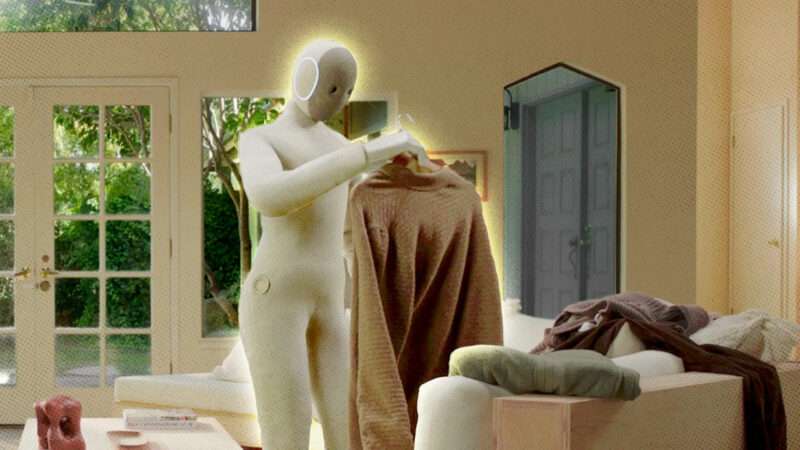
The newest home robots look less like a Roomba and more like C-3PO.
Last year, a demo of 1X Technologies' home robot, NEO, went viral. In a video produced by The Wall Street Journal, the mouthless bot attempted to load a dishwasher. NEO moved clumsily but completed the task—with the help of a human teleoperator. In July, 1X unveiled NEO's new dexterous, tendon-driven hands. According to 1X, the hands "remove the hardware ceiling on what humanoid robots can actually do" and "make data the only barrier to capabilities."
1X is one of several companies creating humanoid robots using physical AI—artificial intelligence that allows robots to operate autonomously in the real world. Companies such as Figure, Tesla, Agility, and Boston Dynamics are competing to produce and deploy bots that can perform human work. As in the broader AI race, China is a formidable player.
In a May post on X, OpenAI CEO Sam Altman mused that "in the long term, we imagine everyone having a personal robot doing anything they need." Humanoid robots have not yet achieved the autonomy and dexterity of the Ex Machina robowomen. Getting them to that level of proficiency will require humans to provide some help—and lots of data.
Just as large language models such as ChatGPT rely on text, robots need massive amounts of data to operate autonomously, as the Los Angeles Times pointed out last year. For some robotics companies, this means collecting a large number of videos—sometimes public, sometimes licensed—of people doing everyday tasks.
Data harvesting to train humanoid robots has become its own industry. The company Shift, for example, pays participants to record themselves doing chores or physical labor. The end goal of providing training data to robotics companies is to create a "world of abundance" in which there is no labor shortage, says Shift co-founder Anton Poletaev. In May, to entice people to provide training data from their apartments, the company offered New Yorkers free cleanings performed by employees wearing cameras strapped to their heads.
Shift's privacy policy prohibits contributors from recording videos of children, intimate situations, or passwords. Poletaev says Shift's algorithms anonymize personal information from session recordings, including faces and identifying materials.
Shift users elect to act as a set of eyes for robotics companies in exchange for cash. Buyers of humanoid robots must consider a different tradeoff.
In the 2025 demo of NEO, a human engineer teleoperated the bot the whole time. But 1X says the latest version of NEO, which is expected to ship to consumers by the end of 2026, will operate autonomously by default. If it encounters an unfamiliar task, owners can ask for an expert teleoperator to take over and remotely maneuver the bot.
"In 2026, if you buy this product, it is because you are OK with that social contract," 1X founder and CEO Bernt Børnich told Wall Street Journal technology journalist Joanna Stern last fall. "If we don't have your data, we can't make the product better."
The company says it has privacy safeguards in place to protect users. According to 1X, owners must schedule times for U.S.-based experts to operate NEO, and the circular lights on the sides of the robot's head will change color while the operator is active. 1X also says that owners have control over the operation session and that users can opt out of data sharing.
Such safeguards are critical for home robots, especially since consumers have raised privacy and security concerns about hack-prone robotic vacuums. In 2024, multiple owners of Chinese-made Ecovacs Deebot X2s reported that strangers had gained access to their vacuums. In one case, a man said a voice projecting from the bot shouted obscenities. The Australian Broadcasting Corporation was able to hack the vacuum as a demonstration, revealing security vulnerabilities. More recently, a hobbyist trying to control his own Chinese-made DJI Romo robovacuum accidentally gained control of 7,000 robovacuums, and he was able to see their live feeds and IP addresses.
Matthew Rueben, a professor of biomedical engineering at the University of Portland who specializes in robot-human interaction, says ongoing transparency is crucial to ensure privacy. A standard notice-and-consent framework in which consumers agree to terms and conditions once may not be enough to clearly communicate privacy risks, he argues.
Even if a user consents to having a robot in the home, researchers have noted, bystanders, including children, may not be aware that the robot is collecting data. To provide ongoing notice of their whereabouts, Rueben has suggested, robots could signal their movements and tracking like expressive video game characters. Picture a yellow arrow bobbing above an NPC's head or a foe's eyes lighting up red.
Although newer robots can appear quite human, Rueben says it is helpful to think of them like machines—not living beings—when weighing privacy risks. That way, consumers can consider the higher-level decisions behind the robot's design and the ways a company may use or process data from the robot. "I ask questions about what kind of sensors it has and what its software actually does," Rueben says, "and I try not to make any assumptions based on what a human could typically do."
The Jetsons world is not here quite yet. But soon, more and more humanoid robots may enter homes and unburden humans from chores. Consumers must decide how much information they are willing to offer their new helpers.
The post AI Companies Promise Humanoid Assistants. How Will the Robots Know What To Do? appeared first on Reason Magazine.





 Bengali (Bangladesh) ·
  English (United States) ·