
 2 hours ago
5
2 hours ago
5 
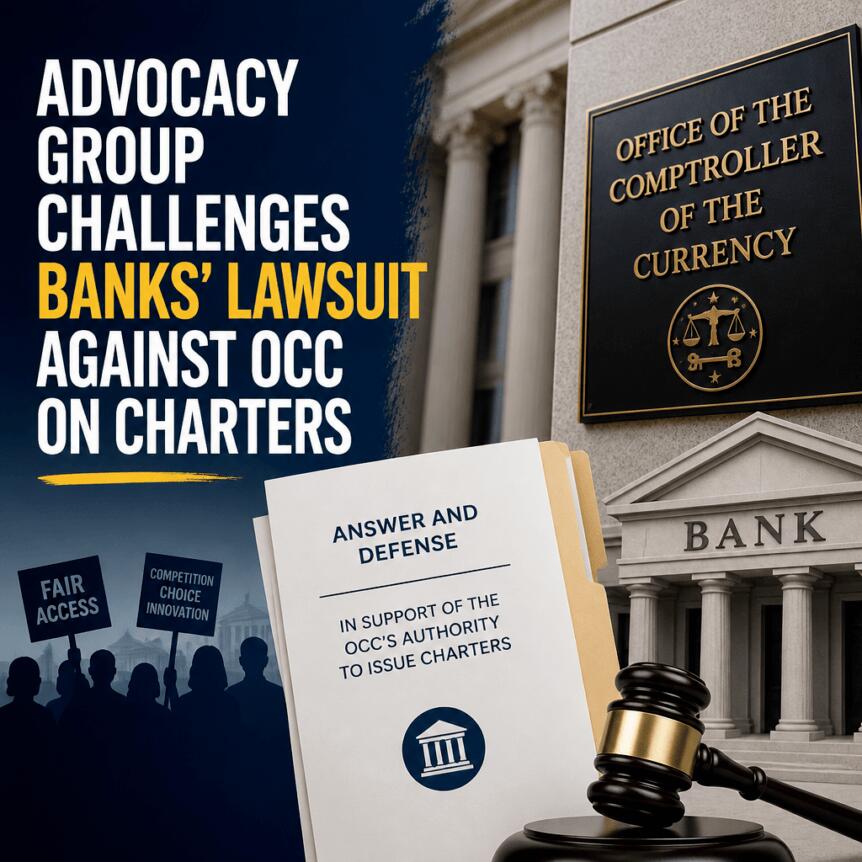
Crypto industry group the Crypto Council for Innovation (CCI) has thrown its support behind the Office of the Comptroller of the Currency’s (OCC) approval of national trust charters for multiple crypto-related firms—arguing that a lawsuit brought by the Independent Community Bankers of America (ICBA) is meant to slow innovation.
In comments made on Monday, CCI CEO Ji Hun Kim said the ICBA action is “a clear attempt to resist national trust charters, payments innovation, and competition in financial services.” The legal challenge, filed Friday in the U.S. District Court for the District of Columbia, alleges the OCC approved charters for entities—including crypto firms—without adequate safeguards and compliance requirements normally expected of banks.
Key takeaways
CCI argues the ICBA lawsuit is intended to curb OCC-backed national trust charters and related payments innovation. The ICBA lawsuit contends the OCC approved bank-style charters without sufficient safeguards and bank compliance standards. OCC approvals and conditional approvals cover several crypto firms, including Circle, Ripple, Fidelity Digital Assets, BitGo, and Paxos, as well as World Liberty Financial. Some lawmakers have criticized the approach as potentially allowing exchanges to access federal credibility without bank obligations.CCI frames the lawsuit as an anti-innovation move
CCI’s backing comes as the debate around the OCC’s charter approvals sharpens. Kim characterized the ICBA suit as an attempt to block national trust charters—mechanisms designed to let institutions operate under federal frameworks—while also limiting competitive pressure on traditional financial services.
The CCI’s position places it in the broader camp supporting the OCC’s push to expand which firms can pursue chartered roles in U.S. finance. A separate earlier report by Cointelegraph noted industry support for the OCC’s approvals and conditional approvals for crypto companies pursuing national trust charters.
That support has nevertheless faced political headwinds. Certain lawmakers have argued that some crypto companies may seek the credibility and regulatory access associated with banking-like charters while avoiding what they view as essential protections and obligations of insured depository institutions.
What the ICBA lawsuit alleges
ICBA filed its complaint on Friday, challenging the OCC’s charter decisions. According to the lawsuit coverage by Cointelegraph, the ICBA alleges that the OCC approved U.S. bank charters for entities, including crypto companies, without sufficient safeguards or compliance measures typically tied to bank oversight.
ICBA President and CEO Rebeca Romero Rainey said in a statement that Congress did not establish the national trust charter as a “side door” for crypto firms to obtain the perceived credibility of a federal bank charter while avoiding responsibilities such as the Community Reinvestment Act obligations, consolidated supervision, capital and liquidity standards, and FDIC insurance that apply to insured depository institutions.
For investors and market participants, the practical stakes are straightforward: charter structures can affect how firms manage risk, meet compliance requirements, and interact with the financial system. A successful legal challenge could slow or reshape the pathway for crypto firms seeking chartered status, while a defense could further entrench the OCC’s broader interpretive approach.
OCC approvals include major crypto names, including World Liberty Financial
The OCC’s most recent decisions, as detailed in earlier Cointelegraph coverage, have included approvals or conditional approvals involving a number of crypto-related companies. These include World Liberty Financial, Circle, Ripple, Fidelity Digital Assets, BitGo, and Paxos.
One of the approvals singled out by lawmakers is tied to World Liberty Financial. That decision came under the leadership of OCC head Jonathan Gould, a Trump pick who has served since July 2025, according to the reporting context summarized by Cointelegraph.
Cointelegraph also reported that World Liberty Financial has been the subject of probes over alleged ties to royal families in the United Arab Emirates. While those investigations do not directly determine whether the OCC’s charter approvals meet legal standards, they can shape political pressure around regulators and increase scrutiny of the chartering process.
Separately, the same broader policy debate also includes lawmakers’ concerns—raised in a Senate Banking Committee-related statement cited by Cointelegraph—that some crypto companies may be attempting to act like banks without accepting the full framework of safeguards and obligations.
The larger regulatory question: access to the banking system vs. bank obligations
At the center of the dispute is an asymmetry: crypto firms pursuing charters may be seeking federal authorization and the operational credibility that can come with it, while community bankers and some policymakers argue that the benefits should not be available without the same oversight and consumer-protection expectations imposed on insured depository institutions.
The CCI’s argument—that the ICBA lawsuit is an attempt to resist charter-driven competition—implies that existing legal pathways should allow qualified applicants to expand the reach of crypto services within the U.S. financial system. In contrast, the ICBA’s filing argues that the OCC’s approvals bypass elements of banking regulation that Congress intended to remain tied to insured bank status and related requirements.
For the industry, this matters because charter outcomes influence more than just corporate branding. Charter status can change relationships with banking partners, the structure of compliance programs, and how regulators evaluate capital, liquidity, and supervision. For traditional institutions, the lawsuit is also about maintaining parity: ensuring that competition happens under comparable regulatory expectations.
Next, market participants should watch how the court addresses the ICBA’s claims and whether the litigation affects ongoing charter approvals or conditions. Whatever the outcome, the case is likely to further clarify—through legal interpretation—the boundary between “bank-like” trust frameworks and the obligations that come with full insured depository oversight.
This article was originally published as Advocacy Group Challenges Banks’ Lawsuit Against OCC on Charters on Crypto Breaking News – your trusted source for crypto news, Bitcoin news, and blockchain updates.





 Bengali (Bangladesh) ·
  English (United States) ·