
 1 month ago
68
1 month ago
68 
Poet Nyla Matuk’s debut novel, Leila and Khaled, centers the reality of being Palestinians under Israeli occupation and in diaspora. It is a story of discovering love and beauty amidst dispossession, and how that can be an act of resistance. Leila is a Palestinian Canadian film scholar who visits Occupied Palestine as part of an academic delegation. Khaled is co-organizer and local guide for the group. There is an instant attraction between the two, despite Khaled being much younger. What follows is a slow burn affair, marked by furtive glances and stolen moments. For Leila, the desire to know Khaled is also a hunger for the ancestral land her father was in exile from since young adulthood, and whose stories he withheld. Through streets and restaurants where settlers roam at ease, along the highway with the segregation wall and military observation towers, and across invasive checkpoints, Leila and the others witness how Palestinians like Khaled inhabit, traverse, and exist in resistance in their Occupied land.
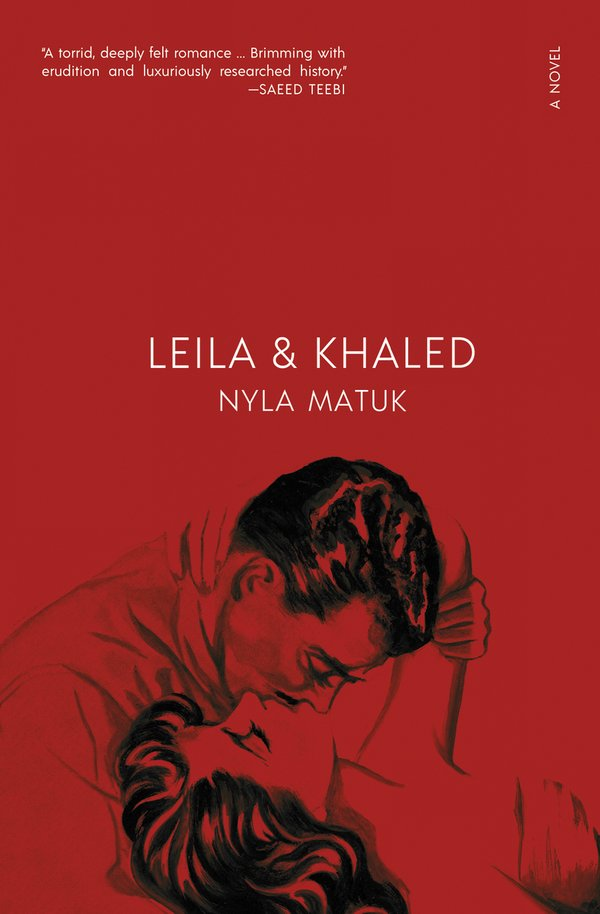
Amidst this, the 1948 Nakba and the ensuing denial and lack of accountability is ever present. In corresponding with Dov Weiss, an Israeli journalist and former paramilitary member who presents himself as peacemaker and a proponent of the two-state solution, Khaled peels back layers of hypocrisy and unacknowledged roles in the Nakba. The novel explicitly contends with the myth-making behind the Israeli military state.
In conversation, we spoke about belonging and cultural identity across generations, Palestinian perception in the West, writing a romance charged with grief and history, and more.
Bareerah Ghani: Belonging is a salient theme in the novel. One of Leila’s co-delegates reflects on how her Palestinian father considered himself a refugee but did not think his daughter truly “belonged to the people.” I’m curious about your thoughts on what it means to inherit culture, identity, and belonging across generations, especially when the land itself remains inaccessible to Palestinians.
Younger generations, whose parents are not from Western countries but who grew up here, are starting to identify more with their parental roots.
Nyla Matuk: We are all curious about our roots, and maybe in the Palestinian case, those who do not live on the land are particularly interested in cultivating a sense of belonging. In the West, where most diaspora Palestinians have an awareness of settler-colonialism because something similar happened to Indigenous nations in so-called Canada and the United States, this curiosity and sense of exile may be more pronounced.
Although I was born in Canada and learned English and French, the histories of the English and French are not my history. If anything, the English and French settler-colonial presence works against my need for belonging: These histories are uncanny for someone whose family on both sides lived through violent colonial transformations in India and Palestine.
I grew up in the early 70s in Ottawa. The Canadian multiculturalism policy was in place there, so my parents put me in French school, though neither one of them spoke French. We spoke English at home because it was my parents’ shared language. My father was Palestinian. My mother was born outside Delhi, India, and her family had lived in the north of India for several generations. She carried a sense of rootedness to Hindustani customs. But the idea then was to come to the new country and blend in. They made fewer efforts to stay connected to their homelands than many immigrants do today, I think.
I think younger generations, whose parents are not from Western countries but who grew up here, are starting to identify more with their parental roots as opposed to wholeheartedly embracing Western culture and its nationalist myths, which have worn thin. These younger people are politically engaged, for example, with Palestine. They have become aware that Western domination continues with relentless violence, including historical revisionism in the form of national patriotism, propaganda, and image-building. None of this is newly discovered or unique to the Palestinian case, however.
BG: Why do you think younger generations are, as you say, more politically aware of Palestine and also more inclined to embrace their parental roots versus assimilate into Western cultures where they were physically rooted?
NM: It feels to me as if Western society has not provided them with a scaffolding of meaningful or even real historic connection. I mean, it’s capitalism, celebrity worship, corrupt governments; it’s governments with evil foreign policies. They live under genocidal, racist governments––the US, Canada, the UK, Germany, etc. And in a way, it’s colonialism come home to roost in the sense that there isn’t a melting pot. People are not blending in and forgetting their roots. And identity politics, which became a certain kind of political valence, especially in the 80s and 90s, has limited application when we think now on the reckoning that has come, what has been brought to bear, for example, in Canada with acknowledging the genocide of the Indigenous peoples here on Turtle Island. When that starts to get filtered out into the education system, people start to say: Well, wait a minute, why are there so many people around the world that are being displaced just as they have displaced the Indigenous peoples here? In my generation, our textbooks taught us about the fur trade and how everyone got along, trading away. They never mentioned anything about the residential school system. There was not a trace of any of that in the history books I read growing up in French Canadian Catholic schools.
BG: There’s a moment in your novel when Leila says, “We want liberation in the diaspora, too.” Can you talk a little bit about that? And what it has been like to embrace Palestinian identity in the West previously and right now with the growing support for Palestinian liberation.
NM: Ironically, if you think about being a person of Palestinian descent who doesn’t live on the land, it does come down to individual identity. My own mother told me: “Don’t tell anyone you’re Palestinian.” It was regarded, to put it mildly, as an identity that raises eyebrows. In any given room, circumstance, or place that you might walk into, you didn’t talk about it. Divulging this information, I’ve come across crazy scenarios. One person turned out to be former IDF. I was having some luggage repaired, and he was miming killing people and telling me, “Well, there are some Palestinians that are good, and some that are bad.” And then he asked me my surname. I said, “That’s none of your business.” He asked me that because they keep lists of Palestinian surnames.
Palestinians are surveilled in the diaspora––not as much, obviously, as they are surveilled in their own homeland, but there’s a whole surveillance mechanism that shadows them. It’s an identity that’s been suppressed. As a national liberation movement, it’s been suppressed. It’s been labelled terrorism. That sort of propaganda has not only made Palestinians into the number one terrorists as a trope but has served the idea of state violence and state power as being unreproachable in all cases.
My own mother told me: ‘Don’t tell anyone you’re Palestinian.’
BG: I’m so sorry you had that interaction, and I’m sure many others like it. And that you were told to conceal your identity. No one should have to live like that. Do you think, given the widespread exposure to the current genocide through social media, there is change on the horizon, with respect to how Palestinians are perceived in the West?
NM: I think that most people who are not overt Zionists understand things they didn’t understand before, because they either didn’t look for the information, were not curious, or were worried about being censored or in some way reprimanded. Just yesterday, at the Canadian Museum for Human Rights, an exhibit opened for the first time in the museum’s history about the 1948 Nakba. It’s momentous. But in a national newspaper two days before, and even a few months prior, you had these evidence-free op-eds from Zionists––including one on the board of the museum, who melodramatically resigned over the fact that this exhibit couldn’t be stopped. You have this denial of 1948. What 1948 does, and this is why I discuss it in my novel, is undermine the entire raison d’être of the ethno-state by explaining that it was made only possible through forced displacement that created an artificial demographic change. Why are there refugees in Gaza? Why have so many hundreds of thousands of Palestinians for generation after generation lived in internal refugee camps, or in refugee camps in Lebanon, Jordan, Syria? It’s because they were forcibly driven off their land and not allowed to return, and those who did try to return were massacred. I think more and more people are going to learn this history now.
BG: I am curious how Leila and Khaled came to you, and how their story became a romance tinged with grief, not just by their surroundings, but by the histories that they bring together.
NM: In some ways, the character of Khaled is an allegory of Palestine itself––he’s narrating the history, and that’s for Indigenous peoples everywhere. It’s very important to tell those stories.
I was inspired by Hiroshima Mon Amour, a film by Alain Resnais with a screenplay by Marguerite Duras. It’s set in 1959, several years after the bombing of Hiroshima and Nagasaki. A woman comes from France, meets a Japanese man, and they have this affair while she is visiting. She’s an actress making a film about peace, and it becomes a sort of story within a story. She tells the Japanese man about a German man whom she fell in love with during the war, and who was shot dead. She’s living with this tremendous catastrophe and grief, and this grief is brought to bear in the context of being in Hiroshima. In the very beginning of the film and she says, “I saw everything in Hiroshima,” and he keeps saying, “No, you saw nothing.” The two of them are in this weird, trance-like interaction with each other. They struck me as two people living with mass trauma. I wanted to model both of the people in my novel after that, because, really, the novel is about the Nakba.
I also wanted to have a diaspora Palestinian and a [local] Palestinian on the land. I wanted to bring them together as an idea of national liberation, because it’s liberating for the diaspora Palestinian to understand what happened. All of that is so internal and has been kept shut by the propaganda machine that is the Zionist project. I wanted that opened up and told to a person who may have lived there, may have been born there if circumstances were different and 1948 hadn’t occurred.
BG: I wondered about how you were thinking through Leila’s encounter with Palestine versus Khaled’s experience of living under occupation. There’s a part where Khaled says to Leila, “Palestinians from outside sometimes overthink things.” Could you talk a little bit about that, because for me, that’s where the tension was between moral responsibility and diasporic guilt.
Art coming out of material conditions is important as an assertion of unique social identity—it belongs to the land. Not any land in the region, that land.
NM: That’s an interesting way of putting it. Leila doesn’t have that much guilt. She didn’t leave. Maybe her father had guilt. I think what Khaled is referring to in that moment is the fact that living in the West, you don’t fully understand the material consequences of dispossession.
I remember one time—it’s so interesting that this is coming into my mind now—years ago, I had a conversation about Palestine with a prominent Canadian writer, novelist, and poet, whom I respected, and thought was great. He said to me: “I’m very much on the side of Palestinians, but why does Hamas have to attack?” It was such a naive question, and I realized that people have a bizarre idea about what it means to be occupied and put into a prison. Like, of course you’re going to revolt. You’ve had everything stolen from you, you may be an orphan, your family may have been murdered, your history denied, and on and on.
I think even Palestinians outside can overthink because they can be full of Western ideas that are Zionist by default––like, what about a two-state solution? Khaled was referring to a certain naiveté and brainwashing that takes over when you don’t live there.
BG: Another moment that I find striking is when Khaled challenges the notion that Palestinians are so stoic, have so much صمود, sumud. I’m curious about this framing of resilience. What role does it play in how Palestinians are perceived and when does that expectation of resilience become a burden rather than a recognition of their humanity?
NM: If you think about living in Gaza, growing up in Gaza, there is a stoicism because otherwise how could you get through the day? How about living in the so-called West Bank (yes, that is a colonial term too) where pogroms take place in the hills, where you need a permit to get to Quds and will likely never get one, and your family’s village is buried under a Zionist “national park”? It’s that stoicism they’re referring to with sumud. But then there’s a pushback, saying, yeah, we’re not okay because we’re highly traumatized by this. We’re extremely alarmed, as everyone should be, that these Western governments are just allowing this, not using the law to stop it, continuing to sell arms, providing other support for genocide.
BG: There’s a moment where Leila is at The Walled Off Hotel, and argues about how it should be boycotted, how it appears less an act of resistance and more tourist kitsch. Khaled thinks it does help the cause of liberation because it calls attention to what could be there instead. How do you view this particular Banksy installation, and more broadly, the role of art in the Palestinian struggle for liberation?
NM: At first, I was suspicious of The Walled Off Hotel as an idea. I was like, why are you aestheticizing military occupation and apartheid? And making light of it? But then I ended up changing my mind because it does make people think. Material conditions, social conditions, depicted in art and/or design, as in the case of The Walled Off Hotel, have a role in struggle because they force viewers into a pragmatic understanding of day-to-day struggle, material loss, imprisonment. Think of the many depictions over the decades of the twisted electric wires on top of the apartheid walls that imprison Palestinians and enforce their separation from Jews. The material conditions are depicted as much in this repetitive motif as the tanks on Afghan war rugs.
Years ago, my master’s thesis was about the moral sources of Western art. I critiqued the Hegelian notion of Romantic art, which is a cornerstone of Western ideas about aesthetic autonomy. I argued that art is a product of the social conditions in which it was created, not just the sort of brainchild of artist geniuses. I mean, every village has its own tatreez, its own blend of herbs for za’atar. Palestinian Arabs are a culturally distinct group. And art coming out of those material conditions is important as an assertion of unique social identity—it belongs to the land. Not any land in the region, that land, where those peasant farmers were first starting to meet European Jewish settlers, even embracing them at first and teaching them how to grow olives, lemons, pomegranates, and other local farming [techniques].
Historic materialism is really where I’m at. The story of two people who fall in love, despite their fated social condition—of being diasporic and on the land. This is a material reality of being Palestinian.
So many works of Palestinian literature are about that. Even the beautifully rendered and painted resistance posters telling the story of resistance, of Land Day 1976; telling the story of working the land itself, the olive trees, and all of the other flora and fauna. They’re about the armed resistance, but also about existence as resistance.
In Palestine, Searching for the Remains of My Grandmother’s Village
An excerpt from “The Hollow Half” by Sarah Aziza

BG: After readers finish the book, what do you hope stays with them?
NM: That Palestinians exist outside of this particular military occupation. They have a history before Zionist occupation, before 19th century colonial dreams. And that they will have a future, because the last part of the novel talks about return. Leila can’t stay, but the narrative is a return. Because there’s hundreds of thousands of Palestinians in camps, internally or externally, that must return. The return is practically feasible. Leila’s return stands for the fact that the right of return cannot be derogated.
The post A Story of Love and Resistance Amidst Dispossession appeared first on Electric Literature.




 Bengali (Bangladesh) ·
  English (United States) ·