


Healthcare organizations run on connected systems that support clinical care, operations, and the patient experience. When people search for types of software used in healthcare industry, they usually mean the core platforms that keep clinics and hospitals moving without delays, errors, or data gaps. Competitor guides tend to cluster around EHR/EMR, practice management, telehealth, imaging, and decision support.
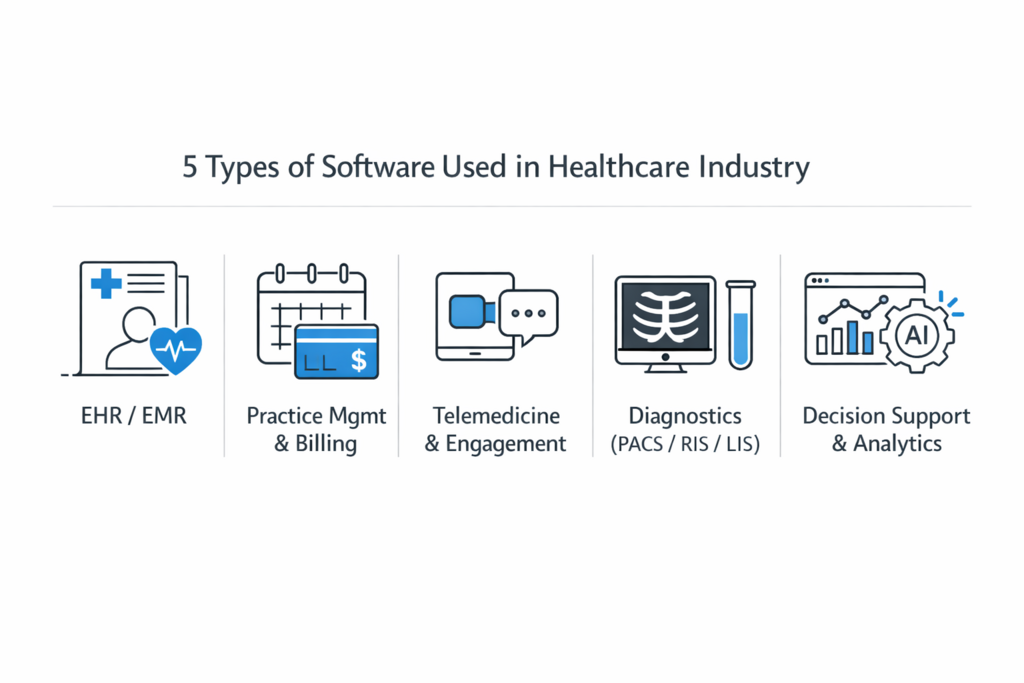
Below are 5 different types of software used in the healthcare industry, explained in practical terms, with clear examples and what to watch for when you build or integrate them.
A quick way to map types of healthcare software
Most types of healthcare software fall into three buckets:
Clinical systems: support diagnosis, treatment, and documentationOperational systems: run scheduling, billing, claims, internal workflows
Patient-facing systems: portals, messaging, remote care, self-service
This framing makes it easier to compare different types of software used in healthcare without mixing tools that solve very different problems.
5 Types of Software Used in the Healthcare Industry
Type 1. EHR and EMR systems (clinical documentation and care coordination)
If you ask most healthcare leaders about the most critical types of software used in healthcare, they will point to EHR or EMR platforms. They store patient histories, medications, allergies, clinical notes, and orders. In modern settings, EHR functionality is also tied to e-prescribing, lab results, imaging access, and clinical workflows across departments.
Where EHR and EMR systems deliver value
Faster access to a complete patient record at the point of careConsistent documentation across teams and locations
Fewer manual handoffs between departments when integrations work well
Example in real life
A multi-site clinic can reduce repeat intake forms and duplicate lab orders when the EHR is integrated with scheduling, eligibility checks, and a patient portal.
What to watch for
Data quality and duplicates when multiple sources feed the recordRole-based access control, audit logs, and permission design
Migration risk if you are moving from legacy systems to a new platform
This category is the foundation for many different types of software in healthcare, because nearly every system wants to read from, write to, or synchronize with the patient record.
Type 2. Practice management and medical billing software (operations and revenue cycle)
The next category of types of software used in the healthcare industry is the operational layer: practice management systems, billing tools, and revenue cycle workflows. This is the software that schedules appointments, checks eligibility, manages claims, tracks denials, and keeps the financial side of care stable.
Common capabilities
Scheduling with provider calendars, room availability, and visit typesInsurance verification and claim submission
Patient invoicing, payment plans, and collections workflows
Example in real life
A practice management platform can automatically flag high no-show risk slots, send reminders, and reduce missed visits. Billing software can standardize claim rules and reduce denial rates by catching missing data early.
What to watch for
Integration quality between scheduling, EHR, and billingReporting accuracy for payer performance and denial reasons
Workflow fit: front desk teams and billing teams work differently
In many organizations, this is the most visible part of different types of software used in healthcare because it affects cash flow weekly, not just clinical outcomes.
Type 3. Telemedicine, remote care, and patient engagement platforms
Telehealth tools surged from “nice to have” to core infrastructure, so most competitor lists include them among the top types of healthcare software.
This category includes telemedicine visits, secure messaging, reminders, patient portals, and remote patient monitoring.
Common capabilities
Video visits and secure chat with identity checksAppointment reminders, follow-ups, and patient education
Portals for test results, care plans, and document signing
Example in real life
A specialty clinic can shorten time to treatment by letting patients upload photos and complete pre-visit questionnaires in the portal, then routing cases to the right clinician before the appointment.
What to watch for
Patient experience: accessibility, device support, and simple onboardingData flow: Does the visit summary land in the EHR or stay siloed
Security and compliance requirements for messaging and storage
Patient engagement tools are a key part of different types of software in healthcare because they reduce admin load and improve continuity, especially for chronic care.
Type 4. Diagnostics and lab software (PACS, RIS, LIS)
Diagnostics often gets under-explained in high-level articles, yet imaging and labs are mission-critical for hospitals and many specialty clinics. This category typically includes:
PACS for storing and accessing medical imagesRIS for radiology workflow, scheduling, and reporting
LIS for laboratory workflows, samples, and results
Competitor resources regularly group PACS and RIS, with LIS nearby, because they form a workflow chain from order to result.
Example in real life
Radiology departments rely on RIS for tracking exams and generating reports, while PACS stores and serves images like MRI, CT, and X-ray for clinicians across the organization.
What to watch for
Workflow latency: how fast results appear for cliniciansStorage strategy: long-term archiving, retrieval speed, and access controls
Integration standards and interoperability between diagnostic tools and EHRs
These systems are often the hidden backbone of types of software used in healthcare, because clinicians feel the impact immediately when results are delayed.
Type 5. Clinical decision support and analytics (CDSS, BI, AI-powered insights)
The fifth category in our 5 different types of software used in the healthcare industry is decision support and analytics. This includes clinical decision support systems (CDSS), quality dashboards, operational BI, and risk prediction.
In plain terms, CDSS tools provide alerts, reminders, guidelines, order sets, and patient-specific recommendations within clinical workflows.
Where decision support helps
Medication safety and interaction alertsGuideline-based order sets that reduce variation
Risk flags for readmission or deterioration when data is available
Example in real life
A hospital can reduce missed steps in sepsis protocols by using decision support prompts linked to vitals, labs, and clinical rules, shown at the point of care.
What to watch for
Alert fatigue: too many prompts can reduce trustTransparency: Clinicians should understand why a recommendation appears
Data governance and audit trails for regulated environments
This category is often described as the “multiplier” across different types of software used in healthcare, because it improves outcomes only when the underlying data flows are reliable.
How these systems should work together (integration checklist)
Listing types of software used in the healthcare industry is easy. Making them work together is where most projects succeed or fail.
A practical integration checklist:
Define one “source of truth” for patient demographics and identifiersMake sure orders and results flow end-to-end, not just partial exports
Align security models and permissions across systems
Plan for reporting from day one, including data definitions and ownership
Test workflows, not just APIs, because healthcare breaks in edge cases
When organizations treat integrations as a product, not a one-time task, the types of software used in healthcare become an ecosystem instead of a collection of disconnected tools.
Build vs buy: when custom software becomes the safer option
Off-the-shelf platforms can be a great start, but many teams hit the same wall: workflows do not match reality, integrations are fragile, and reporting becomes a patchwork. Common reasons companies choose custom solutions:
You have multi-site workflows that vendors cannot model cleanlyYou need deep integration between EHR, billing, and patient engagement
Compliance, audit, and security requirements are stricter than the default tooling
You want automation that reflects how teams actually work, not generic templates
If you are evaluating custom options, Langate’s healthcare page is a good starting point: healthcare custom software development.
This is also where terminology matters. Buyers often search for types of healthcare software, but what they actually need is a cohesive solution that connects different types of software in healthcare into one stable workflow.
Final thoughts
To recap, these 5 different types of software used in the healthcare industry cover the clinical core (EHR/EMR), operational engine (practice management and billing), patient experience (telemedicine and engagement), diagnostics (PACS/RIS/LIS), and intelligence (CDSS and analytics). If you are mapping different types of software used in healthcare, focus on how data moves between them and how teams use them daily. That is what turns software into measurable outcomes, not just another system on the list.









 Bengali (Bangladesh) ·
  English (United States) ·