
 1 month ago
32
1 month ago
32 
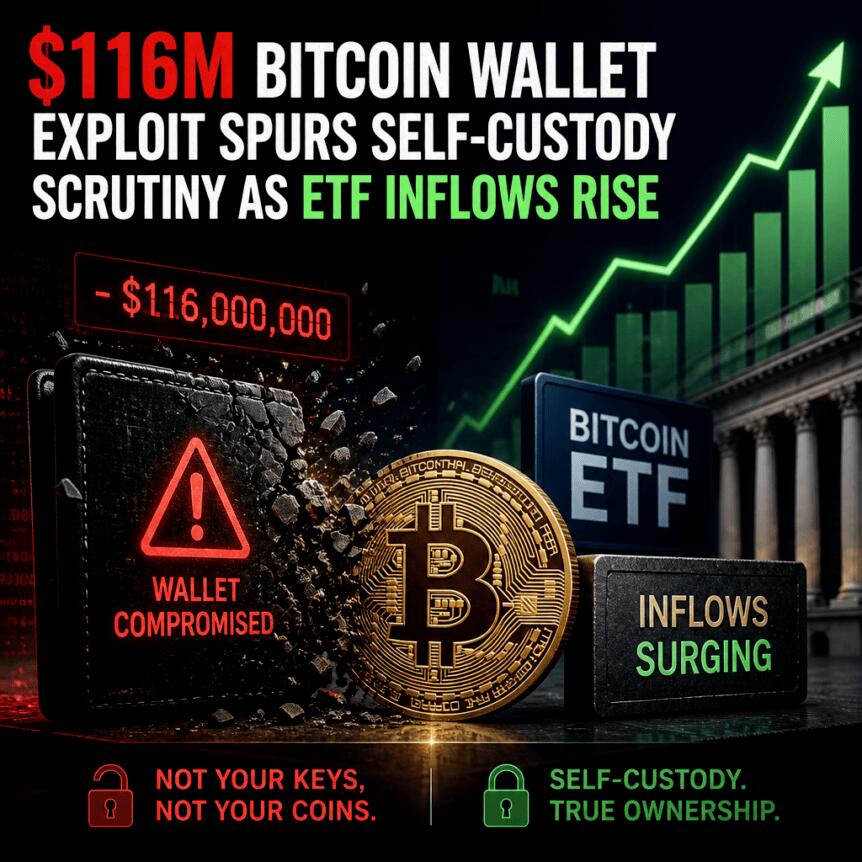
A $116 million hardware wallet exploit has reignited an old Bitcoin question: what is the real risk trade-off between self-custody and using regulated products? The debate is heating up as US spot Bitcoin ETFs post strong inflows, suggesting institutional capital may be finding ways to participate in Bitcoin without directly taking on custody and operational risk.
Meanwhile, major companies across the sector are making moves that underline how intertwined Bitcoin, corporate balance sheets, and emerging AI compute demand are becoming. Strategy is preparing to resume Bitcoin purchases after a rare period of selling, Riot Platforms is reportedly pursuing a large AI-focused compute arrangement tied to its mining footprint, and Trump Media says it will rethink its crypto treasury approach after a sizable quarterly loss.
Key takeaways
A Coldcard-linked hardware wallet exploit drained about $116 million in Bitcoin, adding fresh fuel to the self-custody versus custody-by-others debate. US spot Bitcoin ETFs reportedly saw roughly $1 billion in net inflows for the week, with Bloomberg analyst Eric Balchunas calling it one of the strongest periods since October. Strategy CEO Phong Le said the firm plans to resume Bitcoin accumulation later this year after selling in multiple quarters to support shareholder-related obligations. Riot Platforms is reportedly arranging 191 megawatts of compute capacity for a “leading frontier AI” project at its Texas campus, highlighting the economic pull of power availability. Trump Media is revising its digital asset treasury strategy after recording large unrealized losses and reshaping how it funds and manages its Bitcoin exposure.Strategy signals a return to net buying
Strategy CEO Phong Le said the company plans to resume Bitcoin accumulation later this year, aiming to reinforce its long-term position after a stretch of smaller sales drew criticism against its earlier messaging. The firm has been publicly associated with a “never sell” posture, and the shift in behavior has become a key talking point for investors tracking whether the company remains purely acquisition-led.
According to Le, Strategy bought roughly 175,000 BTC and sold about 7,000 BTC this year, a ratio that indicates it remains net-buying in magnitude even if it has been selling at notable times. Strategy currently holds more than 840,000 BTC, making it the largest institutional Bitcoin holder.
Le also pointed to a pattern of discrete sell events. The company has reportedly sold Bitcoin on four occasions since May, most recently unloading 1,690 BTC to fund preferred dividends, buybacks, and a dollar reserve. That detail matters because it shows the tension between corporate treasury behavior and a strict “hold only” narrative: shareholders still require liquidity, while Bitcoin’s role in the treasury can put firms in a position where capital needs must be balanced against accumulation targets.
Third-party analysis referenced in the report suggests this model becomes harder when companies trade below their Bitcoin net asset value, because capital raises can be more dilutive and ongoing financing may be more difficult to sustain. For Strategy, that context helps explain why investors are watching not only the size of purchases, but the timing and stated intent around future net buying.
ETF inflows rise as self-custody concerns resurface
US spot Bitcoin ETFs are reportedly seeing renewed demand even while Bitcoin’s price action remains subdued. For the week, the ETFs attracted about $1 billion in net inflows, according to the report cited, marking the third-best week since October—an interval Bloomberg analyst Eric Balchunas described as Bitcoin’s “silent IPO.”
The “silent IPO” framing refers to the idea that early holders or initial investors may sell into a rising stream of institutional buying via ETFs, helping explain why new capital can flow in without immediately lifting prices. In that sense, the ETF rebound becomes more than a headline number: it’s a reminder that ETF demand can coexist with supply dynamics that keep the market from moving as fast as some observers expect.
The timing of this demand rebound is also notable given the hardware wallet incident. Earlier coverage highlighted a Coldcard exploit tied to faulty key generation that reportedly drained around $116 million worth of Bitcoin. Balchunas said the episode could ultimately improve ETFs’ attractiveness for investors who worry about self-custody risks—though he emphasized that the relationship may be correlative rather than causal.
He cautioned against assuming causation from any single data point, but suggested that “long-term” some investors may migrate toward ETF structures if self-custody concerns persist. For market participants, the practical takeaway is that custody risk is now part of the investor conversation—not just a technical footnote. If institutional investors continue to treat ETFs as the most operationally straightforward exposure route, demand could remain resilient even when broader confidence fluctuates due to security headlines.
Riot taps power for AI compute partnerships
Riot Platforms is reportedly working on a large compute arrangement tied to Bitcoin mining infrastructure. According to the report, Anthropic struck a $9 billion deal with Riot for 191 megawatts of capacity from Riot’s Texas campus, underscoring how access to reliable power is increasingly valuable as AI data center buildouts hit constraints.
Riot said it secured a 20-year agreement to supply 191 megawatts from its Rockdale campus to a “leading frontier AI” company, with Bloomberg identifying the counterparty as Anthropic. The announcement follows Anthropic’s reported $19 billion data center lease with TeraWulf, reinforcing the broader trend of AI firms seeking additional compute capacity and predictable energy sourcing.
The report places Riot among a growing set of miners expanding toward AI-adjacent strategies, naming Bitdeer, CleanSpark, MARA Holdings, Core Scientific, Hut 8, and IREN as other examples. While Bitcoin mining remains the original mission for these companies, the convergence with AI is shifting how investors think about their long-term asset value: power availability and grid agreements can become a “platform” for multiple high-demand workloads.
The cited discussion also notes that research from Bernstein has suggested partnerships between AI companies and miners could help alleviate power bottlenecks that restrict data center expansion. Even if the details of each company’s arrangement differ, the key point for crypto investors is that miners’ balance sheets and future cash flows may increasingly depend on energy leverage rather than solely on Bitcoin’s mining economics.
Trump Media revises its crypto treasury after large losses
Trump Media says it will revamp its digital asset treasury strategy after a $238 million second-quarter net loss, pointing to balance-sheet risks created by corporate holdings of crypto and crypto-adjacent securities. The company attributes part of the loss to unrealized mark-to-market swings across its digital assets and securities.
In its quarterly reporting, Trump Media reported $190.4 million in unrealized losses across its digital assets. The company also pledged digital assets and equity securities during the second quarter, reflecting how its treasury exposure is constrained by collateral requirements and counterparty structures.
Bitcoin holdings also changed over the quarter. Trump Media reported holding 9,477.16 BTC as of June 30, down from 9,542.16 BTC in the previous quarter. In July, it sold $159.6 million in Bitcoin-related securities and used the proceeds to buy more Bitcoin, increasing holdings to about 14,139 BTC worth $890.5 million by July 31.
Management warned that generating additional income from its Bitcoin holdings could expose the company to counterparty risk—particularly if a partner were to default or become insolvent. It also noted the possibility that, in some cases, it could be unable to recover Bitcoin committed under unsecured arrangements.
The company said it plans to direct more resources toward Truth Social, Truth+ and other media operations as part of a broader shift in capital allocation. For readers, this is a reminder that corporate crypto strategies are not purely about directional exposure; they also involve liquidity management, collateral frameworks, and the operational risks of funding structures that can carry different outcomes than spot holding alone.
Going forward, the market will likely watch whether ETF inflow strength persists as more security-related events test investor comfort with self-custody. At the same time, corporate decisions—whether Strategy’s stated intent translates into consistent net buying, and how companies like Riot and Trump Media manage compute demand or custody-related risk—will continue to shape how Bitcoin is absorbed beyond crypto-native participants.
This article was originally published as $116M Bitcoin Wallet Exploit Spurs Self-Custody Scrutiny as ETF Inflows Rise on Crypto Breaking News – your trusted source for crypto news, Bitcoin news, and blockchain updates.





 Bengali (Bangladesh) ·
  English (United States) ·