

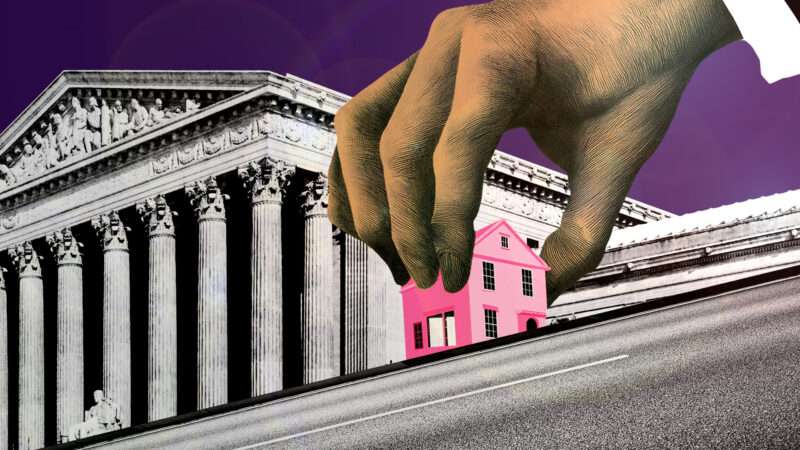
Greetings and welcome to the latest edition of the Injustice System newsletter. The month of June is rapidly coming to a close, and the U.S. Supreme Court has officially begun its mad dash to the finish line, aiming to release all opinions in argued cases by either the end of the month or—judicial vacation plans permitting—by sometime in early July.
How are the justices doing in terms of the workload? Well, a little over a month ago, I wrote about the "11 big cases that I'll be watching out for in the weeks ahead." As of this writing, a whopping one of those 11 has been decided. I was a history major back in college, so I'll let you do the math.
We're expecting more opinions today. Which means that by the time you're reading this newsletter, we may already be dealing with momentous rulings on issues ranging from state bans on transgender student athletes to the reach of the Second Amendment's right to keep and bear arms to the constitutionality of mail-in ballots that were sent by election day but not received until after election day.
And then there is the none-too-small matter of executive power. If any single issue is going to define this rambunctious 2025–26 SCOTUS term, then the debate over the proper scope of presidential power is probably it. The showdown over birthright citizenship, for instance, all started with an executive order from President Donald Trump that purported to do what the text and history of the Birthright Citizenship Clause do not permit the president to do. So in addition to being a case about the original meaning of the 14th Amendment, Trump v. Barbara is also a case about executive authority.
Meanwhile, executive power is truly front and center in Trump v. Slaughter and Trump v. Cook, each of which deals with the scope of presidential control over the leadership of "independent" federal agencies. Trump seems likely to win at least one of these cases, with a majority of the Court seeming likely to allow him to fire a commissioner of the Federal Trade Commission for purely political reasons, rather than "for cause," as the law, and perhaps soon-to-be-overruled Supreme Court precedent, currently require. That's Trump v. Slaughter.
Trump v. Cook is a horse of different color. In this case, Trump seeks to fire a member of the Federal Reserve's Board of Governors "for cause," yet whether or not his purported cause for firing her actually satisfies the "for cause" requirement in federal law is far from settled. I can imagine Trump losing this one. But you never know.
In Other Legal News
This week marks an unhappy anniversary in American legal history. On June 23, the case of Kelo v. City of New London (2005) turned 21 years old. That's the case in which a 5–4 Supreme Court let a local government bulldoze a thriving neighborhood so that private developers would have a blank slate on which to build, all in the hopes of increasing the local tax base.
The constitutional question at the heart of Kelo was whether this use of eminent domain was lawful under the Fifth Amendment, which says that private property may only be taken by the government for a "public use," a term that has traditionally been understood to cover things such as roads, bridges, tunnels, and parks.
Writing for the majority, Justice John Paul Stevens embraced a far more elastic concept that appears nowhere in the text of the Constitution. "The disposition of this case," Stevens asserted, "turns on the question whether the City's development plan serves a 'public purpose.' Without exception," he declared, "our cases have defined that concept broadly, reflecting our longstanding policy of deference to legislative judgments in this field."
How did that misguided judicial deference work out in the end? The homeowners got the boot, the neighborhood was razed, and then the entire redevelopment scheme fell apart. Nothing was ever built. In 2011, local officials urged residents to use the location as a dumpsite for storm debris from Hurricane Irene. And last I checked, the once-attractive neighborhood was still a barren lot.
Sometimes the Supreme Court gets it right. The Kelo debacle is a reminder that sometimes the Court gets it disastrously wrong.
The post 10 Big Supreme Court Cases To Go appeared first on Reason.com.




 Bengali (Bangladesh) ·
  English (United States) ·